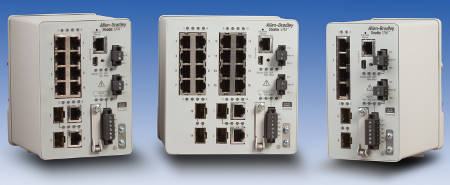
 This presents a challenge for both the machine manufacturer and the end user, as IP addresses are generally unknown until the machine is installed. This can add cost and time to equipment commissioning and delay its deployment in production. Rockwell Automation has addressed this challenge with the Allen-Bradley Stratix 5700 Industrial Ethernet switch, which now includes optional Network Address Translation (NAT) capability.
Hardware-based NAT functionality enables high performance and simplified integration of IP address allocation from a pool of local IP addresses, at the machine IP address level, to the end user's plant network. This can greatly benefit manufacturers integrating identical machines into a production line, especially when multiple equipment manufacturers are integrated into a common production line. The Stratix 5700 switch with NAT capability allows machine manufacturers to offer their standard machines to customers without having to program unique IP addresses. The end user can then more easily utilize the NAT capability to integrate the machines into the larger network. Because the machines have identical standards, they are easier to maintain.
The Stratix 5700 switch with NAT technology also gives users the flexibility to segment or isolate network traffic by determining which devices are exposed to the larger network. By limiting access to specific devices, they can be isolated from the wider network traffic, helping to optimize local network performance.
The Stratix 5700 series of switches is available in 6, 10, and 20-port configurations. Features include IEEE-1588 support, QoS (prioritization), and Resilient Ethernet Protocol (REP). These additional features also enable greater network availability and help improve network performance and troubleshooting for enhanced security. Each Stratix 5700 switch includes dual power inputs, input/output alarms, a console port, SFP slots for fiber, DIN rail mounting, and an operating temperature range of -40°C to 60°C. Model options include NAT, two Gigabit ports, an SD flash card slot, a tropicalized casing, and two different software configurations, resulting in a total of 20 distinct models to better suit machine and end-user applications.