
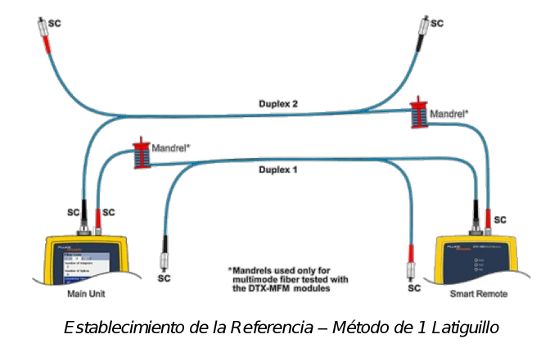
 The components and ultimately the fiber optic links used in the installations for LAN/CAMPUS environments are based on the specifications of the ISO/IEC 11801, EN 50173-1 and ANSI/EIA/TIA 568-C standards.
 As can be seen, the regulations establish a maximum attenuation for fiber optic cable, which, depending on the fiber type and the operating window, will be 1dB, 1.5dB, or 3.5dB/km. They also establish a maximum attenuation for each connection, defining a connection as the joint between two connectors and a coupler or adapter that aligns them. Regardless of the connector type and whether it is multimode or single-mode, the maximum permissible attenuation is 0.75dB. Finally, the maximum attenuation for splices, regardless of whether they are mechanical or fusion splices, multimode or single-mode, is 0.3dB.
It's worth mentioning that the attenuation values established by current standards are excessively high and permissive, both considering the possibility of achieving much better values with existing components and the maximum attenuation allowed by the most demanding applications, such as 1000BASE-SX (3.56dB), 10GBASE-SR (2.6dB), 40GBASE-SR4, or 100GBASE-SR10 (1.5dB). Therefore, it's advisable to use the recommendations of the fiber optic cabling manufacturers to determine the maximum permissible attenuation for the links.
Knowing these values, you can perform an exercise to determine the maximum attenuation of a link.

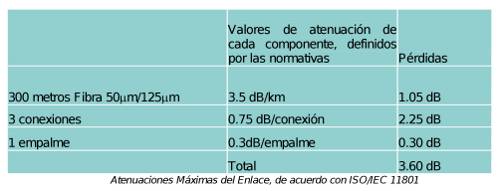 The maximum attenuation of this link must be 3.60dB, therefore, compliance with the regulations will imply an attenuation value of said link lower than this value.
In late 2006, ISO/IEC TR 14763-3 and ANSI/TIA/EIA TSB140 were approved, defining new technical specifications for the measurement components used in the testing or certification of fiber optic links. These new values are 0.1 dB between multimode reference connectors and 0.2 dB between single-mode reference connectors. When a reference connector is compared to any other type of connector, whether standard or non-standard, this maximum attenuation will be 0.3 dB for multimode and 0.5 dB for single-mode. Reference
connectors are those used to perform the measurements; that is, the connectors on the patch cords that will be used, along with the measurement equipment, to carry out the necessary certifications.
Similarly, these technical bulletins or Technical Reports (TRs) define two levels of measurement:
- Level 1: OLTS (Optical Loss Test Set)
- Level 2: OTDR (Optical Time Domain Reflectometer)
Therefore, if either of these two standards is used to certify optical fiber, the maximum permissible values for the link will vary from the values expressed in the table above, in accordance with ISO/IEC 11801, and will become the following:

 It can be seen that the maximum permissible attenuation value for this link has been reduced from 3.6 dB to 2.7 dB, a decrease of 0.9 dB.
Therefore, the ISO/IEC 14763-3 standard is much more restrictive than any other standard and is recommended for Level I certifications.
It is worth mentioning the use of mandrels for multimode link certification.
 Mandrels are cylinders used to wind several turns of the light source's output cable. The number of turns depends on the type of cable and should be specified by the measuring equipment manufacturer. These mandrels act as a filter, eliminating high-order modes. These modes are the most susceptible to cable bends and can be lost with the various folds in the cables and cords, thus altering the light level reaching the opposite end. Therefore, to prevent measurements from varying during the certification process simply due to changing the position of the cord, regulations require the use of these mandrels, which eliminate light that could affect the measurement results.
'
 The latest version of the ISO/IEC 14763-3 standard has recently approved other, more demanding or precise "filters," called launch conditioners or Encirclex Flux. Market acceptance of these new modules will occur gradually, as increasingly demanding applications are deployed, such as 40GBASE-SR4 or 100BASE-SR10, with maximum permissible attenuations of 1.5dB or 1.9dB depending on the type of multimode fiber used. This will imply much greater measurement accuracy, although some commercial instrumentation brands already offer these modules.
Level I Certification - OLTS
Level I certification, or attenuation and link length measurement, requires an optical source and a power meter. The link attenuation value is obtained by comparing it to the output power level of the optical source. Therefore, before measuring this attenuation, the power level of the source must be recorded in the power meter's memory. This process is called Reference Establishment and is the preliminary step to any attenuation measurement process in fiber optic links.
Since there are so many different types of connectors, and the measurement equipment used for certification may have different connectors than those installed in the fiber optic trays being certified, three different options are used to complete Level I: the 1-patch method, the 2-patch method, and the 3-patch method.
1-Patch Method.
This method will be used when the connectors on the measuring equipment are the same as those installed on the fiber optic trays.
To establish the reference, the source will be connected to the meter using a single patch cable.
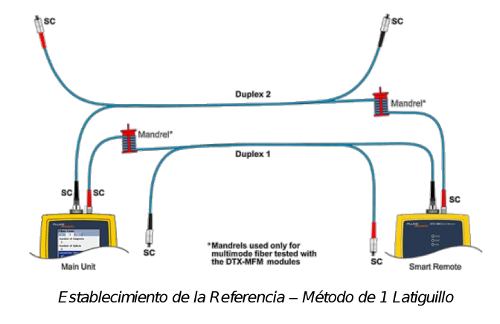 Once the reference has been made, the link to be measured must be inserted between the source and the receiver to perform the power loss measurement of said link.
'
'
'
 With this configuration, an additional patch cord must be added to connect the receiving equipment to one end of the link. This patch cord must be a measurement or reference cord, ensuring that its maximum losses fall within the limits established by the standard. Measurement patch cords are typically duplex, precisely for the purpose of incorporating or using them during the measurement process.
As can be seen, this method is used to perform fiber optic certifications in Permanent Link format, meaning it does not include the patch cords that will later connect the link to the transmission/reception equipment at both ends.
The number of connections and splices in the link to be certified must be manually entered into the measurement equipment. Based on the maximum values specified by regulations for these components, as well as for the cable itself (determined by the measured length), a limit attenuation value for the link is then obtained.
This measurement method is the most recommended, provided it is possible given the type of connectors available on the measuring equipment and the installation being measured, as it offers the greatest accuracy (or lowest measurement error) compared to other methods discussed below.
Two-Patch Cord Method.
This method is used when the connectors available on the measuring equipment are different from those installed on the fiber optic trays.
The first step, as with the one-patch cord method, is to establish the reference point, but this time using a different diagram.
 Note how the coupler or adapter used for reference remains in place during the measurement process, as this method involves using an additional measurement cable with the same type of connector at each end as the one used in the installation being certified.
The two-cable method is recommended when the one-cable method cannot be used, as its accuracy is slightly lower but significantly better than the three-cable method, which will be discussed below.
3-Patch Cord Method.
This method is used when the connectors on the measuring equipment are different from those installed on the fiber optic trays.
The first step, as with the 1-patch cord method, is to establish the reference point, but this time using a different wiring diagram.
 In this case, as the method name indicates, three patch cords will be required to complete the reference establishment scheme. The patch cords connected to the measuring equipment must have a connector identical to the one on the measuring equipment at one end, and the same connector installed on the fiber optic trays at the other. The third patch cord, used to connect the first two, will have the same type of connector at both ends, matching the connector used on the fiber optic trays of the installation being certified.
Once the reference has been established, the link to be measured must be inserted between the source and the receiver to measure the power loss of that link.
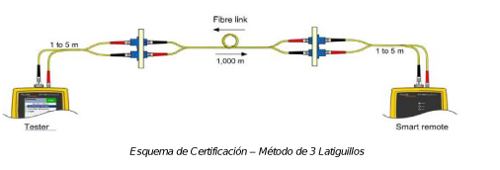 With this third method, measurements can be taken in permanent link or channel format (including the fiber optic patch cords at both ends of the link) simply by removing or retaining, respectively, the adapters used to establish the reference.
It is recommended not to use this method under any circumstances, given its lower precision or greater error compared to the other two methods discussed, except when channel-format measurements are required, as this will be the only method that allows them.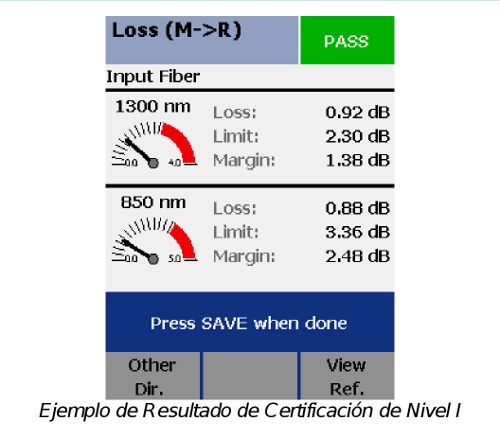 However, neither of these two methods details the individual losses of the different components that make up the fiber optic cabling channel/link; instead, they measure the total losses of said link/channel.
Using any of the three methods to establish a reference, the measurement or certification of the fiber optic links will subsequently be carried out, as previously mentioned.
The measuring equipment should give a PASS/FAIL result depending on whether the link attenuation exceeds the calculated limit value and whether the measured length exceeds the maximum established by the standards. The result may be something similar to that shown in the following figure, where the maximum attenuation values calculated for a multimode link are shown, in both working windows, and the attenuation values resulting from the measurement, as well as the margin of said link that will result from the subtraction between both values.
Level II Certification - OTDR
Level II certification, also known as reflectometry, is a complement to Level I certification, not a replacement.
Reflectometric measurements are typically performed to detect or resolve problems in fiber optic links after a Level I certification has been completed.
What happens if a Level I certification doesn't yield the expected results? A trial-and-error approach can be used, attempting to pinpoint the problem by cleaning or replacing components, etc., but this is always a more arduous and time-consuming process than performing reflectometry.
With an OTDR (Optical Time Domain Reflectometer), we can determine the total link length, the attenuation of each link component (connections, splices, fiber), and even identify if an excessive bend radius is causing the link's attenuation to exceed expectations.
The following figure shows a reflectometric graph, where you can see the total length of the link, the number of existing connections, identified by the peaks of the graph, and the number of splices or, failing that, excessive bends in the fiber, identified by steps.
 Most OTDRs also have the option to provide this data in numerical format, for better understanding by users who are not experts in the subject.
'
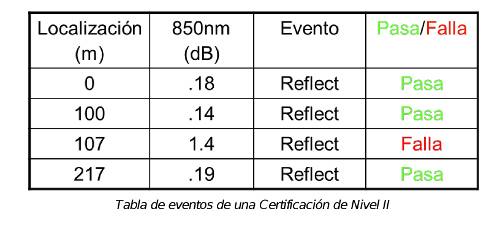 This table clearly shows the position of each element in the link, its attenuation, and whether or not it exceeds the attenuation limit specified by regulations for that element and the total link length. Therefore, it's easy to deduce where the problem of excessive link attenuation might be located.
It's worth mentioning that there are two types of events: Reflective events, which are caused by mechanical connectors or splices, and Non-Reflective events, which are caused by fusion splices and excessive fiber bends. To perform reflectometry, it's necessary to have what are called "casting and receiving reels." These reels, which are essentially sections of optical fiber of a length appropriate to the needs of the measuring equipment, are used to measure the attenuation of the first and last connectors in the link, respectively. Its necessity lies in the accuracy of the measuring equipment, also known as the "dead zone," which implies the need for a certain length of fiber between two events (connectors, splices, bends) so that they can be detected and measured by the OTDR.
The previous figure shows an example of an OTDR with launch and receive coils inserted within the link to be measured.
Inspection and Cleaning of Fiber Optic Connections
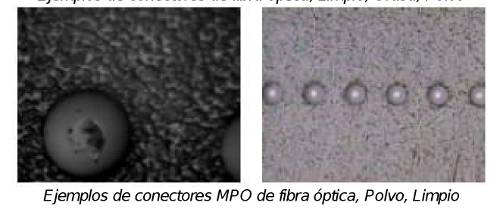
Finally, it should be noted that most problems related to fiber optic links in structured cabling installations are  related to the cleanliness of the connections. Therefore, it is advisable to clean all connections before starting the certification process and to follow an inspection and cleaning procedure for all connections to prevent any existing dirt from spreading and degrading link performance. The most dangerous dirt is dust, as it will block the passage of light and significantly increase link attenuation.
There are many cleaning accessories on the market, with dry cleaning accessories being highly recommended, as shown in the image.
Cleaning MPO connectors commonly used in pre-terminated or pre-connectorized fiber systems is of vital importance.
 This type of connector can align up to 12 fibers, allowing for up to 6 duplex fiber links. If one of these links is in production, but the remaining links suffer from excessive attenuation due to contamination and are therefore unsuitable for the intended applications, cleaning the connector will not be possible until the active link can be disconnected. This will prevent the remaining fibers in the connector from being used. Therefore, it is crucial to clean these connectors before inserting them into MPO modules or couplers.
An important, and sometimes alternative, method to Level II certification, which is commonly used to detect excessive attenuation problems in links, is the inspection of the connections.
 This figure shows a complete inspection and cleaning kit, which in addition to the cleaning accessories mentioned above, includes a microscope consisting of an LCD screen and a multi-magnification probe, usually between 200 and 500x, to inspect the ferrule or surface of the connectors and see in real time the dirt present at the point of the connectors where light is transmitted between connectors.
'
'
Examples of the dirt that can be seen with these microscopes are shown below.

 '
'
Author: Alberto Martínez Technical Manager, Spain&Portugal CommScope Enterprise


