
 Cutting-edge technology and alternative energy sources are known as fertile ground for testing new network systems. Wireless local area networks (WLANs) have been occupying a prominent place in the industry for almost five years now. What advantages do wireless LANs offer users, and more specifically, wind turbine operators?
Ethernet began replacing conventional bus technology in industrial automation many years ago. Bus technology is relatively simple and very reliable, but it's not well-suited to networked systems, and many of the available versions are incompatible with each other. Online access to telemetry data allows operators to fine-tune the system to maximize efficiency and react quickly to errors or malfunctions.
Ethernet has the advantage of allowing individual subscribers to create networks, and it is also a standardized technology (IEEE 802.3), available worldwide at a relatively low cost. It is a particularly attractive alternative for monitoring operations and checking service data. Any modern laptop or desktop computer has an Ethernet interface. The only remaining issue is the network cabling, which takes on a particular dimension in the context of wind turbines.
Maximum performance in challenging terrain
Wind turbines are frequently installed in challenging terrain, particularly in remote, undeveloped mountainous areas, coastal zones, or offshore wind farms, where laying a network of cables to transmit the necessary telemetry data is often impossible. To cover the enormous distances involved in offshore locations—which can exceed 20 km—fiber optic cables are used. This is a very expensive method that also requires extensive experience from the operators responsible for connecting and operating such installations.
 Access to the cable network port presents another problem. If a technician wants to connect to the network, they will need internal access, but this can be very complicated, and not only at sea, partly because wind turbines are structurally very delicate. Any opening or added feature (ladders, doors, etc.) modifies or affects their structure and, therefore, their durability, not to mention the costs. Technicians who want to access wind turbines must, in many cases, be prepared and qualified to climb them. That is, they need both the appropriate qualifications and the right equipment. Even then, depending on weather conditions and location, entering the installation can still be very difficult. The need for technicians to access the equipment when troubleshooting is undeniable, but do they really need that access for routine checks and recording the latest readings?
A wireless network is the obvious solution to this problem.
A wireless local area network (WLAN), as described in the IEEE 802.11 standard, is a wireless Ethernet network, as well as a modern terminal with a built-in WLAN interface.
So far, the WLAN standard has branched out into four variants, from the venerable but still common IEEE 802.11b, which offers raw transmission speeds of up to 11 Mbps, to the more recent IEEE 802.11n standard, which currently offers up to 300 Mbps and is expected to reach 450 Mbps at a later stage.
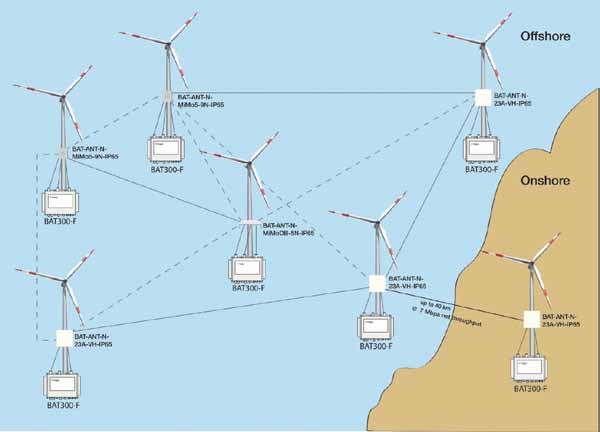 Obviously, these rates are perfectly adequate for transmitting the desired telemetry data.
When such a system is installed, the technician only needs to approach the installation to access the data.
In practice, we see that this is not the only advantage of WLAN technology.
With suitable antennas and the appropriate frequency band, modern WLAN installations can cover theoretical distances of up to 40 km. Of course, transmission speeds will decrease at greater distances, but it will be possible to network even dispersed and complex installations via WLAN. Connections between marine installations and the shore are also becoming feasible.
Data transmissions of up to 300 Mbps. There are other applications that also utilize WLAN in their installations, for example, to avoid the need for high-wear rotating connector assemblies or simply to upgrade legacy systems with the latest networking technology without having to lay new cables. The cables used in wind farms are also subjected to considerable stress when the nacelles rotate to face the wind.
The current IEEE 802.11n standard offers transmission speeds of up to 300 Mbps and significantly more stable data transmissions. It can also cover greater distances than those previously possible with other standards, meaning that another potential use of WLAN is transmitting video images.
The use of wireless technology represents a considerable simplification, but designing and implementing a wireless network requires a thorough understanding of its characteristics. And, however much WLAN is often touted as a replacement for cables, it's not enough to simply plug a connector into each end of the route.
In theory, electromagnetic waves propagate without limits, but interference can occur when a transmitter is nearby. The first step, therefore, is deciding which channel to use for transmission. Every project should begin with an area survey to determine which frequencies might be in use by other WLANs or other wireless technologies. Next, you need to decide which channels are best suited to the intended application.
 The 5 GHz band offers ten times the transmission power, meaning it can cover significantly greater distances than the 2.4 GHz band, making it ideal for point-to-point connections covering large areas.
Many older terminals support only the IEEE 802.11g or IEEE 802.11b WLAN standards, both of which operate in the 2.4 GHz band. This means that an application designed to provide access to technicians via these terminals will have to operate in that band.
In Germany, there is also licensed Broadband Wide Area Network (BFWA) operating at the upper end of the 5 GHz band. This allows for an output power of up to 4 W at the antenna, which could theoretically achieve a range of 40 km, provided the appropriate antennas, sufficiently tall masts, and a clear line of sight between stations are available. See Table I.
Several manufacturers, such as Belden's Hirschmann™ brand, have designed their product lines to allow customers to enjoy the benefits of wireless transmission without disappointment. These units are designed to be exceptionally robust; they must withstand the temperature ranges typical of harsh environments and are intended for installation and operation in industrial settings. For example, each unit is equipped with two WLAN interfaces, enabling them to operate simultaneously on the 2.4 GHz and 5 GHz bands. They also feature robust antennas that support the multiple-input/multi-output (MIMO) technology used in the IEEE 802.11n standard, without which worthwhile transmission rates over long distances cannot be achieved.
 Conclusion:
IEEE 802.11 WLAN wireless network technology can reduce the cost of using wind energy and increase its efficiency. Potential applications range from telemetry data transmission to video monitoring of the installation. The 802.11n WLAN standard was introduced to industrial environments about a year ago and enables the cost-effective use of even widely dispersed wind farms. The units are specifically designed for harsh environments and are waterproof and resistant to frost, high temperatures, wind, and general weathering, as well as being resistant to electrical or mechanical failures. With the appropriate antennas and installation technology, complete solutions can be deployed without weak points. Furthermore, even existing wind farms can be connected at any time using WLAN technology.
 The author,
Olaf Schilperoort,
Product Manager, Industrial Networks,
responsible for the Hirschmann™ series at Belden


