Whether it's dogs chewing on the cables, a simple bump from a vacuum cleaner, a child tugging on the patch cord, or anything else, fiber optic networks can be disrupted by factors beyond our control. A good fiber optic installation isn't enough.
How can this problem be solved?
Until recently, coinciding with the emergence of FTTH technology, talking about fiber optics was almost unthinkable; fiber was considered more delicate to install, care for, and maintain. But the idea that installing fiber is delicate and complex completely disappears when you see an FTTH fiber optic connection installed: the technician connects the OLT in just a few minutes, and it never causes any further problems, unlike what happened with ADSL and copper pairs.
For this to truly be the case, we must meticulously handle the contents of the wall outlet and the installation procedure.
Optical wall sockets:
We might think that any wall socket on the market could perform the same function in a home. In practice, if network security is the goal, not all wall sockets are suitable.
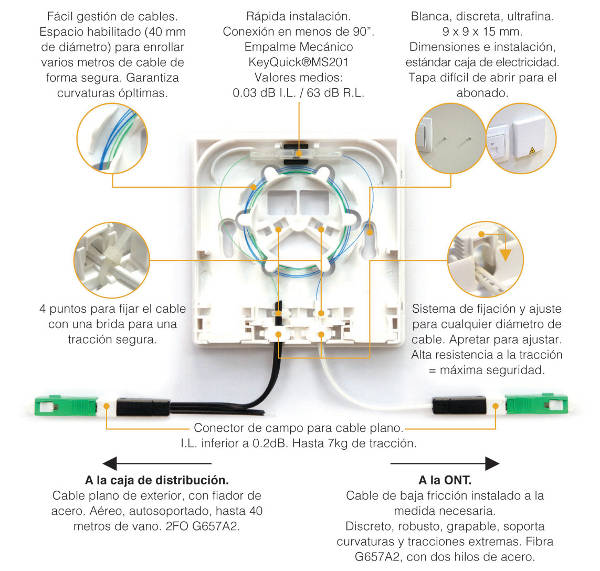
The ideal wall socket should have a double cable tie system. Regardless of the traditional cable ties that secure fiber optic cables inside enclosures, the safest way to prevent strong cable pulls is for the wall socket to have an additional cable tie system that tightly grips the cable. This ensures that a strong pull on the cable should not affect the contents of the box, nor should the patch cord break.
Secondly, the ideal wall socket should have the power cable entering from the back, avoiding wiring in the home and, consequently, tampering and potential damage.
We must make it difficult for the user. The optical wall socket cover should have a snap-on closure. The cover should only be able to be opened with a screwdriver. This feature of the rosette prevents the user from easily opening the rosette and manipulating the contents.
cable
is absolutely essential to avoid the aforementioned failures.
Conventional drop cables are acceptable and can certainly continue to be used. However, if the goal is to resolve and minimize the most typical and common issues for a subscriber, these cables fall short.
There are cables specifically designed to overcome the challenges of the last mile in FTTH deployments, particularly focusing on installation safety and reducing failures.
These cables can withstand tensile forces, extremely strong pulls, and extreme twisting without introducing attenuation. These cables make all the difference.
They are equipped with G657.A2 fibers, allowing for macro-bends and bends to a minimum radius of 7.5 mm without attenuation.
These cables can be stapled directly to the wall with traditional universal staplers. And, as the name suggests, they can be pushed manually without the need for a guide.
Multipurpose cables to be used in indoor and outdoor connections, and in any last-leg application in fiber-to-the-home (Fiber-To-The-Home) deployments.
 Fusion or Mechanical Splicing?
These days, talking about fusion splicing in the last mile—that is, the section from the central office to the subscriber—is becoming increasingly outdated.
There are numerous mechanical splices available worldwide. Each type offers a different level of quality and price.
The high performance of an FTTH installation is achieved solely through the use of reliable, durable, easy-to-use, and therefore cost-effective fiber optic interconnecting elements for the cable operator.
Have you heard of a splice that achieves the same results as a fusion splicer?
We know that for fiber optic experts, the idea of achieving the same optical performance with a mechanical splice as with a fusion splicer is almost unthinkable. But it's true! And it's measurable!
Performing a KeyQuick® mechanical splice takes less than 30 seconds. The average attenuation value is 0.3dB–0.04dB, with no light inside the device. Connection is made by hand, without special tools, and verified visually. No measuring equipment is required.
Opposite connectors: a source of problems.
The use of the special and exclusive CTB50 wall plate configuration in combination with KeyFibre® EasyPush® cables eliminates the need for optical opposite connectors and plugs within the subscriber terminal wall plate.
By removing connectors and adapters from the standard implementation, costs and unnecessary attenuation are reduced, and above all, most problems caused by a lack of cleanliness in these devices are avoided.
It is worth noting that while the above is important, no less significant is the benefit obtained by using EasyPush® cable with internal steel reinforcement connected to a KeyQuick® field connector, which is then connected directly to the ONT.
Pull-proof. Problem solved.
It's important to highlight that this is precisely the cable segment or patch cord that runs from the optical wall outlet to the OLT. And it's right here that our proposed solution reduces the most frequent problem encountered by the operator cable in FTTH installations by almost 100%.
The use of the double-flange wall outlet, along with KeyFibre's EasyPush® cable, which is low-friction with steel reinforcements, and the KeyQuick® 20 field connector, is the safest and most effective solution within the subscriber's premises.
A proven fact:
The cable or patch cord running from the optical wall outlet to the OLT can withstand up to 7 kg of pulling force. We're talking about a really strong pull, very strong indeed.
Currently, there is no other cable combination on the market that is as robust and safe for the operator.
Do you know how little loss is achieved?
We're talking about an insertion loss (IL) of less than 0.3dB in the section from the distribution box to the ONT.
If we compare the optical performance of this combination with the traditional rosette configuration, which requires adding a matcher and two connectors, the minimal difference is between 0.5dB and 0.07dB.
Seeking Installation Security
Remember:
• Eliminating components saves on material costs.
• Adding to this the reduced handling and fewer devices to install reduces installation time.
• This leads to fewer interconnection points, resulting in significantly lower losses.
• Easy installation is safe installation. The KeyQuick® mechanical splice can be installed by any technician without fiber optic experience. The technology's transparency, combined with the elimination of the need for a fusion splicer, makes the KeyQuick® splice system highly cost-effective for cable operators and very easy for technicians to install.
• Remember that the optical performance of this splice is equivalent to that achieved with a fusion splicer.
• The cable is the most important element in reducing the most common faults in FTTH installations within the subscriber's premises. KeyFibre's EasyPush® cable is extremely thin and robust, withstanding a pull of over 7 kg.
Article provided by KEYFIBRE