
The system indicates the fault location on an electronic map and notifies maintenance personnel via email or telephone.
As a result, it accelerates the identification and location of faults (such as increased signal loss, fiber breaks, and water ingress) and facilitates restorative maintenance. It also allows the maintenance center to test installed equipment remotely as a manual test during cable installation.
The ability to perform automated testing of multiple fibers simultaneously saves labor time and installation costs, and reduces the overall work period required.
The current regulatory environment has made it more important than ever for telecommunications companies to proactively monitor and maintain their fiber optic networks. In particular, the substantial penalties specified in service-level agreements and quality-of-service commitments provide operators with financial incentives to invest in the maintenance of their fiber networks.
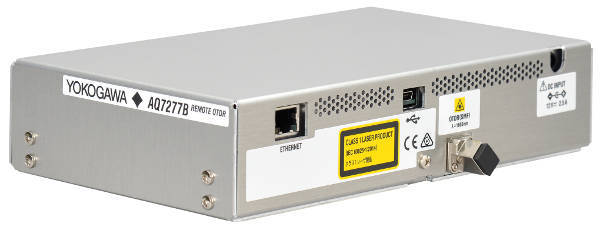
The AQ7277B OTDR module hardware is based on the Yokogawa AQ7280 OTDR, offering superior optical performance in terms of short dead zone (typically 0.6 m) and high dynamic range (up to 50 dB). Furthermore, its size is reduced by 60% compared to its predecessor, improving its integration into RFTS. Its dimensions are now 230 mm (W) × 50 mm (H) × 140 mm (D), and it weighs approximately 1 kg.
There are two models in the AQ7277B family, both equipped with an Ethernet interface (10BASE-T / 100BASE-TX) as standard. The AQ7277B-B01 takes measurements at 1650 nm, a wavelength that does not interfere with the 1310/1490/1550 nm communication wavelengths. It is equipped with an integrated cutoff filter to isolate wavelengths below 1650 nm, and can therefore perform accurate measurements on "live" lines (where active communication signals are traveling). This model is also optimized for testing passive optical networks (PONs) and can measure through high-port splitters used in modern PON systems.
The AQ7277B-B02 is designed to monitor long-distance optical fibers, exceeding 200 km under real-world environmental conditions, and is capable of achieving a dynamic range of 50 dB. It operates at a wavelength of 1550 nm.


