 Added to this is teleworking, the implementation of video surveillance systems for security purposes or to care for the elderly in their own family environment, and the connectivity required for the use of social networks.
The development of increasingly faster and more powerful telecommunications services has been made possible primarily by the deployment of optical communication networks. These networks use light sources (LEDs or lasers) to transmit information through an optical fiber, which, due to its large bandwidth, can meet the demand for high-capacity traffic. To exploit this bandwidth, Wavelength Division Multiplexing (WDM) technology is used. This involves transmitting different channels at different wavelengths (colors) from different light sources over a single fiber, allowing for the individual and independent implementation of different services.
In the context of WDM technology, research into new optical devices that allow for the individual selection of optical channels (filtering), their distribution to different users (demultiplexing), or their routing based on wavelength (optical routing) is crucial for successful implementation. This is the context for the research developed by UPM researchers, whose original idea is based on performing these tasks with a single device that can be controlled in real time to select the desired function.
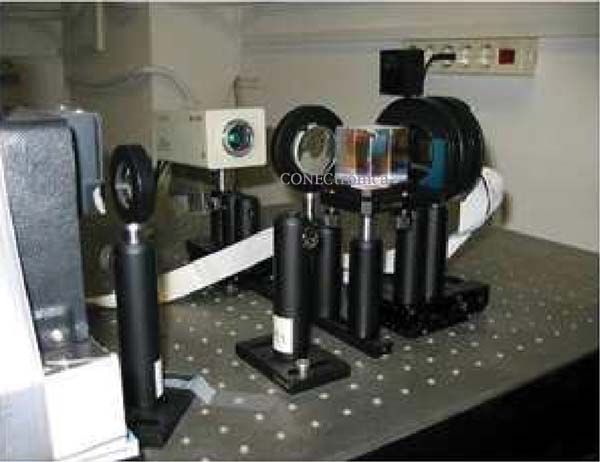
The optical characteristics of the device have been tested in the experimental bench of the laboratory of the photonic technology department of the ETSI Telecomunicación of the Polytechnic University of Madrid, where its ability to contribute to the great social demand for communication services today has been demonstrated, through its application in optical communication networks.
The “spatial light modulator” helps:
The component that enables this function is a 'spatial light modulator' (SLM), a device similar to a liquid crystal display but smaller and with a much higher pixel density, allowing images to be displayed on it. The light incident on the SLM will change direction depending on the loaded image (hologram) and its wavelength, following the laws of diffraction. Therefore, the device will be able to perform different functions depending on the type of hologram implemented in the SLM.
 Various laboratory experiments have demonstrated the spatial light modulator's ability to diffract incident light according to its wavelength and the type of hologram, making it suitable for diverse applications. Typical applications for this multifunctional holographic device focus on metropolitan WDM optical networks, where it can be used as a multiplexer and optical router for protecting and reconfiguring the optical path between nodes.
Holograms are the foundation of the device and are generated by a computer, where they are stored and processed in real time. The goal is to have a readily available database of holograms to dynamically modify the device's functionality. Generally, the holograms used consist of black and white bars of varying thicknesses.
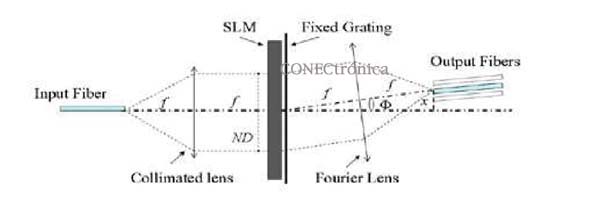
The light from the incoming optical fiber is collimated, that is, parallelized through a lens, and illuminates the SLM and a fixed diffraction grating. A second lens, at the output, couples the first diffraction order of the light to the output optical fiber or fibers, which are placed in the focal plane of the lens. Here, the Fourier transform of the hologram is located, which, in the case of a bar hologram, is a set of equidistant points of varying luminous intensity.
Through this simple structure, the device can perform various applications: tunable filter (fixed or variable bandpass), multiplexer (or demultiplexer), and wavelength router. To switch between these applications, it is only necessary to modify the fixed or variable values of two parameters: 'n' (hologram type) and 'x' (separation of the output fiber from the device's optical axis). This multifunctional capability is the device's most distinctive feature.
References:
Martin Minguez A, Horche PR. “Tunable holographic components in WDM optical networks”, Optical and Quantum Electronics 42 (1): 45-67, November 2010.
Michel C. Parker et al. “Dynamic Digital Holographic Wavelength Filtering”, IEEE/OSA, J. of Lightwave Tech. 16(7):1259-1270, July 1998
Source: Polytechnic University of Madrid (UPM).