 The subsequent adoption of digital technologies, along with fiber optics and wireless networks, ushered in a new technological era and market segmentation. Large operators found themselves competing with smaller, more agile companies that offered close customer relationships and comparable service quality. Adapt or die—that was the question. And in the current climate, GPON technology has arrived to meet the needs of the immediate future. The EU's Digital Agenda aims to promote the deployment of ultra-fast internet access networks exceeding 30 Mbps, with 50% of households having connections above 100 Mbps by 2020.
Our government wants to encourage the development of these privately initiated networks through a National Strategy Plan for Ultra-Fast Networks, which includes infrastructure sharing and provides companies with facilities for network deployment by facilitating permits and even with investment commitments.
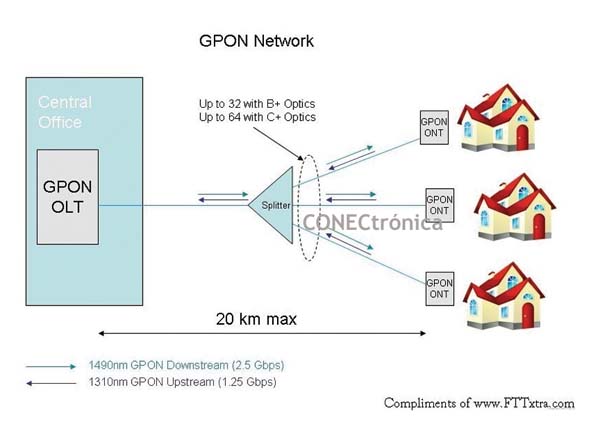
It is clear that if the door is to open to new horizons, local telecommunications operators will focus on the already mature technology that will allow for the deployment of their networks due to its inherent advantages. This is the GPON network technology, or Gigabit Passive Optical Network, which has the following characteristics:
Standardization by the ITU according to the G984.X recommendations, which will allow operators to become independent of manufacturers since the equipment is, in principle, compatible. The standards already include a network management system, something essential for its maintenance and operation.
This is a multipoint, completely passive network, except for its terminal elements. It will use single-mode optical fiber as its transport cabling, branched out using entirely passive splitters. This prevents failures due to power supply issues. The splitting ratio is 1:128. The fiber used is also widely recognized by installers. The range is 20 km, and the standard anticipates reaching 60 km.
The subscriber equipment or ONT would have Fast Ethernet and even Gigabit Ethernet outputs to provide TV, Internet and Fixed Telephony service to residential users and even businesses.
The OLT, or headend equipment, is where the optical fibers run to the users. Each OLT will have several outputs, each capable of serving up to 64 users.
Maximum upload and download speeds of 2.488 Gbps (downstream) / 1.244 Gbps (upstream).
There are already half a dozen good manufacturers of GPON network equipment in the Spanish market. Therefore, let's look for a good engineering firm to design and oversee the project and a good after-sales service that quickly resolves any issues.
With all these premises, success will be guaranteed.
Author:
Author: Pedro Barquero, Telecommunications Engineer at Carbacon Networks