 In many applications, fiber optics has become the preferred medium for delivering higher speeds and higher bandwidth data networks in enterprises, subways, and transportation services. It may be less widely known that optical networks can also contribute to reduced energy requirements. Passive optical networks (PONs) are becoming increasingly common in the ICT sector and are expected to experience significant growth. PONs offer cost-effective bandwidth and high speeds, while also helping to significantly decrease energy consumption.
The Demand for Speed:
Due to significant improvements in network data speeds, bandwidth, and overall capacity, demand continues to rise in telecommunications and data communications applications. Fiber optic technology has proven useful even at speeds as low as 1 Gbps and has seen increased use for 10 Gbps systems currently deployed in enterprise-level data centers. It has become the standard for the current 40 Gbps upgrade, while 100 Gbps systems are expected to become more widespread. Fiber optics has become practical for higher speeds over shorter distances of up to 100 meters. There is growing demand for applications such as servers, routers, and switches in data centers. Fiber not only reduces the size and weight of cables but is also more cost-effective, reduces EMI, and, most importantly, can decrease overall power consumption.
 Lower cost, lower energy consumption.
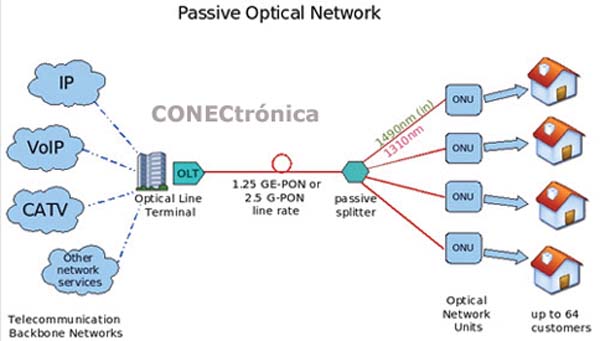
A PON is a cost-effective way to deliver high-performance fiber-to-the-home connectivity by using shared optical fibers, eliminating the need for multiple point-to-point connections. A PON uses small, affordable, unpowered optical splitters instead of the large, expensive, high-power optical repeaters used in traditional optical networks. A PON splitter typically connects up to 32 (or more) homes or facilities on the same network. It consists of an optical line terminal (OLT) at the service provider's central office and a number of optical network units (ONUs) connected closer to the end users (Figure 1).
Downstream signals are transmitted to all facilities sharing a single fiber. Encryption provides security and prevents interception. Upstream signals are combined using a multiple access protocol, such as TDMA (Time Division Multiple Access). Some companies use WDM-PON (Wavelength Division Multiplexed PON) to separate ONUs into multiple virtual PONs that coexist on the same physical infrastructure. Alternatively, static multiplexing can offer efficient use of wavelength to reduce delays at the ONU level.
The cutting-edge technology in this sector is GPON (Gigabit PON), which telecom operators have widely deployed in rural telephone and metro networks in the US and Europe, bringing fiber to homes and businesses. 10GPON versions (10 Gbps downstream and 2.5 Gbps upstream) are under development and being installed in some advanced applications. GEPON is the Ethernet-compliant version of GPON, supporting speeds of 1 and 10 Gbps and higher.
In addition to implementation in telecommunications networks, passive cable systems are also being adopted in data centers at firms such as Google™ and Amazon™, for short-range machine-to-machine connections up to 15 meters to reduce energy consumption, heat, and costs.
 Sandia National Laboratory in Albuquerque, New Mexico, a pioneering PON user, has replaced 600 individually managed data switches with 14 optical LAN elements, making it the world's largest fiber optic LAN. The installation has reduced network energy usage by 65%, saving $20 million over five years in energy bills and other costs. It offers greater capacity, and the longer reach of fiber has allowed it to connect remote facilities to high-speed communications networks for the first time. It is also more secure and reliable, has saved space, and reduced maintenance effort and costs.
Optical Transceivers:
A key component in any optical networking system is the optical transceiver, enabling electro-optical data conversions. According to LightCounting's 2013-2017 REF1 market forecast database, revenue will continue to increase year-over-year, reaching $5 billion in 2017 (up from $3 billion in 2012). Transceivers for DWDM (Dense Wavelength Division Multiplexing) and Ethernet applications are the growth drivers, primarily due to the rapid deployment of 40 Gbps and 100 Gbps ports, the company says. However, 10 Gbps systems currently dominate the Ethernet market and will continue to do so until 2017, when 100 Gbps devices are expected to take over. Customers are seeking smaller form factors and lower power consumption, the company noted.
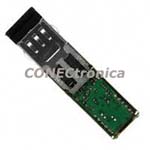
Avago Technologies is a leading company in this sector, offering innovative fiber optic solutions for 10, 16, 40, and 100 Gbps systems and beyond. The HFBR-5911LZ optical transceiver is a typical unit in this current range. It is designed for use in short-range (up to 500 m) multimode fiber optic links at 1.0625 or 1.25 Gbps, making it ideal for Gigabit Ethernet or Fibre Channel network equipment.
The device complies with the industry standard for small form factor (SFF) and requires a 3.3V power supply. The electrical interface is a 2 x 5 connector, while the optical interface uses an LC-duplex connector. Typical applications include high-speed, switched backplane interconnects, mass storage system I/O, and high-speed peripheral interfaces.
 For enterprise and metro networks running 10 Gbit Ethernet, Avago offers the AFBR series of optical transceivers. The AFBR-703SDDZ, for example, is an SFP+ (small form factor pluggable) package with an LC-duplex connector, as used in most modern data centers. It utilizes the company's 850 nm PIN detector and VCSEL technology. With a data rate of 10.312 Gbps, typical power dissipation is 600 mW. The unit includes optical interface specifications that meet 10GBASE-SR standards.
Specializing in pluggable optical modules, Finisar offers a wide selection of innovative devices, enabling datacom and telecommunications companies to expand their operations on a modular basis. The range includes transmitters, transponders, and transceivers to cover a broad spectrum of standards, form factors, and applications. The modules can operate at various distances, from short-range for data center use, to medium-range for campus and metro applications, and long-range for carriers.
Many of the modules incorporate a microprocessor and a diagnostic interface for reliable performance monitoring. This feature allows users to remotely monitor, in real time, the transmitted and received optical power, laser polarization current, transceiver input voltage, and transceiver temperature of any optical device on the network.
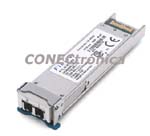
A typical Finisar optical transceiver module is the FTLX1412D3BCL, a small form factor (XFP) device that complies with 10GBASE-LR/LW standards with 10 Gbit Ethernet. It supports bit rates of 9.95 to 10.5 Gbps and a maximum link length of 10 km. Power dissipation is less than 2 W, and it uses an uncooled 1310 nm laser. It requires only a 3.3 V power supply and incorporates an LC-Duplex connector. Digital diagnostics are available via a 2-wire serial interface.
The FTLX8571D3BCL is designed for 10 Gbps SFP+ applications and complies with 10GBASE-SR/SW standards. It supports a bit rate range of 9.95 to 10.5 Gbps, operates on a single 3.3 V power supply with less than 1 W of power dissipation, uses an uncooled 850 nm VCSEL laser, and has a maximum link length of 300 m. The device includes an LC-Duplex connector and also offers integrated diagnostic functions.
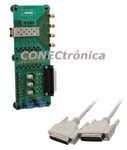
Another interesting option for developers is the Finisar FDB-1027 evaluation board. Featuring a unique SFP+ edge connector and enclosure, and four 50-ohm SMA coaxial connectors to accommodate receiver output signals and high-speed differential transmitter input, the board is ideal for evaluating long- and short-wavelength SFP/SFP+ transceivers at data rates from 125 Mbps to 10.3 Gbps.
Abstract:
Fiber optic technology will enable the demand for higher bandwidth and faster data networks to be met. Pressure is growing to reduce the rampant energy consumption of the ICT sector. Passive optical networks are a step ahead in meeting these dual goals. Optical transceivers are a fundamental component in today's optical networks, and the pressure is on component manufacturers to develop devices that meet the technical challenges of high data rates and low power operation within standard form factors.
Author:
By Rich Miron, Digi-Key Technical Content Team
References
1. Light Counting Market Forecast: http://www.lightwaveonline.com/articles/2012/12/lightcounting-2012-reasonably-good-for-optical-transceiver-vendors.html
© 2012 Google Inc. All rights reserved. Google and the Google logo are trademarks of Google Inc.
Amazon, Kindle, Kindle Fire, the Amazon Kindle logo, and the Kindle Fire logo are trademarks of Amazon.com, Inc. or its affiliates.