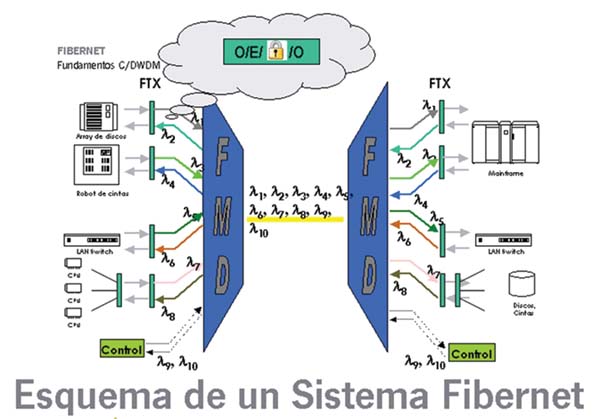
 This new technology allows, on the one hand, continuous monitoring of potential physical tampering with the fiber optic links themselves. If any tampering is detected, the system automatically reroutes all data traffic to another fiber path. On the other hand, it enables the encryption of each customer communication so that it travels as encrypted data.
Due to the critical nature of the transmitted data, the development of this technology has been carried out transparently and with minimal delay. Furthermore, the encryption modules incorporate the latest advancements in data encryption techniques
• AES-256 bit encryption.
• Automatic key generation using the Diffie-Hellman algorithm.
Compared to other encryption solutions on the market, Fibernet's solution achieves excellent performance in terms of latency (communication delay) and optimizes the cost required to encrypt each of the services the client needs.
Fibernet has designed its solution to address potential security issues in communications through two approaches. The first is based on a system that monitors fiber optic cable manipulation and intrusions in real time. If even the slightest problem is detected, the system switches all traffic to the backup route. This functionality is implemented in Fibernet's FIBERSEC product family, intelligent fiber optic measurement systems.
The second solution enables encryption algorithms on the communication transport interfaces of Fibernet's DUSAC family:
• FTX-10c with encryption functionality for high-speed protocols: 10Gbps.
• The FTX-4c features encryption functionality for low-speed protocols: GbEthernet and F.Channel up to 4 Gbps.
The encryption design is low-level, integrated into the FPGA (Field Programmable Gate Array), a semiconductor containing logic blocks whose interconnection and functionality are configurable using a specialized programming language. DUSAC system boards incorporate an FPGA-based design, making it relatively easy to implement and include encryption protocols. Furthermore, this low-level approach offers other advantages:
• Minimal latency added to communications.
• Greater protocol independence.
Data encryption is incorporated into each client signal, using a key that can be entered by the end user/client via a management module with access restrictions. This key, combined with the encryption algorithm, generates a signal that is transmitted over a lambda with a similar bit rate. Encrypted and unencrypted channels can coexist in a given architecture.
According to Esther Gómez, CEO of Fibernet: “At Fibernet, we are aware that fiber optic communications are becoming increasingly common and in demand by large companies that want to take advantage of the enormous benefits these systems offer in transporting large amounts of data. This growing demand has led us to develop innovative encryption systems to curb potential eavesdropping or espionage risks that companies could face when transmitting sensitive data.”