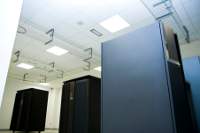
 Antonio Gorrachategui, director of Fibernet's Data Center business area, explains that "when it was built, one of the factors taken into account was energy efficiency and environmental impact." In accordance with the Ecodesign Directive (2005/32/EC EuP), Fibernet established a series of environmental requirements that it was obligated to meet in the design of its Data Center: compliance with the Power Usage Index (PUE), environmental impact assessment, evaluation of efficient equipment according to manufacturers, improvement of environmental performance, energy and water consumption, and energy growth according to demand. Gorrachategui adds that "Fibernet has an internal process control procedure through which the corresponding environmental controls are carried out, in accordance with ISO 14001 and ITIL procedures.".
 Fibernet's Data Center is classified as Tier 3+. It's a data center of over 500 m² that combines energy efficiency with high levels of redundancy. Furthermore, its design has been conceived to allow for growth in performance and services according to customer demands; hence, a modular expansion model was chosen, ideal for offering hosting, advanced monitoring, and critical services.
The seven concepts that define the energy efficiency of Fibernet's Data Center are:
• Environmental: Use of efficient energy sources, optimization of energy use, and consolidation and virtualization of equipment.
• Modular growth: The business, as currently structured, cannot be interrupted under any circumstances. Its equipment and systems can be scaled up or down without impacting the rest of the architecture in the event of any modifications.
• Security: As is well known, physical and environmental threats are a reality that cannot be allowed to prevent a company from operating.
• Scalability: Energy and cooling requirements are key factors that determine the proper functioning and efficiency of the Data Center, so this aspect must be clearly defined in its design.
• Maintenance: The architecture must be designed with high energy efficiency, high availability, reduced maintenance costs, and low CO2 emissions.
• Recommendations: Accurate measurement of consumption and utilization is essential for cost savings – PUE (Power Usage Effectiveness). Set a PUE target for the next three years from the start of operations. Optimizing equipment performance is fundamental to achieving the desired efficiency and savings; this requires choosing the right systems. Maximize free-cooling days to save energy on cooling and comply with Kyoto regulatory requirements.
• Future. In the data centers of the coming years, reduced physical intervention will be crucial, driven by virtualization and automated management. Power and cooling density will change due to the emergence of optical processors, which utilize photons instead of electrons. Data center size will decrease. Bandwidth will increase and become a key factor.
In addition to the services it offers to large companies in its data center, Fibernet connects nearly 80% of the large data centers in Spain with fiber optics across various sectors, from banking (with clients such as Banco Santander, CaixaBank, BBVA, and Banco Popular) to public administration (Tax Agency, DGT, ICO, Correos, Renfe, and the Bank of Spain).