 No company can assume its value chain will remain unchanged. This disruption must be addressed in several ways: infrastructure, shifts in traditional development paradigms, and moving beyond traditional limitations and skills to achieve a cloud-native architecture. Data thus becomes the most important asset and must be leveraged.
Digital transformation is business transformation.
Simply implementing technology does not produce digital transformation, but changing an organization to leverage the potential of these technologies does. To transform, organizations must redesign their underlying business and operating models, as well as the resulting products and services. The term transformation refers to a fundamental change in an organization's day-to-day business, from the types of products and services it produces to how it delivers them. An organization in need of transformation—whether a company, government agency, or service provider, such as healthcare—is typically responding to a change in the market and consumer demand for a product or service. All economic sectors face exponential technological advancements, increased consumer spending, and ever-growing competition. The companies that will benefit from this process are those that have already begun their digital transformation, anticipating their competition and thus building a strategic advantage. The current challenge is figuring out how to capture all the raw data being created every moment. To make it competitive and integrate it into analytical processes that can attract new customers or win back existing ones in an automated way. As long as large volumes of useful data exist, organizations need to integrate and analyze all that information, for which analytics are key. The flow of information from sensors, events, and real-time data is constantly increasing, and this information will have to be stored, managed, and quickly executed to support optimal operations and decision-making.
Digital transformation should be on the agenda not only of all IT directors but also of CEOs and general managers. Why? Because businesses are changing, and those who don't change risk disappearing. 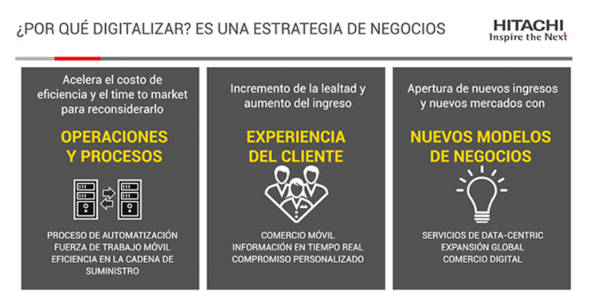 Digital transformation is a business strategy. It accelerates profitability and time to market by allowing a rethinking of operations and processes—with automation, workforce mobility, and supply chain efficiency; it increases loyalty and boosts revenue by improving the customer experience—with mobile commerce, real-time information, and personalized engagement; This strategy reveals new revenue streams and enables access to new markets with new business models, thanks to data-centric services, a global expansion model, and digital commerce. It will need to accelerate cost-efficiency and time to market around new operations and processes, improve customer service to increase customer loyalty and generate more profit, and ultimately discover new markets with new business models.
Beyond using technology to innovate, new digital companies use that technology in innovative ways. Not only must the technology be innovative, but also how it is used, to satisfy a new generation of consumers. In today's world, organizations know that data and easy access to it are the new currency. Currently, most companies are implementing or beginning to implement digital transformation initiatives. The pace and magnitude of the shift toward holistic digitization represent an even greater transformation than the invention and adoption of the internet itself. What we call "digital" today will, in a few years, no longer need that descriptive word, as is already the case when we refer to a camera. Similarly, the "digital" strategy will become standard business practice. Therefore, it is critical to move forward as soon as possible and generate that competitive advantage in a timely manner. He emphasized the importance of changing the current IT model: for example, instead of "competing against the Cloud" (investing in infrastructure), IT should exploit the app business by leveraging the Cloud. In this context, infrastructure must be automated to focus the rest of our resources on the customer. Data Center models face new challenges brought about by mobility, Big Data, and cloud-based apps.
The impact of IT on digital transformation will be such that, while information will become crucial for corporate success, IT will be responsible for providing the strategic competitive advantage, based on the concepts of "Infrastructure Management," "Data Governance," "Mobility," and "Analytics." Infrastructure Management enables the creation of IT as a Service (ITaaS); Data Governance will provide security based on corporate standards; With IT mobility, IT transforms into a service and data provider; and with analytics, IT becomes a knowledge advisor. This entire digital transformation will be accelerated by the Internet of Things (IoT), as what used to be divided into two—Information Technology and Operational Technology—is now being integrated. The Internet of Things will lead to an inevitable convergence of the physical and digital worlds: Billions of sensors, mobile devices, smart machines, and so on, will generate an unprecedented amount of data, and the potential impact on how we live and work will be enormous. 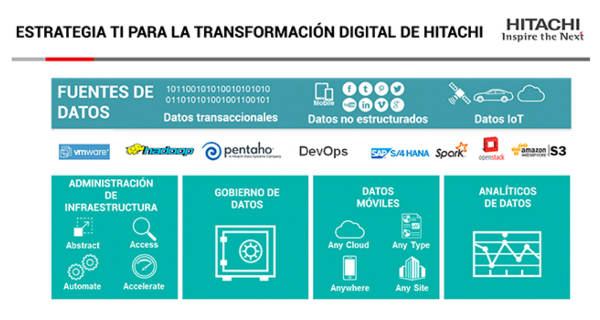 Hitachi Data Systems' proposal for effective digital transformation:
HDS' formula for effective digital transformation is based on four pillars: data management, data control, data mobility, and data analytics.
DATA MANAGEMENT - Application- and infrastructure-independent data management - Automation that frees up IT resources to create added value and reduce errors - Access to the highest level of service and total data availability - Accelerated data performance thanks to flash technology
Data Management: Hitachi Data Systems Solutions
a) Convergence: through efficient, reliable, and agile solutions. The goal is to support systems in a private or hybrid cloud, implement IT-as-a-service models to leverage all the opportunities offered by social networks, mobile computing, and web analytics, as well as automate and centralize IT management. Hitachi Unified Compute Platform (UCP) solutions: The path to a converged IT infrastructure
b) Flash Storage: with all the competitive advantages of fast data access. The goal is to facilitate and expedite decision-making, leverage innovation to identify new opportunities, anticipate changes, and accelerate the time to market. HDS flash solutions reduce the data center's environmental footprint, consolidate applications, and maximize system performance, with a significant reduction in operating costs. The advantages of HDS flash technology. Features of the Hitachi Virtual Storage Platform F-Series.
c) VMware applications for data center modernization and efficiency. Creating virtual volumes brings flexibility and efficiency to VMware and vSphere storage environments, reducing IT workload and increasing data protection and availability through centralized management.
d) Reduced complexity through SAP applications.
e) Reduced total cost of ownership (TCO) through Oracle applications.
Data control
– All the necessary control and flexibility
– Data protection
– Data management policies that integrate protection, authentication, and encryption
– Control of the entire data management process: from creation to archiving
Data mobility
– Complete data availability: anytime, anywhere.
– Data control and security, with full remote accessibility at any time.
– Creation of a data lake that enables data mobilization, even for legacy applications.
– Increased data productivity and work capacity.
Data analysis
– Leveraging the value of existing information through analysis
– Understanding and managing big data
– Integrating analysis into business processes
– Getting the most out of data