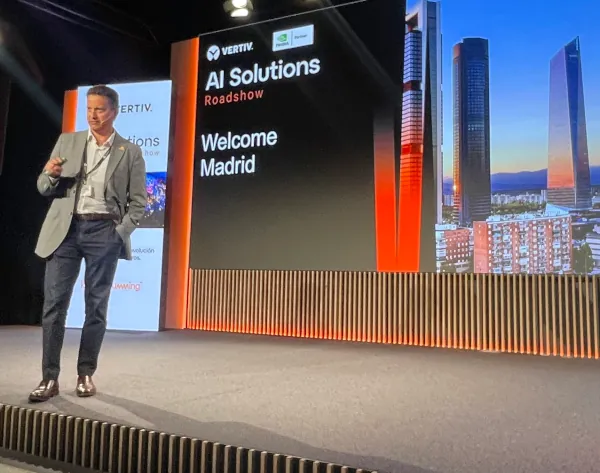
The event, held at Zenit The Study, brought together professionals from the AI ecosystem, including engineering firms, integrators, distributors, and digital infrastructure specialists, to address the challenges posed by the growing demand for AI-driven processing power.
Following previous editions held in Madrid in October 2024 and Barcelona in March 2025, this latest gathering focused on adapting data centers to the demands of so-called "AI factories," highlighting key aspects such as power supply, advanced cooling, and the converged infrastructure solutions needed to ensure operational efficiency and future scalability.
The opening of the event was led by José Alfonso Gil, Sales Director for Services in Southern Europe at Vertiv, who welcomed attendees and presented the main trends transforming the data center sector as a result of the rapid adoption of Artificial Intelligence. During his presentation, he emphasized the need for infrastructures to evolve to meet ever-increasing demands for power, cooling, and availability.
One of the highlights of the event was the presentation by Miguel Del Moral, Director of Indirect Sales for Iberia and Portugal at Vertiv, who analyzed the profound change that data center infrastructure is undergoing due to the expansion of AI. He explained that the growth of workloads based on artificial intelligence models is driving an unprecedented increase in server capacity, energy requirements, and the physical infrastructure that supports them.
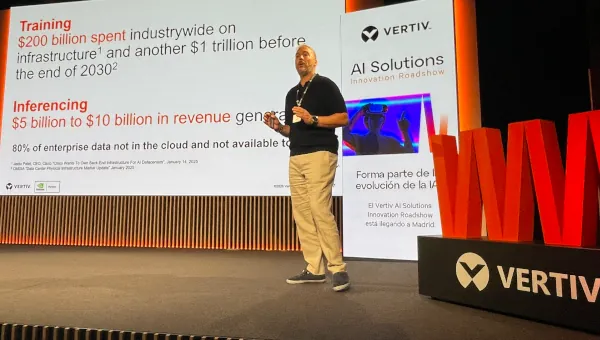
Del Moral pointed out that the sector is witnessing a rapid increase in rack density, driven by the transition from primarily CPU-based architectures to GPU-dominated environments, which are much more demanding from an energy and thermal perspective. This shift necessitates a rethinking of traditional data center design and the adoption of new power and cooling strategies capable of supporting increasingly higher loads.
During his presentation, he also highlighted the strategic collaboration between Vertiv and NVIDIA for the development of AI-ready infrastructures, an alliance aimed at accelerating the deployment of data centers optimized for the next generation of accelerated computing platforms.
He also presented some of the solutions that are part of Vertiv's technological offering to address these challenges, including Vertiv™ SmartRun, designed to simplify and accelerate the deployment of power and electrical distribution infrastructures in high-density environments, and Vertiv™ CoolPhase Flex, a solution aimed at improving energy efficiency and operational flexibility in mission-critical applications.
The agenda also included several technical sessions focused on cooling requirements for AI factories, new energy challenges associated with high-density workloads, and trends in rack integration, design, and system management for AI-ready data centers.
Caterina Giordan, Application Engineer at Vertiv, also participated, focusing her presentation on the cooling challenges posed by the new generation of AI infrastructures. During her presentation, she outlined what she defined as the five AI imperatives in data centers: ensuring continuity of power supply, increasing cooling capacity, optimizing space utilization, improving energy efficiency, and accelerating the deployment of infrastructures capable of supporting high-density workloads.
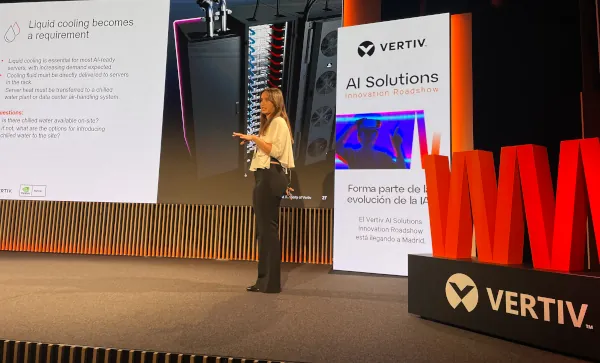
Giordan highlighted the rapid evolution of processors for artificial intelligence applications, noting that the TDP (Thermal Design Power) per chip continues to grow rapidly and could reach 800 watts per processor in the next generations—a figure that far exceeds the capabilities of traditional air-only cooling systems.
Given this scenario, she explained that the industry is moving toward hybrid cooling models that combine air and liquid, allowing for the efficient dissipation of heat generated by servers equipped with high-performance GPUs. She indicated that liquid cooling architectures are ceasing to be an option and becoming an essential element in data centers designed for AI.
The Vertiv specialist also presented the company's various CDU (Coolant Distribution Unit) solutions, designed to manage the distribution of coolant in high-density installations. Among the products highlighted were Vertiv's 121 kW in-rack units, as well as 600 kW, 1,350 kW, and 2,300 kW edge solutions designed to support large-scale deployments. He also addressed the advantages of in-row architectures, which are geared towards maximizing thermal efficiency and facilitating the scalability of accelerated computing environments.
During his presentation, Giordan emphasized that the combination of advanced power supplies, liquid cooling, and integrated management systems will be a key factor in enabling operators to meet the anticipated growth of AI workloads while maintaining infrastructure reliability, energy efficiency, and availability.
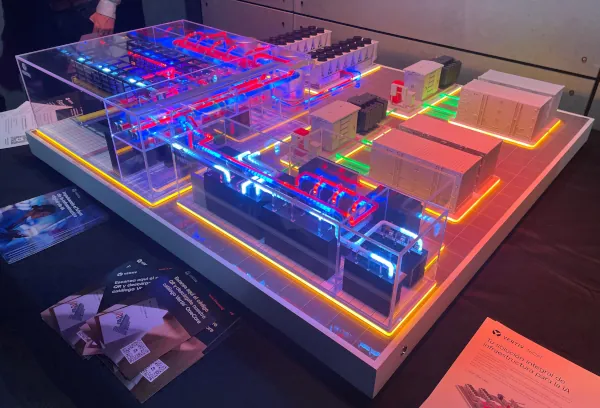
Likewise, Carlos Martínez, Senior Manager Application Engineer at Vertiv, focused his presentation on the impact of the extraordinary densification of data centers at the rack level, a phenomenon driven by the expansion of artificial intelligence workloads. In this context, he explained how the increase in power per rack is transforming the design of critical infrastructure, from cabling to electrical distribution systems, including solutions such as aluminum busbars up to 2,500 A and high-capacity architectures designed for accelerated computing environments.
Martínez described AI as a pulsating electrical load, since the energy consumption of GPUs exhibits dynamic, high-intensity peaks, forcing a rethink of data center energy management. In this regard, he emphasized the importance of thoroughly studying the behavior of generator sets, mentioning the testing capabilities of the Vertiv Liebert EXL S1 system, designed to validate performance in scenarios with high load variability.
The executive also addressed the growing role of energy storage systems, highlighting the use of batteries as a key element in mitigating the power spikes associated with AI computing. In particular, he referenced technologies such as nickel-zinc and lithium iron phosphate (LiFePO₄) batteries, which offer various advantages in terms of energy density, safety, and lifecycles.
Within Vertiv's ecosystem of solutions, he emphasized products such as the Vertiv™ Power Bar, Vertiv™ HighPower Bar, Vertiv™ Remote Power Panel, and Vertiv™ Power Distribution Unit (PDU), designed to support high-energy-density environments. He also anticipated an evolution toward architectures in which GPUs are powered directly with high-voltage direct current, around 800 V DC, thus reducing energy conversion stages and improving overall system efficiency.
In this vein, he mentioned the development of solutions such as the 800V medium-voltage rectifier-UPS concept, designed to simplify the power chain by eliminating multiple intermediate stages, as well as the Vertiv Power Nexus platform, designed for high-power and scalable environments.
Martínez also highlighted the advantages of the Vertiv™ SmartRun system, which arrives pre-assembled from the factory, allowing for up to an 85% reduction in deployment times and up to a 75% reduction in installation labor, significantly accelerating the commissioning of critical infrastructure.
Finally, he introduced the BYOP (Bring Your Own Power) concept as an emerging trend in the planning of next-generation data centers, as well as the need to consider the low thermal inertia of GPUs, which increases the importance of highly reactive protection and cooling systems. In this area, he highlighted the role of BESS (Battery Energy Storage Systems) and microgrids, citing solutions such as Vertiv™ DynaFlex BESS and Vertiv™ Energy Core, aimed at strengthening the energy resilience and flexibility of AI infrastructures.
The presentations were closed by Javier Martínez, Senior Manager, Application Engineering at Vertiv, who spoke about the imperatives of integrated rack, design and management of systems for AI factories.
The day concluded with an open Q&A session, followed by a networking event between attendees and industry experts, where they analyzed the opportunities and challenges arising from the rapid evolution of AI and its impact on digital infrastructures.
With initiatives like the Vertiv AI Solutions Roadshow, the company reinforces its commitment to helping customers and technology partners develop resilient, efficient infrastructures ready to meet the growing demands for power, cooling, and scalability required by the new generation of AI-powered applications.