Multilayer Radars:
A traditional radar has several layers of components stacked on top of each other, each with different tasks. The radome is the outer protective layer, which must allow radio waves to pass through unimpeded. The antenna array performs the conversion between an electrical signal and the emitted radio waves, as well as reading the radio echoes and converting them back into an electrical signal. The shielding separates the antenna array from the radar circuit board, where the radar circuit board contains key components such as the transceiver and processors.
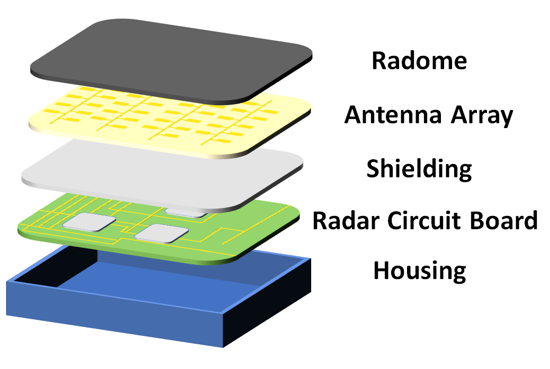 Radars of this type still exist, but they tend to take advantage of the greater availability of space to incorporate as many features as possible. For example, the new high-performance radars from Continental, Arbe, and others are still quite large. These radars are typically used at the front of the vehicle, where high resolution and long range are required. But on the rest of the vehicle, ranges can be shorter, and the precise positioning of detected objects is less important than field of view and proximity measurement. These changes in requirements allow for a reduction in radar size and open up more possibilities for further reducing the overall package size.
On-Board Integration:
The current trend among radar suppliers, such as Bosch, Continental, Infineon, and NXP, is to integrate the radar circuit board and the antenna. Combining the two reduces the size of the enclosure by eliminating the need for a shielding layer and a separate antenna board. Part of this progress is due to the shift from 24 GHz to 77 GHz, resulting in shorter wavelength radio waves and a smaller antenna array. The second factor is the evolution toward highly integrated chips. Instead of having multiple discrete chips on the radar circuit board, Si-CMOS technology allows the transceiver to perform almost all the tasks required by the radar, such as signal processing and object identification. This frees up space on the radar board and allows room for the antenna. However, not all suppliers are making the leap directly to Si-CMOS, a point explained by IDTechEx in "Automotive Radar 2022-2042."
Antenna in the package:
Some innovators and suppliers, such as Texas Instruments, are going a step further and placing the antenna on top of the transceiver chip itself. This means the entire radar can be reduced to just a few tens of millimeters in each direction. This is cutting-edge radar technology, and it's hard to imagine how a radar could get any smaller.
Antenna on the Vehicle:
The trade-off designers must make when reducing radar size is a decrease in performance. A smaller antenna array may have short range and low resolution. So, is there a way to obtain all the advantages of a large antenna array while still maintaining high levels of integration?
One possible solution is to start embedding the antenna in the vehicle's exterior surface. This has already been proposed in research; for example, the Fraunhofer Institute is working on RadarGlass, which transforms headlights into radars. IDTechEx believes this could also be applied to body panels, embedding the antenna in the plastic to create enormous, versatile, and powerful arrays. Furthermore, by decentralizing the antenna, multiple arrays could be coordinated through a single controller. With large antenna arrays working in unison, new performance gains could be unlocked.
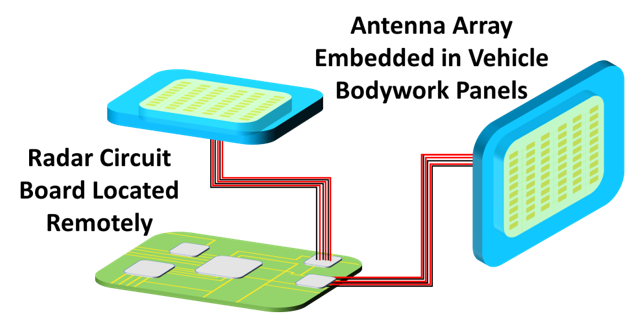 To integrate radar antennas into or on the surface of vehicle body panels, various additive manufacturing processes for electronics could be used. One of the most developed methods is laser direct structuring (LDS), which uses a laser to selectively activate an additive within an injection-molded plastic component, followed by chemical plating. This method is already used to manufacture antennas in a wide variety of consumer electronics devices. Methods in an earlier stage of development include in-mold electronics (IME), in which conductive traces are deposited before thermoforming and subsequent injection molding; the application of films functionalized with the metallic pattern already printed on them; and simply printing conductive patterns onto a 3D surface. The IDTechEx report "3D Electronics 2020-2030: Technologies, Forecasts, Players" provides a detailed overview of how electronics can be integrated within or on the surface of 3D structures.
However, one has to wonder how this integration fits into the existing value chain, since manufacturing a radar in this way is far more complex than a supplier simply delivering a box for the OEM to assemble. For example, who manufactures the body panels? It's unlikely that BMW and Mercedes would want their doors designed by Bosch, but at the same time, how could a supplier like Bosch design a radar antenna for each of the door variants offered by BMW and Mercedes? This concept might be interesting for someone like Tesla, which has a highly vertically integrated manufacturing process, but Tesla seems to be moving away from radar. It's likely that this type of technology will remain on the drawing board for some time to come.