IK4-TEKNIKER will develop the technology in control and safety systems for the LSST telescope
The technology center will develop the control and security systems for the Large Synoptic Survey Telescope (LSST), the world's most advanced telescope, which will become operational in Chile in 2020.
To record, through high-precision images, the entire sky visible from planet Earth. This is the objective of the Large Synoptic Survey Telescope (LSST), an ambitious international project in which IK4-TEKNIKER has a prominent role.
The technology center's expertise in ultra-precision technology has allowed it to position itself in recent years as a leading supplier for major international scientific facilities. In this context, the LSST represents a significant challenge for the center, as it requires the use of cutting-edge technology in control and safety systems.
In collaboration with the engineering firm GHESA-Empresarios Agrupados, which is responsible for developing the main structure of the telescope, IK4-TEKNIKER will carry out the design and development of the control systems, safety, camera cable rotation and mirror protection cover of this large state-of-the-art scientific facility.
The main difficulty that the researchers at the center must face lies in the high precision and dynamics required by the movements of the main axes (azimuth and elevation) of the telescope, which have been custom-designed for this project.
The objective is to photograph different areas of visible space in the shortest possible time. To achieve this, the control system must be able to dampen the vibrations produced by the movement of these axes as quickly as possible and then immediately photograph the targeted area.
In addition to the control system, IK4-TEKNIKER is developing a safety device to ensure the telescope's safe operation, protecting the investment and the safety of the operators. This system monitors travel limits, overspeeds, emergency stop buttons, and the proper functioning of all components.
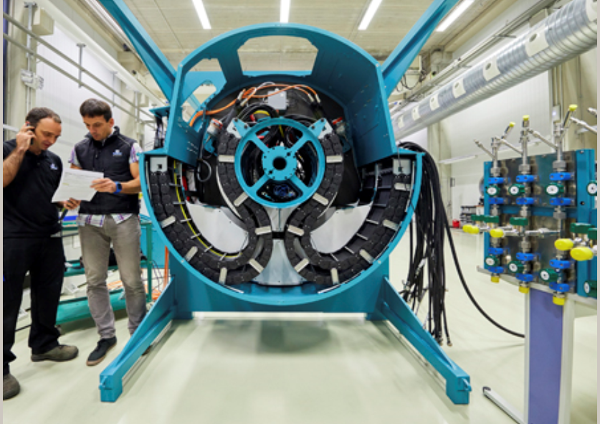
Within the framework of the project, the technology center also contributes knowledge for the design and development of the camera's cable rotator, a mechatronic device that winds or unwinds all the supplies that the camera needs (power cables, communication cables, fiber optic cables and cooling hoses).
This device, with a rotation range of ±90º, when activated, prevents the camera from having to drag the cables and hoses during its rotation movement, freeing it from suffering any kind of stress and thus ensuring that no disturbance is introduced to the camera.
This device also includes a safety system that ensures that in the event of a synchronization error between the camera rotation and the cable rotator rotation greater than 3º, the control system will be able to act to ensure the integrity of the entire system.
IK4-TEKNIKER is also responsible for the movable protective cover of the main mirrors by designing another novel mechatronic system intended to preserve the optics against falling objects, rain or dust.
LSST will be a telescope with an 8.4-meter diameter mirror (the width of a tennis court) capable of surveying the entire visible sky. It will be equipped to scan the sky every three or four nights, producing an image 40 times larger than a full moon thanks to a 3,200-megapixel digital camera. The telescope, located at an altitude of 2,700 meters, will analyze the images in real time and will be able to detect any significant variations, from supernova explosions elsewhere in the universe to asteroids that could impact Earth.
The construction of the telescope, which is expected to be operational in 2020 at Cerro Pachón in the Chilean Atacama Desert, has an approximate cost of 700 million dollars and is the result of close public-private collaboration, as well as a hundred astronomers, physicists and engineers working together to make a reality of equipment that will allow a giant leap in the knowledge of the workings of the stars.
Unlabeled
-
Apollo and Alcatel-Lucent have announced an industry milestone: a successful demonstration of data transmission at approximately 3 terabits per second (Tbit/s), based on 40 Gbit/s channels, per fiber pair in a submarine network. Apollo is a...
-
Cloud-TM, the EU's cloud computing project, presents an initial prototype
After three years of hard work, the Cloud-TM (Transactional Memory) Platform prototype has been launched. This announcement marks the final stage of one of the largest cloud computing research projects in the European Union.
-
The M2M boom is driving massive growth in the value-added services market
The tremendous expansion of machine-to-machine (M2M) connections in the coming years will cause the market for services associated with value-added services (VAS) to expand by a factor of seven and reach $10 billion in 2017. -
WLAN monetization and 802.11ac, the most important Wi-Fi trends in 2015
Location-based services, social networks as user registration credentials between companies that provide guest access, or Hotspot 2.0 roaming consortia have been some of the most talked-about Wi-Fi trends during 2014.
-
Mateo Valero, awarded an ERC Advanced Grant, which is the most prestigious aid for a scientific project
The European Research Council (ERC) has awarded Mateo Valero, director of the Barcelona Supercomputing Center – National Supercomputing Center (BSC-CNS), an Advanced Grant in the physical sciences and engineering category for his project 'Riding on... -
How does coherent optics increase data speed? - Modulation and polarization multiply the data capacity in optical networks.
In the early days of optical networks, all optical signals relied on a simple mechanism known as on-off keying (OOK). Simply put, this mechanism works by turning a light on and off to transmit data. OOK is a broader term used to describe...
Newsletter
Latest News
New advances in 6G: Keysight, NTT and DOCOMO accelerate distributed MIMO simulation
Keysight Technologies has announced a collaboration with NTT DOCOMO and NTT to boost...
Avatel Telecom signs an agreement with MasOrange and expands its coverage to 95% of Spain
Avatel Telecom has signed a wholesale agreement with MasOrange that will come into effect on June 1st and...
RETN launches new trunk route between Romania and Moldova to strengthen connectivity in Eastern Europe
RETN announces the launch of a new end-to-end trunk route linking Drobeta,...
GCF and TCCA integrate interoperability testing into the MCS certification for 5G and LTE networks
The Global Certification Forum (GCF) and TCCA announce that interoperability testing (IOP) is now...
SQuA is born, the alliance that will boost the quantum technology ecosystem in Spain
Spain will have, for the first time, a specific association for the development of its ecosystem...
Subscribe to CONECtrónica magazine
You can subscribe to the Conectrónica magazine in 2 formats.
Digital Format: 5 downloadable PDF editions at an annual cost of 60 Euros (VAT included)
Paper Format: 5 editions to be received by mail at an annual cost of 180 Euros (VAT included).
Contact our subscriptions department at subscriptions@conectronica.com
Payment via Bizum or bank transfer
Technical Courses and Seminars
DataCom: Technical guide for networks, fiber optics and structured cabling
Digital transformation has turned data networks into a critical infrastructure for...
Taoglas launches The Antenna Podcast, a new technical space about antenna design and innovation
Antennas remain one of the most critical and, at the same time, most misunderstood elements in...
ISE 2026 Barcelona: Summits, Megatrends and the most ambitious content program in the AV sector
Returning to Barcelona in February 2026, Integrated Systems Europe (ISE) presents its program of...
E-book: the future of satellite communications
Mouser Electronics, Inc., in collaboration with Qorvo and other technology innovators...
European project “Engineers of the Future” with free online training for young people and teachers on cybersecurity, green energy and automation
The GAIA Cluster has participated in the European project "Engineers of the Future", co-financed by...
Optical Networks
VIAVI launches AI Experts: artificial intelligence to accelerate network validation and diagnosis
VIAVI Solutions Inc. has announced the launch of AI Experts, the first addition to its...
The glass box imperative: governance of intent-based automation in AI-native networks
Connectivity is a fundamental infrastructure, and reliability standards continue to rise...
Multidimensional reconfigurable add/delete optical multiplexer for WDM-MDM systems
In the rapidly evolving field of optical networks, the demands for greater flexibility and...
LAN 2026: Standards, Trends and New Developments in Local Area Networks
The local area network (LAN) ecosystem is undergoing a phase of accelerated transformation in 2026, driven by...
Evolution of optical networks: ROADM, OpenROADM and OpenZR+ in the 400G and 800G era
The rapid increase in data traffic is driving the construction of new infrastructure worldwide...
Legrand launches Chroma Link, the fiber optic solution for high-density AI networks
Legrand has announced the launch of Chroma Link™, a fiber optic cabling solution with...
Hollow Core Fiber (HCF) Deployment and Testing
Hollow Core Fibers (HCF) represent a significant evolution...