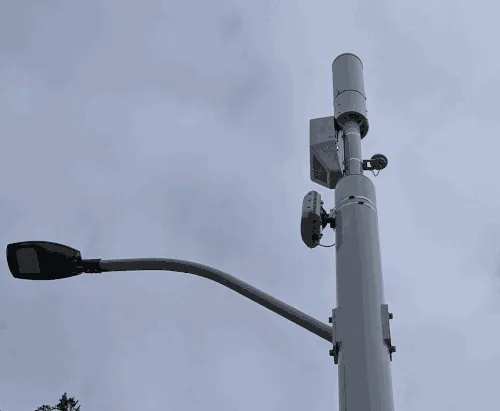
The smart street light, designed and supplied by ANDREW, can conceal all electrical connections and mid-band radio equipment within its base, ensuring a clean and discreet installation. At the top, a custom-designed street light integrates the existing lighting for seamless aesthetics, while also providing mounting options for next-generation 5G and future 6G technologies. This innovative design houses a Ruckus WiFi 7 access point, a 5G millimeter-band gNB (base station), and a 10-port ANDREW antenna, delivering high-capacity connectivity without compromising the visual harmony of public spaces.
The new 5G mmWave equipment installed on the lamppost was supplied by Ericsson and configured in Stand Alone (SA) mode with Dual Connectivity (DC), interoperating with a second Ericsson gNB operating in the mid-band (3.5 GHz). This configuration allows the network to combine the ultra-high capacity of millimeter-wave frequencies with the wider coverage characteristics of the mid-band spectrum, optimizing both performance and reliability.
In the deployed system, the millimeter-wave radio layer is dedicated exclusively to user-plane traffic, while the mid-band layer (FR1, operating at 3.5 GHz) serves as the anchor for control-plane signaling. This architecture ensures that all data traffic benefits from the high capacity of the mmWave link whenever coverage is available, while maintaining robust control-plane connectivity through the mid-band layer.
During testing, no user plane aggregation was applied between FR1 and FR2 (26 GHz) to allow for a clear assessment of the independent performance of each radio layer. When the user equipment moved beyond the effective coverage area of the millimeter band, the system seamlessly switched to mid-band operation for both the user and control planes, demonstrating the resilience of dual connectivity in 5G.
The measurement campaign of the deployed system, conducted at six outdoor locations at increasing distances from the streetlight, evaluated the system with two millimeter-wave bandwidth allocations: a single carrier (100 MHz bandwidth) and eight aggregated carriers (800 MHz total bandwidth for the downlink and 400 MHz total bandwidth for the uplink). Under line-of-sight conditions, the eight-carrier configuration achieved a stable average throughput of 3.9 Gbps on the downlink, with an uplink of up to 239 Mbps, confirming the considerable additional capacity that can be achieved with millimeter-wave technology compared to conventional mid-band deployments.
Latency measurements revealed an average round-trip latency of 4.5 milliseconds at all measurement points within millimeter-wave coverage, regardless of operator configuration and under both line-of-sight (LoS) and partially obstructed line-of-sight (NLoS) conditions. This highlights the performance advantages of maintaining millimeter-wave connectivity for latency-sensitive applications. These findings validate the suitability of smart street light-based mmWave deployments for high-capacity outdoor scenarios where direct or near-direct line of sight can be guaranteed, such as pedestrian zones, public spaces, and university campuses, and can provide valuable insights for planning and optimizing future dense urban network deployments.
The equipment installed in the smart streetlamp has been connected to NEXTONIC's 5G core network, provided by Ericsson. This integration will allow researchers to test and validate advanced network functionalities in a real-world outdoor environment, enabling them to leverage the full capabilities of the lab's 5G SA infrastructure.
The deployment was funded through the ADVANCE-6G project (Acquisition of Equipment for the Scientific Computing and Communications Infrastructure for Advanced Experimentation in 6G Networks), which was awarded to IMDEA Networks under the UNICO R&D 6G 2022 Program, within the framework of the Spanish Recovery, Transformation and Resilience Plan (PRTR), funded by the European Union – NextGenerationEU. The project aims to provide IMDEA Networks with the necessary scientific and technical infrastructure to address advanced experimentation in 5G and 6G in an integrated manner.
As part of this same project, a broader deployment of the network is currently underway at the Carlos III University of Madrid (UC3M) campus in Leganés. This expansion will include three additional smart streetlights, also supplied by Andrew and Ericsson, creating a larger testbed for research into outdoor millimeter-wave coverage, mobility scenarios, and advanced network functions in a university campus environment.
The deployment has been made possible thanks to the support of Telefónica, which has provided the necessary radio spectrum to operate the network. This collaboration highlights the strong alliance between the telecommunications industry and research institutions to drive the development and validation of cutting-edge wireless technologies.
“This implementation is a clear example of how the UNICO R&D initiative has enabled IMDEA Networks to improve its research infrastructure for advanced wireless technologies,” said Carlos Bernardos, Professor at Carlos III University of Madrid and part-time research professor at IMDEA Networks.
“Through this project, we have been able to test key capabilities of 5G Advanced, such as millimeter wave access and dual connectivity, in real-world outdoor scenarios, laying the groundwork for future 6G experiments. Achievements like these strengthen our scientific foundation and help accelerate the translation of research into practical solutions, ultimately benefiting society.” “By providing IMDEA Networks researchers with direct access to 5G mmWave technology, innovative outdoor use cases and applications can be discovered through open experimentation. Collaboration between industry and academia is key to accelerating adoption and expanding the real-world impact of revolutionary technologies like mmWave,” says Manuel Lorenzo, Director of Technology and Innovation at Ericsson R&D Spain.
“At ANDREW, our research and development efforts focus on enabling the evolution of mobile networks through the integration of multiple technologies and the simplification of network densification. Participation in this project reflects our commitment to advancing connectivity and offering innovative solutions that make next-generation networks more efficient and scalable,” commented Pedro Torres Martos, ANDREW's Chief Technology Officer in Europe.