Voice quality on VoIP networks varies considerably due to several factors. This article will show how service providers can prevent degradation in a VoIP network and deliver voice quality comparable to, or even better than, PSTN levels.
On the PSTN, voice quality is intelligible, sounds natural, allows users to identify speakers, and experiences only minor, annoying variations. Voice is delivered as an analog signal, which terminates at the
nearest Digital Loop Carrier (DLC) or Central Office (CO). The DLC converts the analog signal into
digital samples for long-distance communication, and then at
the final destination, another DLC
converts the digital samples back to analog format at
the TIP-RING telephone interface.
High-quality voice is achieved because analog voice signals are sampled at 8000 Hz and compressed to only 8 bits per sample using ITU-T-G711 Pulse Code Modulation.
Several factors allow the PSTN to maintain voice quality, including:
- Voice Sampling and Compression: Transmission from the source DLC to the destination DLC is digital. Digital transmissions using G.711 are controlled by stratum clocks that ensure synchronization of the supplied sample. Losses or errors in the compressed sample are rare and therefore not perceived by users.
- Delays: End-to-end delays are due to physical transmission delays on the PSTN. There is no memory or packet processing in the transmission, which makes
interactive voice conversations more natural and pleasant.
- Echo: Although the same analog telephones are used for calls over PSTN and VoIP, echo on the PSTN service is not noticeable due to the minimal delays. Balancing end-to-end losses at the DLC and the PSTN CO helps reduce echo disturbances. For international and long-distance calls where delays may be introduced, long-distance echo cancellers are incorporated by the carrier.
- Compliance with TR-57: TR-57 [1] is the North American standard for transmission and switching guidelines in DLC. DLC systems and analog input stages that control TIP-RING telephone lines comply with TR-57 and equivalent transmission characteristics in each country, optimizing transmission quality. DLCs and PSTN COs also ensure reduced delays, resulting in improved call initiation and termination times, as well as enhanced call service utilization.
- Ring Equivalent Number (REN) control and impedance matching: DLCs are typically designed to support up to three to five phones using the same TIP-RING physical wiring. This allows the PSTN to maintain quality despite simultaneous phone use and minimizes interference due to impedance mismatch.
The PSTN is not entirely fault-free. In some international calls, voice quality can be affected for various reasons. These could include improper terminations, satellite link delays and multiple stages of G.711 transcoding, inadequate echo cancellation at termination nodes, long local loops, the use of multiple phones with impedance mismatches, and the use of packet-based intermediate connectivity between long-distance nodes.
When compared to the PSTN, the perceived voice quality of VoIP-based calls is influenced by several factors. These factors—including delay, echo, voice compression, packet loss, G711-PLC, transcoding, gateway losses, and Terminal Coupling losses—are classified according to the TIA-TSB 116-A standard [2].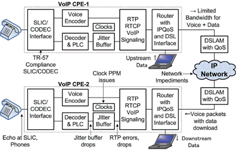 In the VoIP architecture, Customer Premises Equipment (CPE) includes voice services such as the PSTN's DLC. However, VoIP CPE also includes PSTN CO functions, such as ringtone generation, dial-dial detection, call setup initiation, and support functions. VoIP voice is delivered as packets over an IP network. Figure 1 illustrates the various parameters that control voice quality and how the IP network introduces obstacles such as packet loss, jitter, packet errors, and packet fragmentation.
VoIP service is also delivered through CPE in the same way as traditional VoIP adapters, high-end residential gateways, and dedicated IP phones. These devices rely on local area network (LAN) interfaces, such as Ethernet and wireless LAN (WLAN), or wide area networks (WAN) via a digital subscriber line (DSL). The available bandwidth on these network interfaces, along with the device architecture and built-in QoS mechanisms, work together to help reduce packet delays between endpoints. Many CPE devices manage upstream QoS, while downstream QoS is managed by the Internet Service Provider (ISP). Data path control points (COs), such as VDSL Digital Subscriber Line Access Multiplexers (DSLAMs), are now available with QoS support, which helps eliminate VoIP packet drops at IP terminations.
VoIP CPEs are designed with the hardware in mind to reduce device costs, making the service affordable for consumers. For example, clock references cannot match PSTN stratum clocks, and some devices in the CPE input stages cannot fully comply with TR-57 specifications. However, several manufacturers have recently introduced low-cost telephone interface devices that incorporate TR-57 features, enabling improved voice quality. Multiple impedances, tones, call forwarding functions, and planned loss adjustments for each country still need to be incorporated to adapt to local sound level values and improve overall voice quality.
In some countries, internet and VoIP services are provided by different providers. To reduce costs, subscribers may select the internet service with the lowest bandwidth. To overcome these bandwidth limitations, VoIP providers use codecs such as G729A instead of G711. G729A voice compression is eight times greater than that of G711, resulting in lower sound quality. Furthermore, VoIP calls may traverse multiple gateways and transcoders—conversions from one compression system to another—to reach
end users on other
VoIP networks, the PSTN, or wireless networks
.
Due to network congestion, packet loss is inevitable. Packet Loss Concealment (PLC) algorithms are incorporated into the CPE to manage unexpected packet losses. During periods of silence, jitter buffers are adjusted to optimize the packets available from the network interface and minimize buffer delays. This activity also mitigates the problems encountered by packets resulting from end-to-end clock drift.
Echo is a critical problem that affects voice quality. End-to-end VoIP call delays and noise levels also contribute to echo. Lower delay helps reduce echo. Delays can be improved with increased bandwidth, QoS mechanisms, and CPE designed for lower packet processing delays. Noise levels are primarily determined by end-user phones, end-to-end impedances and losses, and the country of deployment. VoIP voice quality can be further improved by incorporating carrier-provided echo cancellers into the
CPE process.
In VoIP networks, voice quality must be continuously monitored. Voice Quality Monitoring (VQmon) software is used in many installations, but not all CPE devices can provide dynamic quality improvement based on monitored parameters. To achieve the highest quality, CPE devices and the deployed end-to-end infrastructure must be capable of supporting dynamic quality improvement based on monitored parameters.
As explained in this article, several improvements are being implemented to ensure voice quality comparable to that of the PSTN from a user experience perspective when using VoIP services. However, VoIP quality may surpass that of the PSTN when using broadband voice. In traditional PSTN and VoIP services, telephone acoustics and processing limit voice frequencies to 300–3400 Hz. In broadband voice, acoustic interfaces and processing support frequencies from 50–7000 Hz, enabling natural-sounding conversations with a sense of presence. Broadband compressed audio using the G722 codec requires the same bandwidth as G711. Other broadband codecs, such as G729EV [3], operate at half the bandwidth of G711. The perceived quality achieved with some codecs often surpasses that of G711 PSTN. The voice quality level 'R' of broadband voice is around 20% better than G711 based on upgrades of a model with a model bandwidth R following ITU-T-G107 and G113 recommendations [4,5].
Broadband voice is also being deployed in Europe, supported by DECT (Digital Enhanced Cordless Telecommunications) broadband phones. These installations rely on broadband input stage hardware and acoustics. The telephone input stage, connected to the Subscriber Line Interface Circuit, and hardware sampling devices provide ample bandwidth. Currently, several conference phone models, PC-based software phones, and IP phones offer broadband voice support. Acoustic interfaces on digital phones, Bluetooth, DECT, and Wi-Fi can also be used for broadband voice services . A number of improvements are being implemented to ensure voice quality is comparable to PSTN when using VoIP services, and that VoIP quality can surpass PSTN levels when using broadband codecs. In traditional PSTN and VoIP services, telephone acoustics and processing limit voice frequencies to 300–3400 Hz. In broadband voice, acoustic interfaces and processing support frequencies from 50–7000 Hz, enabling natural-sounding conversations with a sense of presence. Broadband compressed voice requires less bandwidth than G.711. Listening perceptions of many broadband codecs surpass those of G.711 for PSTN. The 'R' voice quality level of broadband voice is approximately 20% better than G.711, based on model upgrades with a model bandwidth of R, following ITU-T-G107 and G113 recommendations.
References
- TR-NWT-000057, Functional Criteria for Digital Loop Carrier Systems, January 1993
- TSB-116-A Telecommunications-IP Telephony Equipment–Voice Quality Recommendations for IP Telephony, March 2006
- G729EV: An 8-32 kbits/s scalable wideband speech and audio coder bit stream, May 2006, http://www.itu.int/ITU-T/worksem/h325/200605/presentations/s3p3-varga-beaugeant.pdf
- ITU-T-G107 Amendment-I, New Appendix II-Provisional impairment factor framework for wideband speech transmission, June 2006
- ITU-T-G113 Amendment-1: New Appendix IV-Provisional planning values for the wideband equipment impairment factor Ie,wb, June 2006.
The author: Sivannarayana Nagireddi. Ikanos Communications, Inc.