 It may seem new, but the concept of the Metaverse dates back to 1992, when science fiction writer Neal Stephenson defined it in his novel Snow Crash as a virtual, collective, fictional world. Today, it's simpler to refer to it as an "immersive, three-dimensional" internet.
Following the announcement, interest in building digital worlds skyrocketed among companies and users, so much so that, according to a Bloomberg Intelligence survey, the Metaverse technology platform could become an $800 billion market by 2024.
However, to be deployed, the Metaverse will need a robust technological infrastructure capable of providing all the computing power, storage, and bandwidth necessary to deliver a truly immersive experience. In fact, Qualcomm indicated in 2018 that developing a virtual reality environment like the Metaverse would require a minimum internet speed of 200 Mbps.
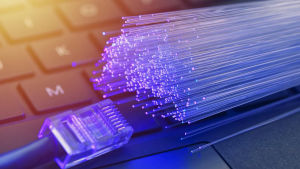
Considering this, the technology that currently meets these demanding requirements is fiber optics, as it offers very high speeds, reaching capacities of hundreds of Terabits in recent tests
Fiber optics will become the indispensable connection for developing the virtual and immersive experiences that will characterize the Metaverse, as it guarantees various parameters that are fundamental for developing a real-time experience, such as greater signal stability and real-time audio and video transmission.
Undoubtedly, connectivity will be crucial for enabling the Metaverse. However, the maturity of this new immersive environment will not be reached for at least 10 or 15 years, and it will also require the collaborative or individual work of various companies, some of which are already advancing in the construction of their own metaverses, such as Microsoft, Nvidia, and Epic Games, the creators of Fortnite.
This projection of at least a decade means that the Metaverse will leverage the advantages of technologies like 5G once it has matured and become widespread in the market. It will even reach its full potential when the concrete path to 6G begins, with the first commercial implementations of this sixth-generation technology expected to start around 2028.
Considering the future of the internet, connected devices and sensors (IoT), and the advancement of new disruptive technologies, it is plausible to envision a Metaverse that brings everything together in a seamless combination of all these solutions. To achieve this, the computational capacity of data centers and a robust, scalable, and resilient technological infrastructure will be fundamental.
The more complex the platforms, the greater the bandwidth required. New virtual environments for real-time interaction will demand more demanding performance, and in this scenario, the use of fiber optic connections will be even more essential to maintain a high standard of user experience.
*By: Magno Fugisava, Global Market Manager of Furukawa Electric LatAm