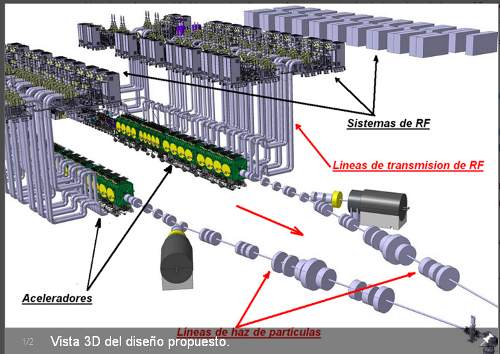
 To achieve this goal, it is necessary to build a whole series of infrastructures, among which IFMIF (International Fusion Materials Irradiation Facility) stands out for its importance; these tests advance the achievement of this goal.
IFMIF is a neutron source with characteristics similar to those of a fusion reactor, whose essential objective is to generate information on the behavior of materials required for the construction of a future reactor. While IFMIF does not have the visibility of ITER (International Thermonuclear Experimental Reactor) in terms of media impact (ITER is currently under construction in Cadarache, France, and aims to demonstrate the scientific feasibility of fusion energy along with key technological objectives), its construction is considered as necessary as ITER's for the design and construction of DEMO, in that the information provided by both facilities will be equally essential.
The IFMIF neutron source harnesses deuterium-lithium (D-Li) stripping reactions, in which accelerated deuterium nuclei are inserted into lithium nuclei, to produce neutrons with an average energy spectrum similar to that produced in a fusion reactor vessel. Materials irradiation experiments require stable, continuous irradiation with high availability. IFMIF will achieve this using two 125 mA beam current linear deuteron accelerators, operating continuously with an energy of 40 MeV per deuteron. The deuteron beams, with a resulting nominal power of 5 MW each, will impinge on a liquid lithium target, moving at high speed—approximately 15 m/s—to dissipate the large amount of deposited energy, thus generating the neutron beam necessary for materials irradiation.
Regarding Validation and Engineering Design Activities: an accelerator that will serve as a prototype for one of the accelerators (LIPAc, Linear IFMIF Prototype Accelerator) is currently under construction within the framework of the IFMIF-EVEDA project (Engineering Validation and Engineering Design Activities). The radio frequency (RF) system that will provide the necessary energy to the accelerator beam is part of the Spanish contribution to the project, which, with a cost of approximately 13 million euros, has been awarded entirely to Spanish companies (“Availability improvements for the LIPAc RF Power System: tetrodes and solid state solutions”. M. Weber et al. 2014. More information.)
The LIPAc RF System consists of eighteen radio frequency chains, sixteen of which are built with very high-power amplifiers using vacuum tube technology, while the other two, of lower power, follow an advanced design with solid-state transistor technology. Both systems were developed in collaboration with companies in the sector in Spain, notably INDRA SISTEMAS for the sixteen tetrode chains and BROAD TELECOM for the two solid-state chains.
Between June 9 and 12, 2014, in Torrejón de Ardoz (Madrid), acceptance tests were conducted on the first two units of the innovative, very high-power, high-availability Radio Frequency Modules, part of Spain's contribution to the IFMIF/EVEDA Project. The tests were carried out at the facilities that CIEMAT has contracted with the multinational technology company INDRA SISTEMAS for the development of this project.
The tests were successfully conducted in the presence of representatives from the institutions participating in the project. These included representatives from the European agency Fusion For Energy (F4E), responsible for the European contribution to the Broader Approach for Fusion agreement, under which this collaboration is framed; the Japan Atomic Energy Agency (JAEA); the Institute of Nuclear Fusion in Legnaro, Italy (INFL); and the IFMIF/EVEDA project team, including Juan Ramón Knaster, a former CIEMAT researcher and the current international project leader. Representing CIEMAT were Joaquín Sánchez, director of the National Fusion Laboratory, as well as the project researchers and staff from INDRA SISTEMAS.
The vacuum tube amplifiers developed by INDRA SISTEMAS to CIEMAT specifications are having a significant impact by paving the way for a new generation of vacuum tube amplifiers that offer greater effective operating time, meaning increased availability. Until recently, improvements to these systems focused on the characteristics of the vacuum tubes themselves. Since these tubes have reached the limits of their technology, CIEMAT's proposal has been to increase the availability and, therefore, the viability of these systems by reducing the time required for maintenance or replacement in case of failure. To achieve this, a system of platforms has been designed that, at different levels, allows for the partial or complete replacement of the amplifier chains. This ensures that even in the worst-case scenario of a failure, the particle accelerator will only need to be shut down for a few hours, unlike conventional systems that can experience downtime of days or even weeks. This system is considered in the international community as the new path towards the improvement of grid-based vacuum tube amplifiers (tetrodes) and has already inspired designs in other facilities (“Development and future prospects of RF sources for linac applications”, (Present and future of Radio Frequency Sources for Linear Accelerators). E. Jensen, CERN. Proceedings of Linear Accelerator Conference LINAC2010, Tsukuba, Japan).
During testing, the 230 kW, 175 MHz nominal frequency radio frequency amplifiers, capable of pulsed and continuous operation, reached their maximum power of 230 kW, exceeding required efficiency, signal purity, and stability characteristics. These units are the most powerful radio frequency (RF) amplifiers built in Spain for this frequency and operating mode.
Once the tests were completed and accepted by international organizations (F4E, JAEA and IFMIF), the equipment is ready for shipment and installation in Japan, where the LIPAc accelerator is being integrated and will operate.
The Spanish contribution to the IFMIF/EVEDA project, which is being implemented with a return to Spanish industry of nearly 100%, is being fully financed by the Spanish government through various actions of the Ministry of Economy and Competitiveness (MINECO) and the former Ministry of Science and Innovation. (Ref. SGIOI. 05-07/09 CIEMAT IFMIF Y JT-60, AIC10-A-000441, AIC-A-2011-0654, Management Agreement BOE 16 January 2013).