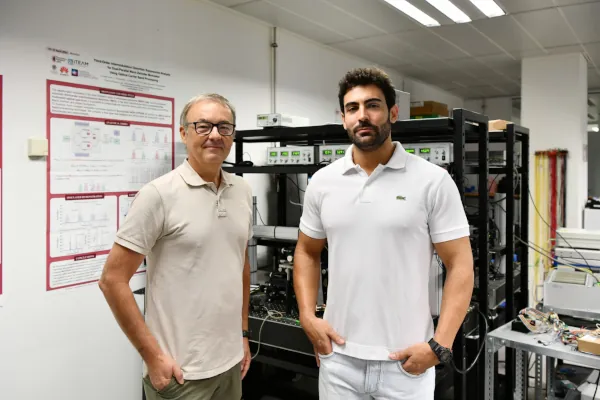
The work, in collaboration with the University of Vigo, was co-led by PRL-UPV researchers José Capmany and Andrés Macho. The research has successfully developed and experimentally demonstrated the foundations of a new light-based information theory called Analog Photonic Information (API).
The research proposes a new way of processing information using integrated photonics—circuits that work with light instead of electricity. This technology would allow certain complex calculations to be performed much faster and more efficiently than current electronic systems, especially in tasks related to artificial intelligence, scientific simulations, or medical diagnosis.
A new way of working with mathematical models
“Until now, mathematical computing models were designed first and then attempts were made to adapt the technology to them. We have reversed the process: we have created a mathematical model specifically designed to take advantage of the real capabilities of current and future photonic technology,” explained José Capmany.
This new light-based language would reduce processing times and energy consumption in operations that currently require enormous computing power. This would have a direct impact on data centers, whose energy demand grows every year due to the rise of artificial intelligence and massive data processing.
Improvements for the Healthcare Sector
Among the system's potential applications are the development of new drugs through molecular simulations, the improvement of autonomous driving systems, advanced robotics, and medical image processing. In the latter case, it could help accelerate tests such as CT scans, reducing the time needed to generate and process diagnostic images.
The technology could also be applied in fields such as astronomy and defense, where enormous volumes of data are handled, requiring real-time responses.
One of the most relevant aspects of the work is that this new photonic computing would be more error-tolerant and require fewer additional resources to correct errors than other emerging technologies, such as quantum computing. This would facilitate its scalability and future implementation in real-world systems.
"If we are successful, we will have laid the foundation for designing a whole new generation of photonic chips that would coexist with current electronic chips and could transform the way we process information," stated Andrés Macho.