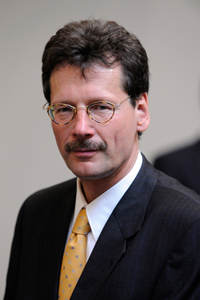
 It is the recipient of a Carlos III University of Madrid-Banco Santander Chair of Excellence for the 2014/15 academic year. The Chairs of Excellence program aims to boost UC3M's research profile worldwide through the incorporation of internationally distinguished professors in all disciplines.
Dr. Steinmetz will also join the IMDEA Networks Institute as a Visiting Professor. The Madrid-based research center is a regular collaborator in the scientific activities of the Telematics Department at UC3M. Dr. Steinmetz has been a key figure for the Madrid institute since its inception: he chairs its Board of Trustees and has been a member of its Scientific Council since 2007. He is also a member of the European Technology Platform Net!Works+ISI, along with IMDEA Networks. This community of more than 500 ICT operators, systems manufacturers, and research groups from the EU and associated countries aims to develop 5G technologies, providing an action plan for the deployment of 5G networks with a 2020 target date.
As a renowned network scientist, Dr. Steinmetz has outlined an ambitious research plan for his six-month stay, focusing on fundamental aspects associated with the anticipated transition to a new technological paradigm for the Internet of the Future. His work will aim to address the major challenge for future communication systems posed by the increasingly dynamic operating conditions, the diversity of use cases, and the growing demands for quality. Indeed, we are witnessing the constant development of mechanisms to meet the need for adaptable communication systems capable of accommodating the current plethora of heterogeneous communication devices, network access techniques, and services. Dr. Steinmetz will collaborate with experts in this field from UC3M and IMDEA Networks to identify viable alternatives to current communication systems. The detailed analyses obtained are expected to provide valuable data for decision-making regarding transition costs, in terms of their technical complexity, the expected improvements in functionality and performance, resource consumption, and the stability of the new systems.
A career at the forefront of multimedia communications research
Professor Steinmetz is recognized for his outstanding publication record, influential research findings, and dedication to the service of science. He has served as Director of the School of Engineering at TUD, Director of the Fraunhofer Institute for Technology and Innovation (IPSI), and is currently Chairman of the Board of Directors of the Hessian Center of Technological Competence in Telemedia (httc), all in Germany. Always at the forefront of innovation, Dr. Steinmetz is a Fellow of the ACM and the IEEE and has been, and continues to be, praised by colleagues and students for his excellence as a teacher and mentor.
Steinmetz is a highly regarded author. In recent years, he has published (as author or co-author) more than 550 academic articles covering topics as diverse as distributed and communication systems, the multimedia environment, peer-to-peer communications, and parallel programming. Among his works, the acclaimed technical manual on multimedia technology, 'Multimedia Technology: Principles, Components and Systems', stands out. For this work, he received the prestigious ACM SIGMM Multimedia Award in 2008 for outstanding technical contributions to computing, communications, and multimedia applications. This award highlighted his pioneering work on multimedia communications and the fundamentals of multimedia synchronization.
The Chair of Excellence recognizes Ralf Steinmetz for his success in promoting research in network science and for his dedication to developing the next generation of multimedia communications. Dr. Steinmetz follows in the footsteps of more than 100 distinguished academics who have benefited from the UC3M program, seven of whom have also joined IMDEA Networks as visiting researchers. These collaborations have greatly contributed to strengthening the Institute's international ties, establishing stable partnerships, exchanging research experiences, and mutually enhancing scientific and technical knowledge and capabilities.