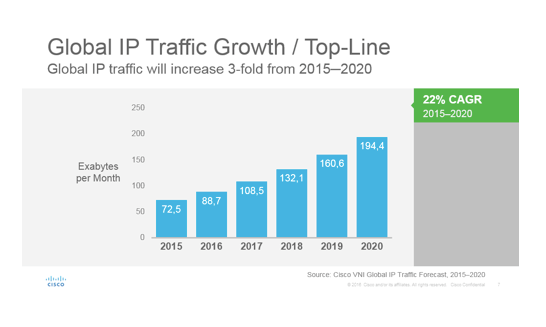
In Spain, IP traffic will double during this period, reaching 25 exabytes annually (2 exabytes monthly) in 2020—the equivalent in gigabytes of all the movies ever produced in the world crossing Spanish IP networks every three hours—up from 11 exabytes annually (917 petabytes monthly) recorded in 2015 (an 18 percent year-over-year growth rate).
This is according to the eleventh edition of the Cisco® Visual Networking Index™ (VNI) Global Forecast and Service Adoption 2015-2020 annual report, which highlights how digital transformation, based on the increasing adoption of personal devices, the deployment of Machine-to-Machine (M2M) connections, and faster broadband speeds, will have an even greater impact on the increase in IP traffic.
 IP Traffic Projections and Drivers
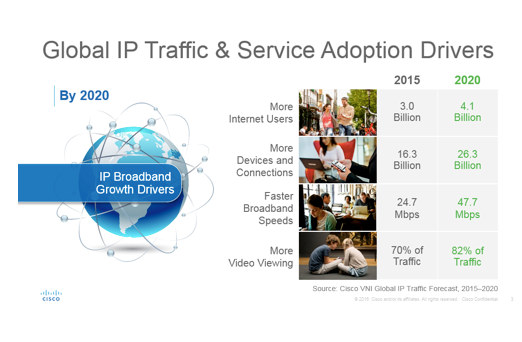
• More Internet Users – In 2020, there will be approximately 4.1 billion internet users (52 percent of the projected world population of 7.8 billion, according to the UN), up from 3 billion in 2015 (40 percent of the world's population). In Spain, there will be 35.3 million internet users in 2020 (76 percent of the population), compared to 32.8 million in 2015 (71 percent of the population).
– More Connected Devices – In 2020, there will be 26.3 billion connected devices (3.4 per person on the planet), compared to 16.3 billion in 2015 (2.2 devices per capita). This includes tablets, smartphones, and ultra-high-definition TVs, as well as M2M connections and wearable devices such as smartwatches and health trackers. In Spain, there will be 340 million connected devices in 2020 (7 connections per inhabitant), up from 186 million in 2015 (4 connections per capita).
- Growth of the Internet of Things and M2M connections. – The evolution of the Internet of Things (IoT) continues to drive the growth of IP traffic. Applications such as video surveillance, smart meters, health monitors, and other next-generation M2M services are contributing to this growth. M2M connections will almost triple, from 4.9 billion in 2015 to 12.2 billion in 2020, representing almost half of all connected devices (46 percent). The connected health segment will experience the fastest growth in M2M connections, increasing fivefold between 2015 (144 million) and 2020 (729 million), while the connected home segment will account for almost half (5.8 billion) of all M2M connections during the period analyzed. In 2020, there will be more than 200 million smart homes globally, up from 90 million in 2015. In Spain, there will be 210 million M2M connections in 2020 (62 percent of all connected devices), compared to 82 million in 2015 (44 percent of the total), representing a year-on-year growth rate of 20.7 percent.
- Traffic generated by smartphones surpasses that of PCs. – In 2020, 71 percent of all IP traffic will originate from devices other than PCs, including smartphones (30 percent), televisions (25 percent), tablets (13 percent), and M2M modules (3 percent), compared to 47 percent in 2015. PCs will account for 29 percent of IP traffic in 2020 (53 percent in 2015). In Spain, 60 percent of all IP traffic will originate from devices other than PCs (smartphones, 23 percent; tablets, 17 percent; televisions, 15 percent; M2M modules, 5 percent), while PCs will account for 40 percent (69 percent in 2015).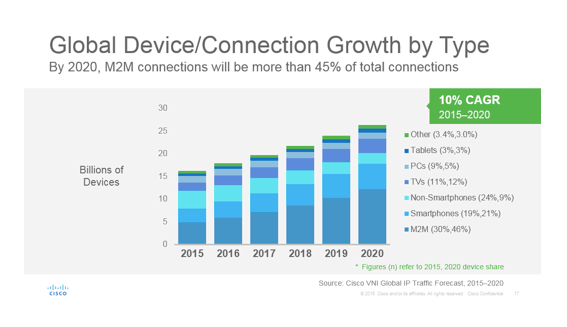 • Increased video traffic. IP video will triple, reaching 82 percent of all IP traffic in 2020, up from 70 percent in 2015 (a 26 percent year-over-year increase), driven by the growing use of internet video as on-demand IP video, video shared via file sharing, video streaming games, and videoconferencing. IP video will account for 84 percent of total consumer traffic in 2020 (75 percent in 2015), and 63 percent of total enterprise traffic (36 percent in 2015). In 2020, video (combining consumer and enterprise traffic) will represent 79 percent of all internet traffic (63 percent in 2015), with ultra HD and HD video accounting for 16 percent and 66 percent of the total, respectively.
In Spain, IP video will account for 78 percent of all IP traffic in 2020 (57 percent in 2015), tripling in the period analyzed (a year-on-year increase of 25 percent). In the consumer segment, IP video will account for 82 percent of total traffic (64 percent in 2015), while in the enterprise segment it will represent 63 percent (35 percent in 2015). By 2020, video (combining consumer and enterprise) will account for 77 percent of all internet traffic (54 percent in 2015), with ultra HD and HD video representing 16 percent and 74 percent of the total, respectively.
• Adoption of advanced services. Online gaming will be the fastest-growing residential internet service, with a compound annual growth rate of 5.3 percent between 2015 and 2020, increasing from 1.1 billion users in 2015 to 1.4 billion in 2020. Location-based services will be the fastest-growing consumer mobile service, increasing from 807 million users in 2015 to over 2.3 billion in 2020. Desktop and personal videoconferencing will be the fastest-growing enterprise internet service, with a compound annual growth rate of 21 percent between 2015 and 2020, increasing from 95 million users in 2015 to 248 million in 2020.
• Faster broadband speeds. Globally, the average fixed broadband speed will almost double between 2015 and 2020, from 24.7 Mbps to 47.7 Mbps. 38 percent of all fixed broadband connections will exceed 25 Mbps in 2020 (up from 30 percent currently), and 35 percent will exceed 50 Mbps (up from 19 percent currently). In Spain, the average fixed broadband speed will almost triple between 2015 and 2020, from 21 Mbps to 54 Mbps. 51 percent of all fixed broadband connections will exceed 25 Mbps in 2020 (up from 29 percent currently), and 38 percent will exceed 50 Mbps (up from 17 percent currently). For projected mobile broadband speeds, see the Cisco VNI Mobile Update Report published in February of this year.
• Increased mobility. – In 2015, WiFi and mobile devices generated 62 percent of all internet traffic (WiFi, 55 percent; mobile, 7 percent; fixed, 38 percent). By 2020, WiFi and mobile devices will generate 78 percent of all internet traffic (WiFi, 59 percent; mobile, 19 percent; fixed, 22 percent). The number of public WiFi hotspots, including home WiFi points, will increase sevenfold globally between 2015 (64 million) and 2020 (432 million), with 423 million of those being in homes (57 million in 2015). In Spain, WiFi and mobile devices generated 68 percent of all internet traffic (WiFi, 63 percent; mobile, 5 percent; fixed, 32 percent).
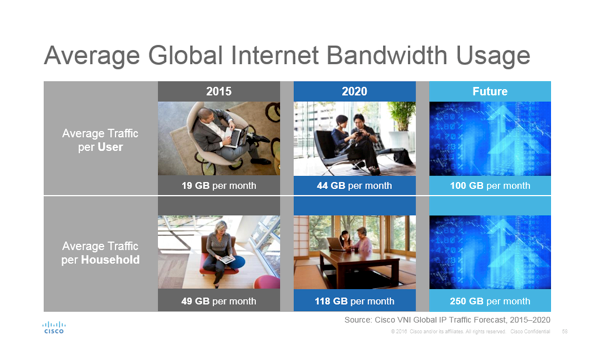 In 2020, WiFi and cellular devices will generate 87 percent of all internet traffic (WiFi, 68 percent; cellular, 13 percent; fixed: 19 percent).
• IPv6, IoT support. – 48.2 percent of fixed and mobile devices/connections will be IPv6 compatible in 2020 (23.3 percent in 2015), and 34 percent of all internet traffic will be IPv6-based (7 percent in 2015). In Spain, 48 percent of all fixed and mobile devices/connections will be IPv6 compatible in 2020 (31 percent in 2015).
• Increase in Distributed Denial of Service (DDoS) attacks. – With the exponential growth of connected devices, cybersecurity concerns are increasing for businesses, service providers, and government agencies. Cisco and Arbor Networks predict that DDoS attacks (with a high capacity to paralyze Internet systems by flooding servers and network devices with traffic from multiple IP sources) will increase from 6.6 million in 2015 to 17 million in 2020 (a 21 percent year-over-year increase).
IP traffic growth by region
- Asia-Pacific: 67.8 Exabytes per month in 2020 (tripling, 22 percent year-over-year increase).
- North America: 59.1 Exabytes per month in 2020 (doubling, 19 percent year-over-year increase).
- Western Europe: 28 Exabytes per month in 2020 (doubling, 20 percent year-over-year increase).
- Central Europe: 17 Exabytes per month in 2020 (tripling, 27 percent year-over-year increase).
- Latin America: 11.6 Exabytes per month in 2020 (doubling, 21 percent year-over-year increase).
- Middle East and Africa: 10.9 Exabytes per month in 2020 (doubling, 41 percent year-over-year increase).
Cisco VNI Report Methodology
The Cisco VNI Report is based on real-world analysis and data on mobile data usage compiled by independent analysts, which Cisco uses to make its own estimates of global IP traffic and service adoption.