1. We are expanding our software portfolio through in-house development, so we will be introducing more software. As Tod Cutler, General Manager of Keysight EEsof EDA (Electronic Design Automation), mentioned, we will soon see the launch of new products related to Electronic Design Automation software.
We recently acquired a company called Anite, which is a specialist in protocol testing and has over 60% of its business in software.
2. These are services. We want to provide a complete solution across the protocol lifecycle (for the client), so we are going to develop the services, and that's why we made this acquisition in August, to support this strategy.
What can you tell us about the acquisition of Anite and 5G?
The first thing we want is an extension for protocol testing. We have a very strong product portfolio for wireless testing, for testing the software of any communication device such as smartphones, etc., but we weren't present in protocol testing (testing the software layer that sits on top of the hardware, or Layer 1). Anite will complement this and will support all existing standards: 2G, 3G, 4G, LTE, and so on.
The second thing Anite will bring is, of course, 5G support. 5G is coming, and we've seen that the standards for 5G aren't yet defined, so the protocol isn't yet defined either. Therefore, as of today, Anite won't help us with 5G because the solution needed for 5G today is much more based on research tools for testing and investigating hardware configurations.
So for 5G, what we have is a simulation tool from the company EEsof (software), and we have what we call the 5G Reference Solution. For example, we have a 5G resonant channel solution, which allows engineers to investigate 5G, to check the quality of a channel and what the configuration should be to make a reliable transmission.
Anite today is basically for testing protocols up to 4G.
 What can you tell us about the shift from traditional hardware to the new modular hardware approach?
In the test and measurement market, benchtop, modular, and portable equipment are all important, and we're going to develop them all. It depends on the customer's application, whether you're in the aerospace/defense industry, the wireless market, or the automotive sector. There are so many combinations; it's not a fixed part at all. As a test and measurement vendor, we don't think, "With just one equipment format, we can address everything." No, we think that if we really want to solve a customer's problem, we can't offer a single equipment format. We try to offer everything the customer wants, and that's why we want to continue developing modular equipment. And a second point, of course, is that we've seen that the modular format is the trend in the market, especially in RF/microwave or high-speed digital products. With modular equipment, you can really integrate high-frequency functions and microwave functions into a PXI because you have new developments in microwave chips. And the same is true for portable devices. Now we can integrate a spectrum analyzer and a 3 GHz network analyzer into a device that weighs just 3 kg—in only 3 kg! When I started my studies, it was a rack! It might have weighed around 26 kg.
So we can integrate these new chips into the PXI cards of modular devices, and it's possible now, but a few years ago this type of integration wasn't available.
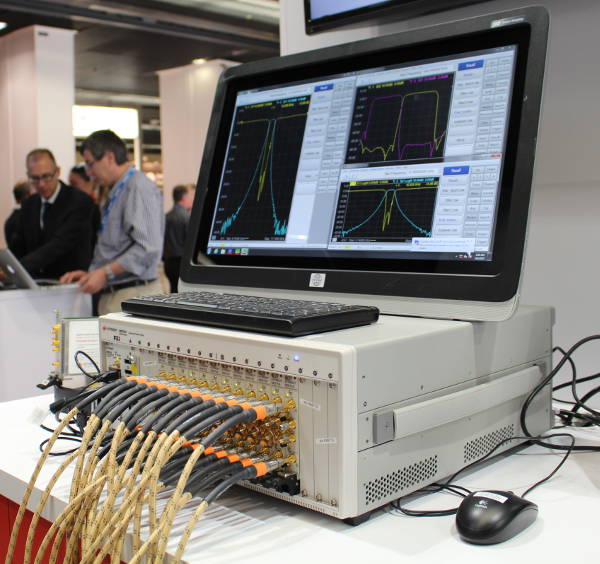
We now see more advantages with PXI, such as flexibility and modularity, in terms of multi-channel applications. For example, we have a VNA with thousands of ports, which isn't possible with a desktop system. You can't stack 20 network analyzers on top of each other to achieve this level of performance, and size is also a factor.
This means that PXI was probably previously limited to data acquisition, switching, and other basic functions, but now it can enter the high-end applications market.