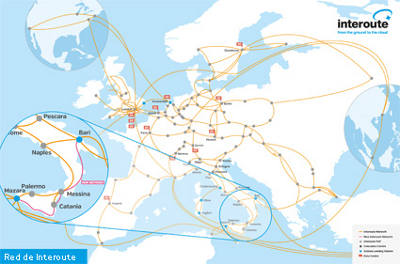
This new route will provide diverse and high-capacity connectivity, from Interoute's base stations in Mazara del Vallo (Sicily) and Bari (Puglia) to submarine cables needing to connect to Europe. In recent years, cables from Greece, Malta, Tunisia, and Israel have landed at Interoute's submarine landing stations in southern Italy.
Driven by the growing demand for internet services and broadband applications, Terabit Consulting identified 160 new submarine cable projects, valued at a total of $22.6 billion, that have been confirmed by operators and project developers. In the same report, Terabit Consulting estimates that 37% of the proposed new submarine fiber optic projects will involve the regions of South Asia, the Middle East, Europe, Africa, and the Mediterranean.
The new route is designed to support 8 Terabits per second of traffic, offering wavelength service of up to 100 Gbits per second. More importantly, thanks to this new route, Interoute can now offer its customers three completely different routes from Mazara del Vallo and Bari to the main cities connected to its pan-European network. This not only reduces vulnerability and the risks associated with a single point of failure but also enables shorter submarine cable routes by providing an alternative landing point for those located further away, such as Marseille.
Diego Matas, General Manager of Interoute Iberia, commented: “With the expansion of its network, Interoute is making southern Italy the most attractive landing point for all submarine cables coming from the Far East, the Middle East, and Africa, aiming to reach Europe. Based on Cisco's estimate that the Middle East and Africa will continue to experience the greatest IP traffic growth through 2018, with growth predictions multiplying fivefold and a compound annual growth rate of 38% (Cisco Visual Networking Index, 2014), the demand for broadband services appears set to continue rising.”.