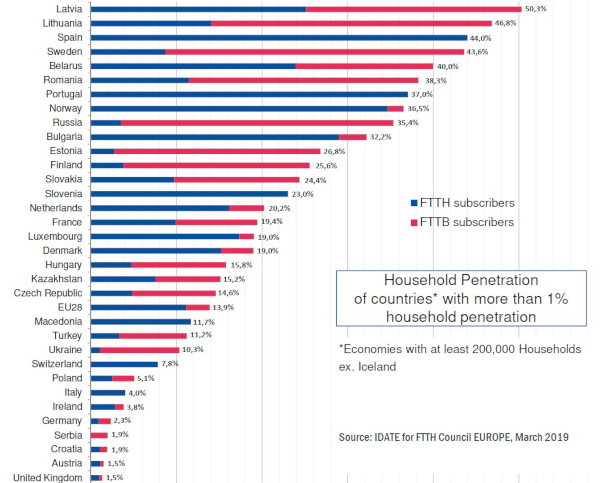
The number of fiber-to-the-home (FTTH) and fiber-to-the-building (FTTB) subscribers in Europe increased by 15.7% in the EU39 [1] since September 2017, with over 59.6 million FTTH/B subscribers in September 2018. Although Russia is the leader in terms of FTTH/B subscribers in the European region, it has shown a lower growth rate compared to other European countries that are recovering rapidly with a growth of 21%.
The deployment of FTTH and FTTB networks has increased significantly. By September 2018, FTTH/B coverage was estimated to have reached 46.4% in the EU39 and 36.4% in the EU28 [3]. This shows a clear upward trend since September 2015, when the estimated coverage rate in the region was 39% in the EU39 and 27.2% in the EU28.
This year [4], the country with the most new subscribers is European. Spain added 1,858,743 new FTTH/B subscribers, followed by France with 1,480,220 new FTTH/B subscriptions, while Russia saw its FTTH/B subscriber base grow by 1,256,000 new customers. Other countries also experienced notable increases, such as the Czech Republic with 523,950 new subscribers and Italy with 449,637. Italy saw outstanding growth in the number of approved homes, from 4,398,435 in September 2017 to 6,295,000 in September 2018, representing a total increase of 43.12%.
The utilization rate increased to 37.4% for the EU39 from 34.8% the previous year, with the recovery rate for the EU28 (38.2%) surpassing the EU39 rate for the first time. Countries such as Andorra, Belarus, Belgium, Latvia, the Netherlands, and Romania are experiencing utilization rates exceeding 50%.
It is interesting to note that fiber technologies have evolved in recent years. As of September 2018, we observed a predominance of FTTH architecture over FTTB (56% vs. 44%).
In the European region, alternative players are the most involved in the expansion of FTTH/B, contributing approximately 55% of all FTTH/B players. We also see that governments and local authorities are becoming more involved in fiber projects, either directly, by signing agreements with telecom operators, or through public funding. It is also worth noting that incumbents in some countries have begun to modify their strategy to deploy FTTH solutions, rather than continuing with the development of legacy copper- or cable-based networks.
Commenting on the report, Ronan Kelly, Chairman of the FTTH Council, said: “These new figures show a momentum that has been accelerating in recent years. Full fiber is the way forward, and the Market Panorama results provide compelling evidence of this. Fiber expansion is booming in many countries, and today more consumers are aware of the benefits of fiber. Our work is not finished, however; there is still a long way to go before all citizens and businesses have access to the benefits of full fiber in Europe.”.
FTTH Classification / B - European Classification
Latvia leads the ranking for FTTH penetration in Europe for the third consecutive year
Latvia remains the leader in FTTH/B, topping the rankings for another year, followed by Lithuania (46.9%). Spain makes a significant leap from 33.9% to 44%, placing it third, slightly ahead of Sweden with 43.6%.
The UK joins the global FTTH rankings
This year, the UK enters the global rankings, achieving a penetration rate of 1.3% and an acceptance rate of 13.1%. FTTH/B subscriptions grew by 83% compared to September 2017, reaching a total of 369,250 subscribers, and FTTH/B households rose to 22.8%, totaling 2,817,000 homes.
The UK regulator, Ofcom, has played a significant role in promoting FTTH/B investment across the country. After reducing wholesale prices for Openreach services to encourage investment and competition in the market, Ofcom established a plan to support full-fiber investment in July 2018. The plan follows the direction set out in Ofcom’s 2016 Digital Communications Strategic Review, which aims to support the Government’s ambition of providing 15 million households with full-fiber broadband access by 2025.
The Netherlands, host country of the FTTH Conference 2019.
In September 2018, the Netherlands had 3,064,000 homes passed by FTTH/B, for a total of 1,577,700 subscribers—a 5% increase in passed homes and a 16% increase in subscribers compared to the previous year. Fiber consumption was approximately 51.5% of all homes passed by FTTH/B technology, placing the Netherlands among the leading countries in Europe.
FTTH market forecasts 2020 and 2025.
These market forecasts are based on an individual analysis of 15 countries [1]. While Russia is expected to continue leading the ranking of approved FTTH/B homes in 2020 and 2025, it is very interesting to note that the UK is likely to reach second place in the ranking.
FTTH market forecasts for 2020 and 2025.
These market forecasts are based on an individual analysis of 15 countries [1]. While Russia is expected to continue leading the domestic ranking of approved FTTH/TB connections in 2020 and 2025, it is very interesting to note that the UK is likely to reach second place in the ranking by 2025, ahead of France and Spain. The plan estimates around 187 million homes approved for FTTH in 2025 in the EU28, bringing fiber closer to the end user, with FTTH accounting for 63.8% compared to 36.2% for FTTB.
Finally, these forecasts highlight the role of public incentives for fiber-based technologies in fostering the growth of FTTH across Europe, which will also be positively impacted by the copper shutdown.
We believe that the recently adopted European Electronic Communications Code will further increase the number of approved homes, if implemented correctly, by providing regulatory certainty and incentives for investors of all types and enabling more players to join the fiber league, added Erzsébet Fitori, Director General of the FTTH Europe Council.
[1] EU 39 includes Andorra, Austria, Belarus, Belgium, Bulgaria, Croatia, Czechia, Denmark, Estonia, Finland, France, Germany, Greece, Hungary, Iceland, Ireland, Israel, Italy, Kazakhstan, Latvia, Lithuania, Luxembourg, Malta, Macedonia, Netherlands, Norway, Poland, Portugal, Romania, Russia, Serbia, Slovakia, Slovenia, Spain, Sweden, Switzerland, Turkey, Ukraine and United Kingdom
[2] Coverage = Homes wired / Homes
[3] EU 28 includes Austria, Belgium, Bulgaria, Croatia, Cyprus, Czechia, Denmark, Estonia, Finland, France, Germany, Greece, Hungary, Ireland, Italy, Latvia, Lithuania, Luxembourg, Malta, Netherlands, Poland, Portugal, Romania, Slovakia, Slovenia, Spain, Sweden, United Kingdom
[4] Between September 2017 and September 2018
[5] Bulgaria, France, Germany, Italy, Kazakhstan, Netherlands, Poland, Portugal, Romania, Russia, Spain, Sweden, Turkey, Ukraine, UK