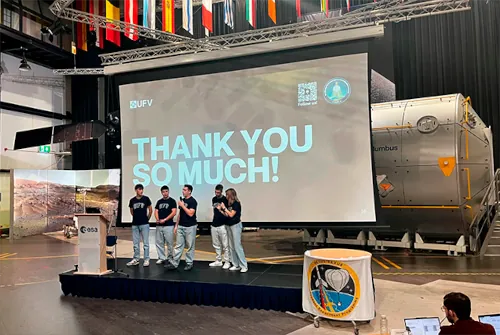
The university's participation in BEXUS also stems from a subject at the Higher Polytechnic School, which reinforces the value of a training model capable of promoting, from the classroom, projects with international projection, a high technical level and a clear orientation towards innovation.
A benchmark program in the European aerospace ecosystem
The REXUS/BEXUS program, a collaboration between the German Space Agency (DLR), the Swedish Space Agency (SNSA) and the European Space Agency (ESA), offers European university students a first-class experimental platform to develop and validate technology under conditions close to those of a space mission.
In the case of BEXUS, the experiments travel aboard a stratospheric balloon capable of ascending to an altitude of 30 kilometers, subjecting the payloads to extreme pressure and temperature conditions. Participating in this initiative means accessing a highly competitive environment, where teams must pass rigorous technical reviews by international experts and demonstrate the scientific, technological, and operational viability of their developments.
BLESS: IoT connectivity in extreme conditions
The project for which UFV has been selected is called BLESS (BEXUS HaLow Evaluation in Stratospheric Systems). Its objective is to perform the first in-flight characterization of the Wi-Fi HaLow protocol (IEEE 802.11ah) in the stratosphere, in order to analyze how this technology behaves during ascent and evaluate the resilience of commercial hardware under extreme environmental conditions.
The experiment aims to fill a significant technological gap. While the Internet of Things demands reliable communication standards that connect terrestrial and non-terrestrial networks, the Wi-Fi HaLow protocol, particularly promising for its long range, has not yet been validated in aerospace environments. BLESS's mission is to provide that knowledge and establish a benchmark for vertical link quality with potential future applications on high-altitude platforms and satellites.
Interdisciplinary talent and applied excellence
The team is made up of students from Francisco de Vitoria University with diverse engineering backgrounds, including Computer Engineering, Mechanical Engineering, Industrial Engineering, and Artificial Intelligence Systems. Their selection as the only Spanish team in this edition reinforces the value of young university talent and UFV's commitment to technological excellence and applied research.
In the words of Mario Martínez, a UFV student and team lead of the BLESS project, “the fact that our proposal has been selected in Europe is a great joy and a great responsibility. For UFV, this achievement demonstrates that academic rigor and confidence in the talent of our students allow us to reach top-level international goals and contribute, from the classroom, to the major technological challenges facing Europe.”.
Next phase: flight campaign in Sweden
Following this selection, the project now faces a schedule of reviews and validation phases that will culminate with the flight campaign planned for October 2026 in Sweden.
Participation in BEXUS thus represents not only recognition of the work done, but also a demonstration of UFV's ability to train professionals prepared to respond, with rigor, innovation and international vision, to the technological challenges of the present and the future.