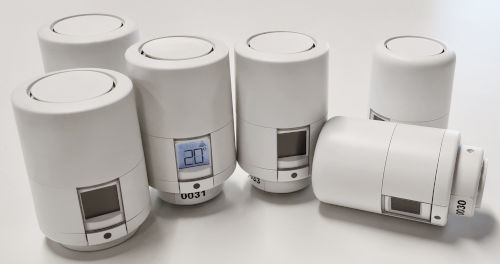
Thomas Steen Halkier, CEO of NeoCortec, comments: "We wanted to test the performance on a leading networked smart valve and demonstrate how easy it is to switch to NeoMesh, even pre-existing models, taking advantage of the scalability and energy savings benefits.".
Radiator valves present an excellent opportunity for implementing smart buildings. By incorporating a sensor and a wireless network link into the eTRV, a room's temperature can be monitored and automatically controlled from a central location. Danfoss' Ally range of eTRV valves uses Zigbee technology to provide networking capabilities. However, one of Zigbee's main limitations is its lack of scalability, making it impractical for multi-family buildings, office spaces, retail environments, or other workspaces. Zigbee also requires mains power for routing.
In contrast, NeoMesh can scale almost infinitely, and the nodes can run on two AA batteries for up to seven years. Installation in a smart building is as simple as placing the nodes and turning them on. The network self-configures and is suitable for reliable bidirectional communication.
The Neocortec team easily removed the existing Zigbee stack from the Ally eTRV transceiver and replaced it with the NeoMesh stack. A test conducted with several modified eTRVs demonstrated how a network with a much greater range and significantly lower power consumption than the original units could be created. Halkier: "This small-scale demonstration shows that it's possible to have hundreds or even thousands of Ally eTRVs on the same network. They can be installed in large buildings without the need for network-powered routers."