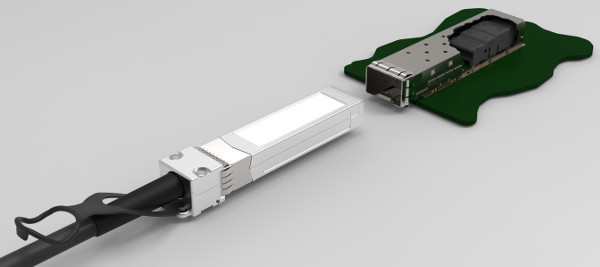
The SFP-DD electrical interface is a further development of the existing SFP pluggable form factor, an interface widely adopted by data centers and other network platforms. The single-channel SFP interface operates at speeds up to 28 Gbps NRZ or 56 Gbps PAM4. The new SFP-DD electrical interface is designed to support two channels, each capable of operating at either 28 Gbps NRZ or 56 Gbps PAM4, resulting in an aggregate bandwidth of 50 Gbps NRZ or 112 Gbps PAM4.
By doubling channel density and data rate, the SFP-DD interface will help meet the demand for greater port density and scalability in next-generation applications, with particular attention to server-side interconnections. An SFP-DD server port, along with QSFP-DD switching ports, enables an overall doubling of port density in network applications.
The hardware specification and schematics for SFP-DD define the characteristics of the main modules, connectors, and housings. SFP-DD modules and direct-attach cables use a common mechanical design. The modules and connectors consist of a self-locking mechanism with the housing at the insertion point. SFP-DD-based network equipment will support legacy SFP cables and modules, as well as new double-density products, to offer designers optimal flexibility.
Key features of SFP-DD
• Single-port SMT connector and housing
• Heat dissipation options for flexible thermal management
• Mechanical definition of modules
• Support for optical and copper interfaces, with physical layer specifications to be determined outside the scope of the SFP-DD MSA multi-source agreement
Key advantages of SFP-DD
• Support for optical modules up to 3.5 W
• Possibility of two high-speed interface channels with host connection
• Backward compatibility with all current SFP interfaces
• Specification developed by an industry consortium to facilitate interoperability with multiple vendors