Larger, more efficient machine learning (ML) models will play a key role in addressing the emerging requirements of AI acceleration workloads. The need to significantly scale future computing fabrics is driving exponential growth in I/O bandwidth and greater connectivity reach to support larger xPU clusters, as well as more resource-efficient architectures such as GPU disaggregation and memory pooling.
Electrical I/O (i.e., copper trace connectivity) supports high bandwidth density and low power consumption, but only very short ranges of 1 meter or less. Pluggable optical transceiver modules used in today's data centers and early AI clusters can increase range, but at cost and power consumption levels that are unsustainable given the scaling requirements of the AI workloads ahead.
A co-packaged xPU (CPU, GPU, IPU) optical I/O solution can support higher bandwidths with high energy efficiency, low latency, and greater range, which is exactly what scaling AI/ML infrastructure requires.
Optical I/O solution based on Intel silicon photonics
Intel has developed a fully integrated 4 Tbps bidirectional OCI chiplet based on Intel's proprietary Silicon Photonics technology to address the massive bandwidth demands of AI infrastructure and enable future scalability. This OCI chiplet contains a single silicon photonics integrated circuit (PIC) with integrated lasers, an electrical integrated circuit with RF TSV, and a pathway for incorporating a detachable/reusable optical connector.
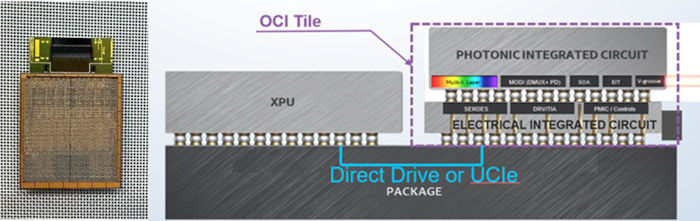
The OCI chip can be combined with next-generation CPU, GPU, IPU, and other bandwidth-intensive system-on-a-chip (SoC) applications. This initial implementation paves the way for multiterabit optical connectivity with >4x greater bandwidth density than PCIe Gen6, <3pJ/bit power efficiency, <10ns (+TOF) latency, and a range exceeding 100 meters.
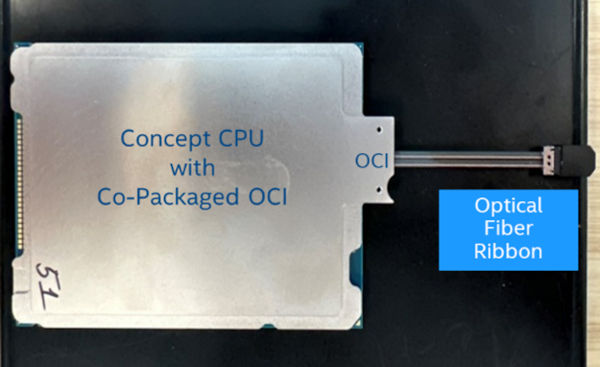
We plan to demonstrate our first-generation OCI chiplet co-packaged with a concept Intel CPU running a fault-free link over fiber (BER <10E-12 with a PRBS31 pattern) at OFC 2024 in San Diego from March 26-28 (Intel booth #1501). This initial OCI implementation is a bidirectional 4 Tbps chiplet compatible with PCIe Gen5, supporting 64 data lanes at 32 Gbps in each direction over tens of meters, implemented as eight fiber pairs each carrying eight DWDM wavelengths. Beyond this initial implementation, the platform has line-of-sight capability for 32 Tbps chiplets.
OCI Transmitter: Optical spectrum of 8 wavelengths in a standard single-mode fiber
The only PIC in the current chip stack can support bidirectional applications up to 8 Tbps and contains a complete optical subsystem, thanks to Intel's unique ability to integrate DWDM laser arrays and optical amplifiers directly onto the PIC. This provides reliability orders of magnitude higher than conventional InP lasers. These integrated silicon photonics chips are manufactured at one of our high-volume US facilities, which has already shipped more than 8 million PICs with over 32 million on-chip lasers in pluggable optical transceivers for data center networks, delivering industry-leading reliability. In addition to the proven performance and reliability advantages, on-chip laser technology enables wafer-scale manufacturing, run-through, and testing, resulting in greater subsystem-level simplicity and reliability (e.g., no fibers connecting the ELS and PIC) and manufacturing efficiency.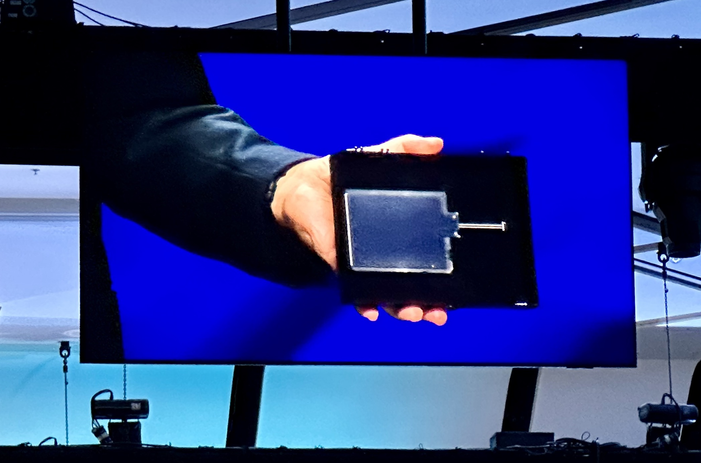
Another differentiating advantage is that OCI uses standard, widely available single-mode fiber (SMF-28), eliminating the need for polarization maintenance fiber (PMF), unlike other technical approaches on the market. PMF has rarely been used because system vibration and fiber movement can negatively impact performance and the associated link budget.
Several Intel groups are contributing to the development and implementation of OCI as a key optical I/O technology. This highlights how Intel can deliver a complete next-generation computing solution with our leading capabilities in silicon, optics, packaging, and platform integration.
Intel's proven silicon photonics platform and technology can deliver the most reliable and highest-performing optical connectivity solutions to enable ubiquitous AI.