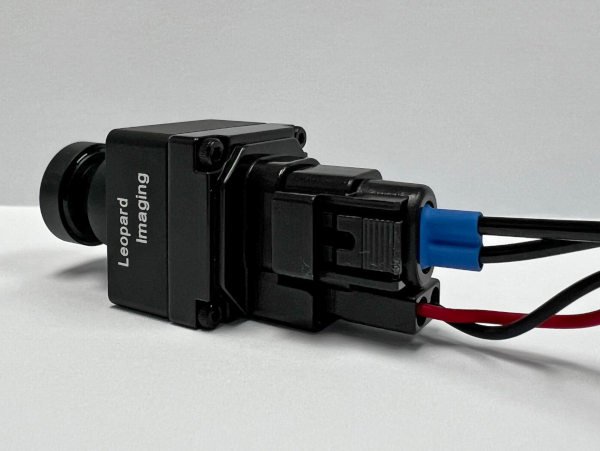
By upgrading the existing wide-angle camera system from a traditional GMSL2 copper interface to a 10GBASE-AU fiber optic-based link compliant with IEEE 802.3cz, the new system provides scalable data communications of up to 10 Gb/s.
David Sánchez, hardware designer at KD and project manager for the technology collaboration, also highlighted the camera's unique features:
“We have successfully integrated our KD7251 optical transceiver into Leopard Imaging’s LI-VENUS-ISX031-BASE-AU camera. This advancement demonstrates the KD7251’s ability to operate in compact automotive camera modules (PCBs smaller than 20 x 20 mm) while extending link distances to up to 40 meters. By leveraging glass optical fiber, we eliminate electromagnetic compatibility (EMC) issues, reduce cable weight, and support asymmetric link speeds to optimize power consumption. This innovation is key to the next generation of in-vehicle networks, where high bandwidth, low latency, and interference-free data links are critical.”
With the new optical link, the Leopard Imaging LI-VENUS-ISX031-BASE-AU camera supports higher data transmission, greater resolution, and increased image depth. By replacing the copper interface with the KD7251 optical transceiver, in-vehicle connectivity has significantly increased from 3 Gb/s to 10 Gb/s.
The camera weighs only 162 grams. It is equipped with Sony's ISX031 Diagonal 7.45 mm (1/2.42 Type) CMOS image sensor and can be used in a surround-view system. The integration of Corning's cable and connector system improves access to complex positions, such as inside a side mirror. Furthermore, the new solution allows cable lengths of up to 40 meters without any loss of data transmission quality.