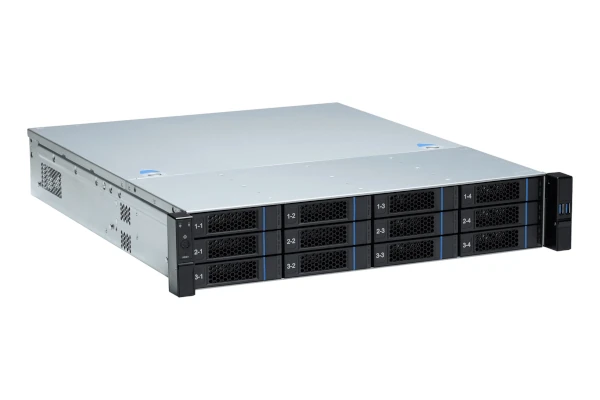
The architecture is designed to separate the storage of large volumes of video from applications that require lower latency, such as VMS systems, databases, playback, and AI processing.
Up to 312 TB of storage:
The NViS 6712 features 12 3.5-inch HDD bays providing up to 312 TB of JBOD raw capacity, primarily intended for recording multiple video streams and for long-term storage.
Two M.2 PCIe NVMe slots allow for the installation of SSDs to run VMS applications, databases, metadata, AI caching, and other workloads that require fast storage access. The system also includes an interface for an M.2 SATA SSD.
This separation allows for distributing continuous recording operations and I/O-intensive applications across different storage devices.
For installations requiring data protection, a hardware RAID controller can be added via PCIe.
Intel Core 2 Series Processors:
The platform supports Intel Core 2 Series processors with an architecture based solely on P-cores, with configurations of up to 12 Performance Cores, 24 processing threads, and a maximum Turbo frequency of up to 5.9 GHz.
These resources can be used simultaneously for recording, VMS, playback, databases, video processing, and analytics applications.
AI Acceleration via PCIe Gen5:
The NViS 6712 features a PCIe Gen5 x16 slot for installing graphics cards or AI accelerators, depending on system requirements.
It supports dual-slot cards up to 260 mm in length and a maximum power consumption of 250 W, including select Intel and NVIDIA graphics options.
It also has an M.2 interface compatible with the Hailo-8 accelerator, enabling local AI inference. These options, along with Intel OpenVINO and Intel Quick Sync Video, can be used for object recognition, event detection, image analysis, and intelligent video search.
For configurations requiring both a RAID controller and a graphics card, an optional riser with two PCIe x8 interfaces is available for installing both components.
Industrial and Smart Factory Applications
: In addition to video surveillance applications, the platform can be used in industrial monitoring and smart factory systems, where cameras provide information for monitoring production lines, worker safety, anomaly detection, and other visual analysis tasks.
Local storage allows for the preservation of large amounts of video for historical analysis. Visual data obtained at the edge can also be combined with information from machines and sensors for industrial analytics applications and digital twin environments.
In Physical AI applications, the NViS 6712 can function as a local node for collecting and preprocessing visual data. HDDs store recordings, while NVMe drives can be used for active workloads. Optional accelerators enable tasks such as recognition, labeling, and preprocessing before transferring certain data to external AI training or analysis systems.
Local processing and cloud connectivity:
The NViS 6712 can also be used as a local recording and analysis node within cloud-connected architectures.
In this configuration, video streams can be stored and processed locally, while only specific videos, events, metadata, or alerts are transmitted to centralized systems or cloud services. This avoids the need to continuously transfer all raw video over the network.