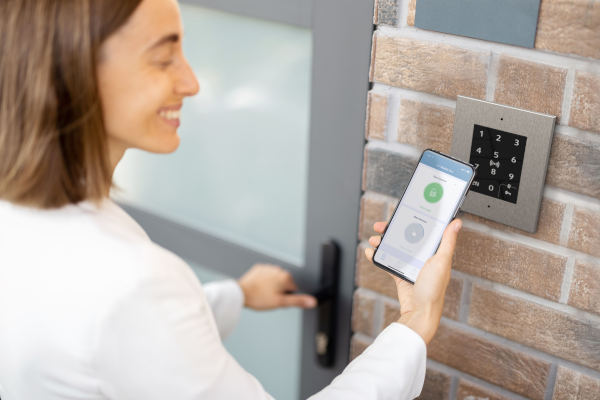
For example, to access an office building, some employees prefer quick access via their mobile phone, while others may feel more comfortable with an RFID card. Similarly, PIN codes may be the best option for occasional visitors, such as professionals from various services. The unit can also allow two-factor authentication, such as mobile phone credentials followed by a PIN code, which is recommended for buildings requiring enhanced security.
Residential buildings also require the same flexibility: younger people often prefer mobile access, but with a PIN code as a backup in case, for example, their phone battery dies. Older residents, on the other hand, sometimes prefer an RFID card or a PIN as their primary method of accessing their building.
While offering flexibility, the 2N® Access Unit 2.0 avoids wasting space and money by combining multiple devices and modules. This makes installation very simple and also streamlines the management of access control devices in the facility.
2N® Access Unit 2.0 is compatible with another recently launched product from the company, 2N® PICard, which allows administrators to create a unique set of cryptographic keys for each location and then use it to encode new Protected Identity Credentials that are placed on RFID cards. 2N® PICard Commander is based on Mifare DESFire technology, which combines a high level of security with an exceptionally simple workflow.
Julio Castillo, Business Development Director for 2N in Iberia, states: “2N® Access Unit 2.0 is 2N’s direct response to the increased demand from customers for flexibility in access control options. One of the central pillars of the current era in access control – what 2N calls the 'Access Control 3.0' era – is multi-user technology because projects have different needs and no two users are alike. Therefore, maximizing usability means maximizing flexibility.”