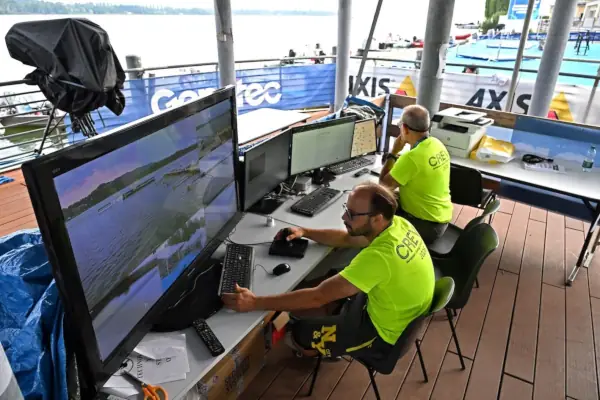
The event brought together 434 professional athletes from 31 European countries and featured a centralized video surveillance system that allowed for monitoring of the different areas of the venue. The system integrated video feeds from Axis Communications cameras installed along the regatta course and on the finish line tower.
Centralized Video Surveillance and Spectator Management:
The Genetec Security Center platform provided operators with a single control panel from which to monitor cameras and coordinate various security activities. This integration enabled the management of spectator flow, real-time surveillance, and streamlined coordination of operations during competitions. The decision to fully migrate to Genetec Security Center stemmed from the need for a centralized solution with customized control panels. The system also incorporated mobile app notifications for operators deployed throughout the venue and features for quickly searching recordings for forensic analysis.
These capabilities made it possible to improve the supervision of the facilities and provide information to the staff responsible for responding to possible emergencies.
Security Service Red designed and implemented the infrastructure.
The technological infrastructure was designed, installed, and managed by Security Service Red, a company specializing in systems integration for large sporting events and a Genetec partner. The company was responsible for the operation of the solutions deployed in the finish line tower, which served as the competition's operations center. The installation integrated video management, real-time surveillance, and analytics systems within a single platform.
Maurizio Fratini, head of security at Security Service Red and technical director of fiber optics and audiovisual transmission for the Organizing Committee since 2012, highlights that the centralization of the images made it possible to have immediate information and send real-time alerts to the operators' mobile devices.
According to Fratini, the solution also provided support to rescue teams and divers involved in aquatic interventions.
One of the infrastructure elements was the communications network installed in Lake Varese, used to connect the various technological systems of the championship. According to Pierpaolo Frattini, CEO of the Organizing Committee, the installation included kilometers of fiber optic cable laid on the lakebed. This network allowed the timing systems, live broadcasts, and video surveillance to be connected via a single high-speed digital ring. The infrastructure provided the necessary connectivity to coordinate technological and security services during the event. Frattini points out that having an advanced network and a centralized platform was essential for organizing a competition of this scale.
Video Recordings for Potential Artificial Intelligence Applications:
In addition to surveillance and security functions, the system allowed for the collection of high-precision video recordings during the regattas. According to Security Service Red, these images could be used in the future as training data for artificial intelligence algorithms intended for river and maritime security applications. This is a potential future use of the recordings, not an artificial intelligence function that the press release indicates was already implemented during the championship.
Dario Schiraldi, channel account executive at Genetec Italy, highlights that the deployment allowed them to demonstrate the platform's capabilities in a dynamic sports environment with different monitoring needs.
Preparation for the 2027 World Rowing Masters Regatta:
The experience gained during the 2026 European Rowing Championships will serve as a benchmark for organizing future events in Varese. These include the 2027 World Rowing Masters Regatta, for which a larger influx of crews, staff, and spectators is expected. The Organizing Committee plans to leverage and expand upon the experience acquired with the safety and communications infrastructure.
The project is also presented as a benchmark for the technological modernization of other rowing facilities in Italy, through centralized video surveillance systems and communication networks capable of adapting to the needs of major sporting competitions.