The system evaluates data on human movement, including body vibrations such as breathing and muscle activity, using Fujitsu's proprietary artificial intelligence. This enables the automatic detection of anomalies, including subtle changes in breathing and irregularities in body vibrations, which are difficult to detect with existing technologies that rely solely on motion detection. The system can operate automatically, allowing for 24/7 monitoring and management, including nighttime and early morning hours when staffing is limited. Because it does not record video or collect personal data of any kind, privacy is maintained. Since Fujitsu's technology uses millimeter-wave radar for detection, it can be used effectively in low-light environments.
The system is equipped with a feature that issues alerts under specific conditions, such as when a person falls and does not get up for a certain period, when a person remains in a specific location for an extended time, or when sleep abnormalities occur, such as breathing difficulties. Notifications can be sent to individually designated recipients, ensuring that the appropriate people receive the information quickly, preventing delays in the initial response, and maximizing user safety.
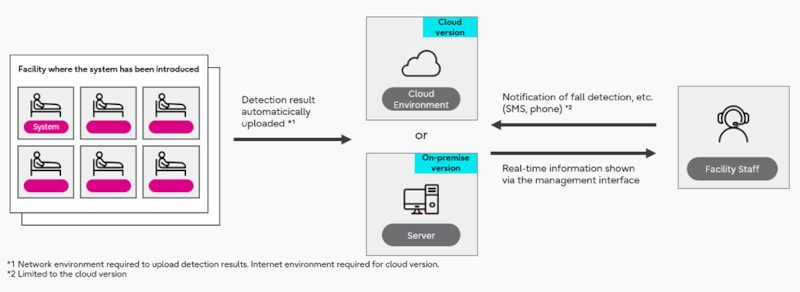
Figure: Summary of system usage
Prior to the launch of this system, Fujitsu has been verifying the effectiveness of millimeter wave radar monitoring technology in accessible toilets with AEON MALL Co., Ltd. and in experiments related to the detection of falls of hospitalized patients with Wakayama Medical University.
Grades
[1] Millimeter wave monitoring system: This system is not a medical device as defined by the Pharmaceuticals and Medical Devices Act.