3 key features of KNX Secure:
• Data integrity
Preventing attackers from gaining control by injecting manipulated code. In KNX, this is ensured by adding an authentication code to each message: this embedded code verifies that the message has not been modified and that it does indeed originate from a trusted source.
• Current code
Attackers can record frames without manipulating the content, to play them back later. In KNX Data Secure, code is guaranteed to be current using a sequence number, and in KNX IP Secure, using a sequence identifier.
• Confidentiality
Encrypting network traffic ensures that an attacker has as little information as possible about the data actually transmitted. By enabling encryption of KNX network traffic, KNX devices guarantee at least encryption according to the AES-128 CCM algorithms along with asymmetric keys.
KNX Secure includes KNX IP Secure (IP media) and KNX Data Secure (TP/RF media). KNX IP Secure is used for KNX installations (typically their backbone) exposed to an external IP network, such as the internet. KNX Data Secure is used for KNX installations not exposed to an external IP network. This article focuses on KNX Data Secure. Each KNX Data Secure product ships with a unique FDSK (Factory Device Configuration Key), as shown in Figure 1. After the device key is added to an ETS project, it is automatically set. This means the user cannot manually define or modify the key, and it is never visible. From that point on, the device only accepts the key for subsequent configuration with ETS. The FDSK is no longer used during subsequent communication unless the device is factory reset, after which all data on the device will be erased.
KNX Data Secure can only be used with devices that support and have enabled Data Secure. However, when secure communication is not required, KNX Data Secure devices can also be used with other KNX devices that do not support this standard. There are two ways for a device with secure transmission to work with a device that does not.
The first is to disable secure transmission on the KNX-Secure device (Figure 2). In this case, the device with KNX-Secure disabled will behave as a device without KNX-Secure.
The second way is to individually configure the group addresses as "Off" or "Automatic" (Figure 3). Then, it can be linked to group objects of devices with security enabled or disabled. All functional objects in a KNX Data Secure device can be configured with different security levels according to different requirements. For example, a touch panel control object can be configured for secure transmission, while an actuator object can be configured for insecure transmission.
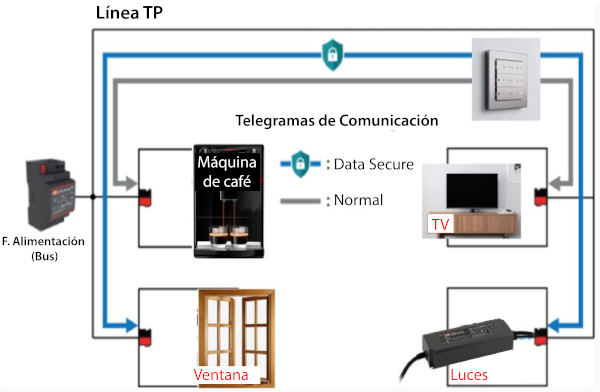 Configuring the KNX Data Secure buttons to switch to unsecured (Plain) mode while paired with an unsecured KNX device, and leaving the remaining buttons in Data Secure mode for communication with secure devices. If an application involves personal or property security (such as controlling doors or windows), Data Secure communication is recommended. If an application is not related to personal or property security (such as controlling a TV or coffee machine), users can choose whether or not secure communication is necessary. Note that once the object is configured in unsecured mode, communication from that point onward will no longer be protected by Data Secure.
MEAN WELL will announce more new KNX Data Secure products and update existing products with Data Secure. OLFER will distribute these devices in Spain and Portugal.