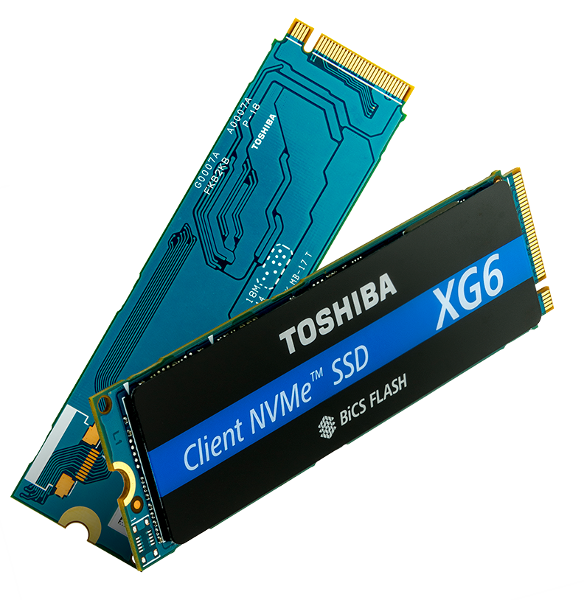
As the inventor of flash memory and the first to introduce the concept of 3D flash memory, Toshiba is focused on continuously pushing the boundaries of what is possible and advancing the technology. Its 3-bit-per-cell BiCS FLASH technology (triple-level cell, TLC) improves the performance, density, and efficiency of SSDs. Its innovative 96-layer stacking process, combined with advanced manufacturing and circuitry technology, achieves an approximately 40 percent increase in capacity per unit of chip size over 64-layer 3D flash memory.
"The introduction of the XG6 series paves the way for Toshiba customers, data centers, and enterprise SSDs to migrate to 96-layer technology," says Paul Rowan, Vice President of the SSD Business Unit at Toshiba Memory Europe, regarding Toshiba Memory's revolutionary capabilities in the continuous improvements to its BiCS FLASH technology.
It continues: "Ideal for client use cases, embedded systems, and data centers, the new XG6 NVMe SSD series are versatile drives with capacity options up to 1TB and an optimized controller design for increased performance and energy efficiency. Toshiba Memory is at the forefront of 3D flash memory development with 96-layer BiCS FLASH."
The new XG6 series is available in a single-sided M.2 2280 form factor and supports PCI Express® Generation 3x4 channel and NVM Express™ revision 1.3a. A hallmark of the XG6 series is its powerful combination of efficiency and performance, consuming 4.7W or less of power and achieving up to 3,180MB/s sequential read and nearly 3,000MB/s sequential write speeds, and up to 355,000 random reads and 365,000 random write IOPS. Achieved through SoC optimization, the XG6 series delivers industry-leading sequential write performance.
Additional features include:
• Security: pyrite or self-encrypting drive models compatible with TCG Opal Version 2.01, as well as block SID and digital signature support.
• Compatibility with the user-selected over-provisioning function via the NVMe command
• First-class sequential performance (customer class)
• Improved SLC buffer to enhance disk performance for client workloads.
"The industry continues its transition to higher densities of 3D flash technology, with petabytes of 3D NAND growing at a CAGR of 75 percent through 2022," commented Greg Wong, founder and principal analyst at Forward Insights. "The introduction of 96 layers is a significant milestone for flash memory in meeting the growing demand for faster and denser storage."
Well suited to a wide range of read-intensive applications that prioritize energy efficiency, burst performance, and a compact size, the XG6 series will be available in capacities of 256, 512, and 1,024 gigabytes.
More information or a quote