But is it really easy to develop a new LoRa solution or migrate to one?
Understanding a new wireless technology and choosing the right solution for your application can be challenging. Wireless radio frequency (RF) design typically requires in-depth RF expertise and adds significant development time for designers.
This article will introduce the four main elements of LoRa network architecture and analyze in detail some of the most common challenges designers face when developing LoRa end nodes. We will also see how standards-compliant LoRa modules can help overcome these challenges and reduce time to market.
LoRaWAN Network Architecture:
LoRa is a wireless modulation or physical layer technique that enables low-power end devices to communicate over long distances. LoRaWAN is a wireless network protocol that acts as a Media Access Control (MAC) layer and is implemented on top of the LoRa physical layer. The LoRaWAN specification details the communication protocol and network architecture and aims to provide secure end-device communication and interoperability within the network.
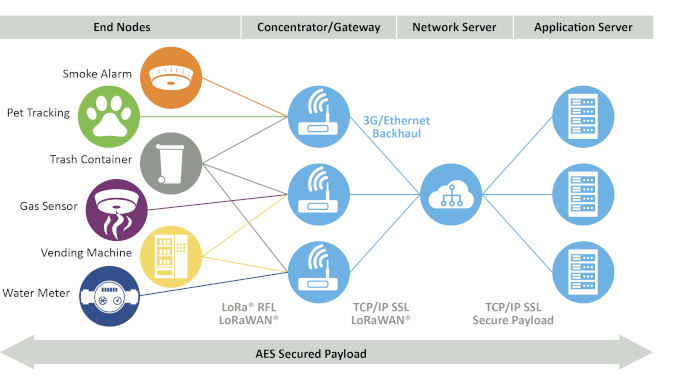
The LoRa network has four elements, as shown in Figure 1.
1. End nodes are elements of the LoRa ecosystem that collect sensor data and transmit/receive data. They are typically remotely connected and battery-powered.
2. The gateway is a transparent bridge between the end nodes and the network server. End nodes typically use LoRaWAN to connect to the gateway, while the gateway uses high-bandwidth networks such as Wi-Fi, Ethernet, or cellular to connect to the networks.
3. A network server connects to multiple gateways. It collects data from the gateways and filters duplicate messages, decides which gateway should respond to messages from the end nodes, and adjusts data rates to extend the battery life of the end nodes.
4. The application server collects data from the end nodes and controls the actions of the devices on the end nodes.
Let's look in more detail at what LoRa end nodes are and the challenges their design presents.
Common Challenges in LoRa End Node Design:
End nodes are simple objects, such as sensors and actuators. They are typically the "things" of the Internet of Things (IoT). In the LoRaWAN ecosystem, an end node communicates with the network server through one or more gateways.
Most often, LoRa end nodes are low-cost, battery-powered applications that need to be very cost- and energy-efficient. Depending on development time, target costs, power consumption, and available RF expertise, there are several options available for building LoRa end nodes. Before analyzing the available options for building LoRa end nodes, let's look at some of the most common challenges designers face when designing end nodes, which can help us choose the right product.
The most common challenges when designing this end-node architecture are:
1. RF Design.
As with any wireless design, extensive RF design expertise is needed to design LoRa end-nodes. When using LoRa SoCs/SiPs, the end-node device developer is responsible for the entire RF design, including schematics, bill of materials, PCB layout, antenna tuning, and other RF hardware. Even with the best documentation and application design guides, RF design is not always easy. It not only requires in-depth RF knowledge but also involves considerable development time for designers. Debugging RF designs often requires specialized equipment, which increases development costs. To overcome the challenges of RF design, some vendors offer SoCs/SiPs with excellent documentation, standards-certified reference designs, and detailed chip design packages. However, to achieve the shortest development time and reduce risk, an optimized, tested, and RF-certified LoRa module is almost always the best option. These modules can provide a complete solution as a single component, reducing design risk and development time.
2. Regulatory Compliance and Certifications:
LoRa/sub-GHz radios typically operate in the unlicensed ISM band, and frequencies vary by region, posing a challenge for hardware and software designers. Great care must be taken to design a solution that complies with regulations while keeping bill of materials costs to a minimum. Furthermore, radio frequency regulatory requirements are constantly changing, so keeping up with regulatory changes, retesting devices, and recertifying them for compliance can cost end-node developers several thousand dollars and engineering time that could be dedicated to new projects. Using a certified LoRa module easily solves this problem, as the module manufacturer is responsible for staying current with regulatory requirements and recertifying modules to the latest specifications. All these costs and the time spent on regulatory compliance can be completely avoided by choosing a LoRa module certified to the standards.
3. Multi-Region Operation:
LoRa devices support multiple frequencies depending on the region. Often, end-node manufacturers first launch their products in a major region. Once demand increases, companies explore expanding the same design to other regions. Having a single part number that supports multiple regions allows for seamless migration and expansion of the final product to different countries and regions. A regulatory-certified LoRa module that operates across multiple frequency bands is ideal for this type of product expansion.
 4. Robust Software
: Generally, LoRa modules integrate the entire LoRaWAN stack within the module, and the end-node developer only needs to implement initialization and communication with the module. With LoRa SoCs/SiPs and standalone LoRa modules, the stack must be provided by the manufacturer, or the developer must develop their own stack if one is not provided. To minimize software development, it is recommended to choose LoRa modules/ICs that are compatible with the manufacturer's LoRaWAN stack. Manufacturers' proven LoRaWAN stacks ensure interoperability of end-nodes with major LoRaWAN networks and gateways, allowing end-nodes to operate on different networks with reduced risk.
5. Migration Path from Modules to SoCs
Many companies begin their prototypes and initial production runs with certified modules to reduce risk and get their products to market faster. Once their product starts to scale, companies may decide to move to LoRa SoCs/CIs to increase flexibility or reduce bill of materials costs. Migration isn't always easy, so it's very important to consider standalone modules that allow for simple software migration between modules and CIs. Furthermore, it's essential to choose vendors that sell both modules and SoCs, so that the development platform, software migration, and support structure remain consistent.
Regulatoryly certified LoRa modules help overcome challenges and simplify LoRa end node designs. 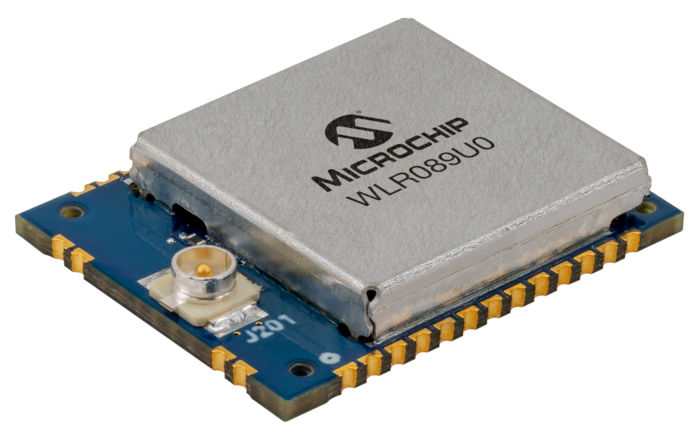 LoRa modules consist of all the necessary radio components along with the LoRaWAN stack and RF circuitry, making them ideal for faster development of LoRaWAN end devices. Since RF development and certification are handled by the module manufacturer, any changes to certification specifications or component replacements are managed entirely by the manufacturer, saving end-user device manufacturers significant development time and recertification costs.
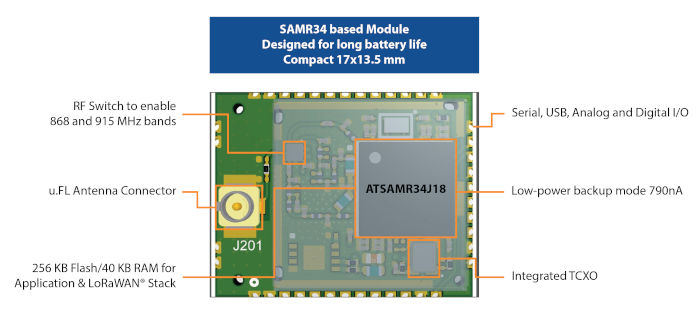
Standalone LoRa modules with highly integrated LoRa ICs provide sufficient memory to run application code along with the LoRaWAN stack. This eliminates the need for an external microcontroller, saving board space and system costs. Figures 2 and 3 show a simple example of such a standalone module. The WLR089U0 module, based on Microchip Technology's SAM R34/35 IC family, is a compact module with 256 KB of flash memory and 40 KB of RAM, making it ideal for space-constrained applications. Furthermore, the module includes an integrated RF switch, enabling multi-band operation and allowing the same module to be used in multiple geographic regions, facilitating market expansion for end-user products. The WLR089U0 is also compatible with Microchip's proven LoRaWAN stack and proprietary peer-to-peer software, simplifying software development for end users building LoRa applications. Because the modules are based on the SAM R34/35 ICs, the migration path is also much simpler, both from modules to ICs and vice versa. Choosing a module like this helps overcome the usual design challenges of developing LoRa end nodes, streamlining the entire design process.
Conclusion
Developing LoRa end nodes can be complex and time-consuming. Highly integrated and certified LoRa modules offer a proven, easy approach to overcoming the complex challenges of designing these end nodes. Reliable software, larger memory, integrated RF switches, and regulatory certifications are some of the key features to look for in LoRa modules. Choosing a highly certified LoRa module not only helps simplify the design process but also enables end node developers to successfully differentiate their products and bring them to market faster.