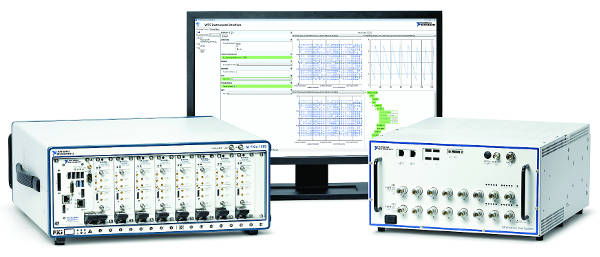
In addition, version 1.3 of WTS improves parallel testing of Bluetooth 5 and low-power Internet of Things (IoT) standards such as ZigBee and Z-Wave.
The new 802.11ax standard project includes significant changes to the physical layer (PHY) to deliver above-average data throughput for users in busy environments. These changes introduce more complexity to characterization, design validation, and production testing efforts, but engineers can leverage the WTS to automate their 802.11ax measurement solutions for accurate and comprehensive test coverage of their new designs. The WTS instrument software and NI vector signal transceivers (VSTs) power large multi-input multi-output (MIMO) configurations up to precise vector magnitude error measurement (EVM) and simultaneous 8x8 dual-band testing. The new software also addresses the challenging task of creating a variety of trigger-based multi-user scenarios where each simulated user has unique waveform alterations and configurations. To shorten development time in the face of these new testing challenges, the WTS provides built-in support for DUT control tools from leading chipset vendors.
In addition, WTS version 1.3 also includes updates to the TestStand Wireless Test Module (WTM). An extension of NI's TestStand software, the industry-leading test executive for parallel testing, the TestStand WTM simplifies the creation of complex wireless test sequences for the lab and factory. The WTM helps engineers achieve fast test times and high throughput by automatically scheduling the execution of multi-site test plans for wireless connectivity devices.
The WTS presents an efficient and robust platform for multi-site testing of the latest low-power 802.11ax and Bluetooth Low Energy IoT devices. This technique systematically scales with the evolving RF requirements of wireless standards to reduce testing costs, increase throughput, and prepare test engineers for the challenges of tomorrow.
Anritsu expands SmartStudio NR with support for 5G RedCap and improves IoT device performance testing
ANRITSU CORPORATION has announced the enhancement of its SmartStudio NR (SSNR) and SmartStudio NR IP Performance (SSIP) software solutions, which now include support for testing 5G RedCap (reduced capacity) devices to assess their performance.