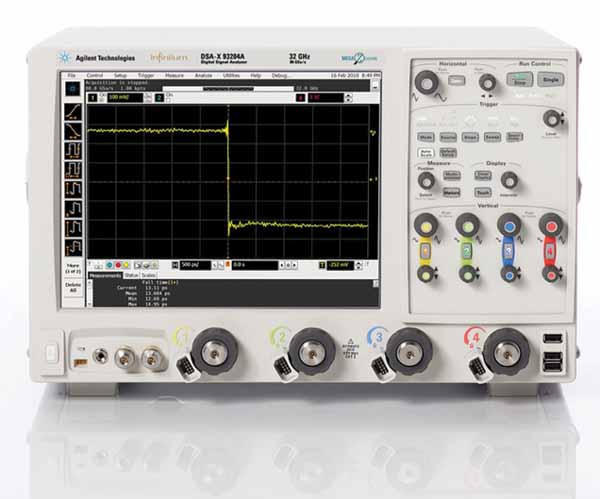
Engineers working in high-energy physics, new wired communication standards, and high-speed serial data links (such as USB, SAS, or PCI Express) use oscilloscopes to capture fast, single-shot events and perform critical measurements, such as jitter, while also ensuring compliance with interoperability standards. Data transmission speeds will increase above 10 Gbps in the coming years, so engineers will need oscilloscopes capable of providing higher bandwidth measurements.
Agilent has invested in a patented indium phosphide (InP)-based integrated circuit process that delivers high-frequency capability while achieving the lowest noise (20 mV to 50 mV/div, 32 GHz) and jitter (150 fs) levels on the market. Its proprietary aluminum nitride construction combines five InP chips into a multi-chip module, incorporating unique noise suppression and heat dissipation techniques.
This revolutionary technology gives the new Infiniium 90000 X Series oscilloscopes true analog hardware performance up to 32 GHz. Other manufacturers, limited to 16 GHz hardware formats, use various techniques (such as digital signal processing boosting and frequency domain interlacing) to increase the bandwidth specification of their oscilloscopes. However, these methods increase noise density and distortion, at the expense of measurement accuracy.
The new Infiniium 90000 X Series oscilloscopes measure random jitter at approximately 50% of that specified by competing products. They feature 2 Gpts of memory.