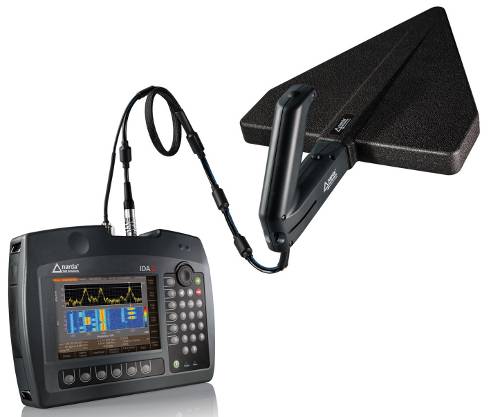
 The IDA 2 enables the on-site detection and analysis of all types of radio interference and problems.
RF interference, whether accidental or deliberate, unauthorized transmitters, and interference between authorized radio signals are difficult to detect when they occur sporadically or are masked by conventional signals. Narda Safety Test Solutions has added I/Q analysis functions to the IDA 2 to detect and locate such signals. The instrument records I/Q data in real time, with a maximum bandwidth of 32 MHz, and stores up to 250,000 uncompressed I/Q data pairs, meaning no information loss. Using this data, the IDA 2 creates high-resolution spectrograms, persistence spectra, and time-domain graphs. Calculations are performed continuously during measurements or after the measurement is complete, using the
stored data. Since the data remains unaltered in the device's memory, it is possible to vary parameters such as frequency or temporal resolution, and zoom in to the maximum resolution offered by the I/Q data.
The combination of high-resolution spectrograms, afterglow spectra, and time-domain graphs facilitates the detection, identification, and localization of signals that are not normally distinguishable in conventional spectra. Technicians can pinpoint the source and cause of interference at the measurement site. The data transfer function to a PC is useful both for documenting measurements and for subsequent analysis.
I/Q Data in the IDA 2: Technical Fundamentals
The IDA 2 combines analog and digital signal analysis methods: A conventional heterodyne receiver is used for preselection, followed by a digital analyzer for fine-tuning and further processing. The received signal is converted to baseband (zero span) after preselection, frequency conversion, and A/D conversion, separating it into its real (in-phase) and imaginary (quadrature) components. The resulting I/Q data is available for further analysis, for example, using FFT. The original data is preserved, allowing for testing by changing the frequency resolution, period, or time resolution
without data loss.
IDA 2: Main Features
The IDA 2 Interference and Direction Analyzer is ideal for identifying and locating radio emissions in both the telecommunications and security sectors. In telecommunications, it is necessary to locate and eliminate external interference. In security, the IDA 2 can be used to locate unknown emission sources and identify potential risks. Through a horizontal scan, the IDA 2 automatically determines the direction of the emitter and displays it on a polar diagram. By performing several scans, it can automatically calculate and display the exact position of the
interfering source. One of the device's options allows the results to be overlaid on digital maps, accurately indicating the location of the emission source, for example, in urban environments, similar to navigation systems.
The position of the interfering source is determined using the integrated GPS receiver and the electronic compass installed on the antenna mount, which defines the direction, elevation, and polarization. Several antenna models are available, which have been optimized to achieve excellent directivity in different frequency ranges, to characterize the signals by polarity. The antennas can be inserted very easily either horizontally or vertically into the ergonomically designed support.
The IDA 2 is a portable device, specially designed for convenient, agile, and intelligent field measurements. The basic unit, including the battery, weighs less than three kilograms. The antenna and mount, which connect to the basic unit, weigh less than one kilogram. The rechargeable battery can be replaced even while the device is measuring, without interrupting operations.