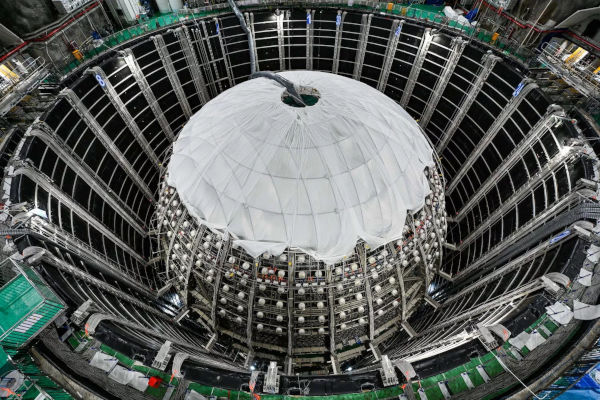
 JUNO's main detector is located 750 meters underground in a specialized laboratory. The photo shows the detector's (still empty) water pool with the central scaffolding. Inside this scaffolding is the 34.5-meter-diameter acrylic sphere, filled with the liquid scintillator. The white cover only protects the sensitive components during assembly.
JUNO is precisely positioned between eight existing nuclear reactors, providing a source of neutrinos for study. At its heart is a giant, highly transparent acrylic sphere, 34.5 meters in internal diameter, filled with 20,000 tons of a specially developed oily substance. This liquid scintillator creates photons when a neutrino interacts with it and is enclosed in a large, 35,000-ton water pool. The photons are detected by an array of approximately 45,000 photomultiplier tubes (PMTs) surrounding the sphere. Teams from the Technical University of Munich (TUM) and Johannes Gutenberg University Mainz are using Spectrum Instrumentation's M4i.2212 digitizing cards in their high-precision, laboratory-scale experiments to characterize liquid scintillators, which require advanced data acquisition. When the JUNO detector comes online in late 2024, it will be the largest liquid neutrino detector ever built. The detector will dramatically improve our understanding of the interactions and properties of these elusive ghost particles.
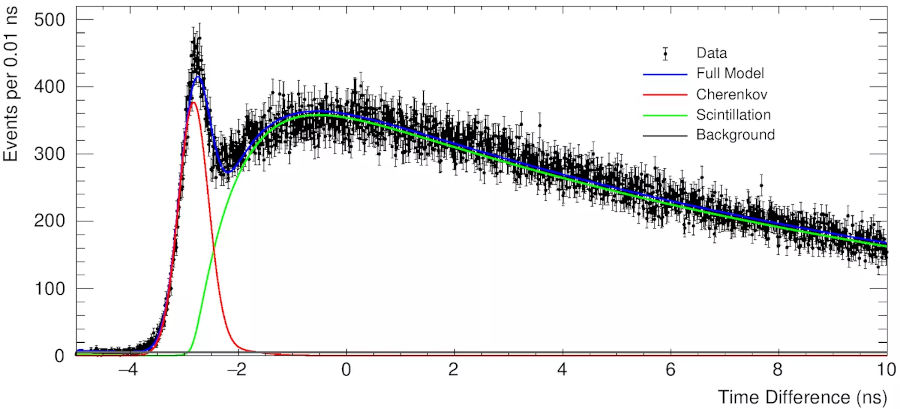 Typical light emission kinematics for a slow liquid scintillation mixture. Cherenkov light (red line) in the form of a sharp peak in time is followed by the slower decay of the scintillation light (green line).
Neutrino Detection:
The central acrylic sphere contains the liquid scintillator surrounded by a layer of water. Both must be ultrapure, as the slightest contamination could introduce radioactive material. During construction, workers had to wear two pairs of gloves, since even a trace of sweat from a fingerprint could contaminate and ruin the entire project. The detector is located in a specially excavated space 750 m underground to protect it from ambient radiation.
When a neutrino interacts with the liquid scintillator (LS), it deposits the interaction energy into the molecules of this substance. The enormous light emission of the LS (typically > 10,000 photons/MeV) ensures a precise determination of the deposited energy. It would be very beneficial to also be able to reconstruct the direction of the incident neutrino. In this case, the faint but directional Cherenkov light from the neutrino's initial passage through the water is matched to provide physicists with this information.
The goal of the ongoing development of liquid scintillators in Munich and Mainz is to separate the fast but weak Cherenkov light from the dominant scintillation light to enable simultaneous energetic and directional reconstruction. To this end, Dr. Hans Steiger's team built several benchtop precision experiments with increased light-gathering capacity and temporal resolution.
"We chose Spectrum digitizer cards because they provide us with cutting-edge performance but, unlike competing offerings, are neither expensive nor custom-built," says Dr. Hans Steiger, who leads the project. "Spectrum's modular approach means we could specify exactly what we needed the cards to do, so we didn't have to make compromises or waste money on unwanted features. I love that they are a standard PCIe product, so we can expand the system in a standard computer chassis as we receive more funding. As a university involved in large, long-term international projects, we need reliable components, and Spectrum's five-year warranty gives us peace of mind."
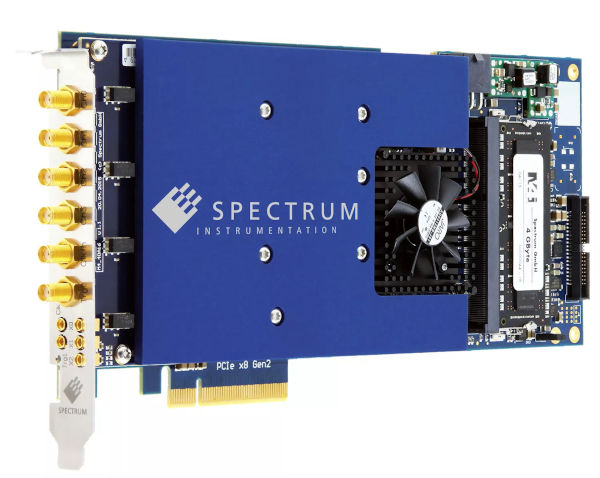 Spectrum Instrumentation's PCIe M4i.2212-x8 digitizer with a sampling rate of 1.25 GS/s on 4 channels.
JUNO's results also boost astronomical research.
In addition to the event reconstruction work, the team contributes a calibration project to JUNO. This involves characterizing the detector material using radioactive sources of gamma rays and neutrons with predetermined energy and incidence directions. "Our characterizations of liquid scintillators are only possible thanks to the ultrafast digitizing cards that allow us to work with timeframes measured in picoseconds. Furthermore, the 5V dynamic range is much better than that of its rivals, which is usually 1V, meaning they can easily handle the 3V pulses from our PMTs that we encounter," noted Meishu Lu, a PhD student in the TUM group. Manuel Böhles, who works in Mainz, adds: "Spectrum has been a great help in finding the best solutions for our project and in resolving any issues with a direct phone call to one of their engineers. It's fantastic that they are committed to supporting fundamental research at many universities like ours."
The diagram shows the first pulse of Cherenkov radiation followed by the scintillation signal, which provides the energy information. This occurs in less than two nanoseconds. By combining this information, the type of particle and its origin can be determined. It could be from one of China's reactors, the sun, the Earth's core, or deep space. "We have never before been able to pinpoint the exact origin of a neutrino in scintillation detectors, so this opens up entirely new fields of research," explains Dr. Steiger. "If, for example, a dying star, or a so-called supernova, emits large quantities of neutrinos in the sky, we can now not only see the neutrinos but also reconstruct with great precision the point in the sky where the explosion occurred. In effect, we now have a telescope to observe these different neutrino sources and better understand the processes." By detecting light across the entire spectrum, gravitational waves, and now also neutrinos with high statistics, energy resolution, and directionality, a new era of multi-messenger astronomy begins.