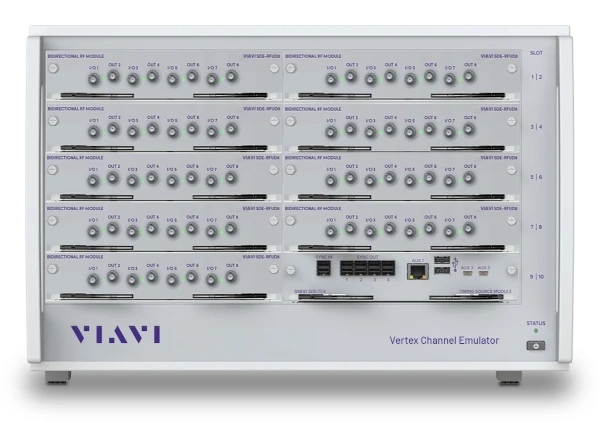
Vertex 6.0 expands VIAVI's wireless product portfolio by bringing real-world RF propagation to the lab, complementing the industry-leading TM500 network emulation platform and TeraVM application validation and security solutions. This is the first Vertex update since VIAVI's acquisition of Spirent Communications plc's high-speed Ethernet testing, network security, and channel emulation business.
Available as field-replaceable RF modules that seamlessly integrate into an existing Vertex 6U chassis, Vertex 6.0 builds upon the previous generation's 5G FR1/FR2 capabilities and now includes emulation for complex cellular, Wi-Fi, military, and aerospace RF technologies. Combined with VIAVI's FR3 MIMO converter and Integrated Sensors and Communications (ISAC) ray tracing, the platform acts as a digital twin of RF propagation for use cases including FR3, Wi-Fi 7, AI-RAN, and ISAC.
“As wireless technologies become more complex, issues that arise in the later stages can pose significant risks. Engineers need test environments that can accurately replicate real-world conditions and validate performance from the earliest stages of development,” said Ian Langley, senior vice president of VIAVI’s Wireless Technology, Security, and Applications Business Unit. “Vertex has been the platform of choice for leading global chipset, device, and network equipment manufacturers for over a decade, and Vertex 6.0 represents a further leap in capabilities that addresses the requirements of complex cellular, Wi-Fi, and other specialized topologies.”.
Each 6U Vertex chassis supports 36 RF ports, 256 digital links, and up to 1.6 GHz of bandwidth. For cellular technologies, the platform supports FR3 bands with up to 1 GHz of bandwidth to meet the growing demands of 6G networks. This includes multi-user (MU) MIMO with phase alignment and support for both TDD and FDD modes. For Wi
-Fi 7/8, it includes native support for 320 MHz and 4096 QAM, supporting configurations from 2x2 to 8x8. The channel emulator also includes a wide range of modes for ground-to-ground, ground-to-air, and air-to-air transmissions, including anechoic and reverberant OTA chambers, as well as for NTN (LEO, MEO, and GEO), mesh, drone, and ISAC networks.