There are currently more than 8.1 billion people in the world. It is estimated that by 2050 there will be 9.7 billion. According to the Food and Agriculture Organization of the United Nations (FAO), feeding that population will require a 70% increase in agricultural production.
Simply expanding current production techniques is not enough to meet future demand, as it is also important to consider that the agricultural industry is the fifth largest consumer of energy and one of the main contributors to greenhouse gas emissions.
Smart agriculture is now a hot topic in the sector. We are seeing how new technologies are being used in farming and livestock to increase both quantity and quality. These technologies include GPS, increasingly intelligent sensors, the Internet of Things in Agriculture (IoTA), cloud computing, automation, driverless vehicles, artificial intelligence (AI), and machine learning (ML). Together, these technologies can be used to create a highly optimized, integrated system that will lead to greater levels of autonomy.
An important aspect of smart agriculture is precision agriculture (PA). It improves crop yields through automated production methods and was first theorized in the 1980s. However, John Deere is credited with being the first to put the theory into practice when, in 1996, the company launched its GreenStar precision farming system, which introduced GPS guidance and automated steering.
The importance of data was clearly recognized in the early days of precision agriculture, and, interestingly, GreenStar's brochure carried the slogan "Information is your new harvest!" Precision agriculture has come a long way since then and is now considered fundamental to the practice of smart farming, which involves accessing and using accurate, real-time data to improve crop quality and yield, make better use of human labor, and, of course, boost the profitability of the agribusiness industry.
With better data, not only can decisions be made faster and with greater confidence, but the decision-making process can be largely automated, resulting in immediate action.
Sensors
are key to achieving higher yields in agronomy, the science of soil management and crop production. For example, a basic indicator of a crop's health (and growth stage) is its color, including some spectral properties invisible to the human eye. Satellite imagery can be used to create a variety of spectral indices. Among the most useful for crop production are the Normalized Difference Vegetation Index (NDVI, which compares near-infrared [NIR] and red visible light levels), the Leaf Area Index (LAI), and the Moisture Stress Index (MSI). In recent years, the use of multirotor and fixed-wing drones equipped with standard and hyperspectral vision cameras and thermal sensors for monitoring has increased, replacing satellites.
Spectral properties can also be an indicator of soil health, and useful information can be obtained from electrochemical sensors (which measure pH and nutrient levels) and gamma radiation sensors.
Combined with more general data, such as air temperature and dew point, wind speed and direction, relative humidity, atmospheric pressure, and solar radiation, this information can power a connected agricultural ecosystem.
Crop health data can be used to create a prescription map (PM), which details where to apply resources such as seeds, fertilizers, pesticides, and water. In addition, weather forecasts, resource costs, and the cost and availability of any machinery that may need to be hired can help inform high-level decisions about when to apply these resources.
It is important to control the quantities of resources, as they have a direct influence on the profitability of the agribusiness, as well as on a number of environmental issues.
Rate Technologies
(VRT) apply seeds, fertilizers, water, and pesticides in optimal amounts and where they are most needed. Generally, there are two types of VRT: map-based and sensor-based. Map-based VRT adjusts product application based on a pre-generated map of the field. Sensor-based VRT does not use a map but rather mounted sensors that measure soil properties or crop characteristics in real time.
Consider planting, for example, where the machinery's seeding rate adjusts in response to the planting pressure. The map will not reflect soil compaction, which affects crop yield, so an in-situ soil texture and compaction detection system—installed on the machinery—is needed to adjust the tillage depth in real time.
As already mentioned, IoT Ag is part of the smart agriculture landscape. IoT Ag-enabled wireless devices will be widely used to measure conditions. Most of these devices will be exposed to the elements—in fields, installed on agricultural machinery, and even on livestock (for livestock monitoring)—so they will need to be rugged.
Many will also need to be battery-powered, as they will be located in remote areas. Although the devices will spend most of their time in standby mode, they are expected to last more than a year before the batteries need replacing, or several years if they can be recharged using photovoltaic cells. Fortunately, several low-power microcontrollers (MCUs) are already being used in battery-powered IoT devices and wearable electronics.
Cybersecurity also needs to be addressed, as IoT Ag devices are, in practice, nodes in the farm's network. Although the data sent by a device may not be sensitive, it is sent to a network containing valuable information and capable of controlling automated machinery.
AI & ML
The VRT, supported by the large amount of data collected, is improving the levels of automation that have been made possible by the guidance of global navigation satellite systems (GNSS) combined with automated technologies such as row/section closing of seeders and spray boom control, for example.
However, the greatest potential comes with the incorporation of artificial intelligence (AI) and machine learning (ML) in the field; and the AI market in agriculture is projected to grow from the current $1.7 billion in 2023 to $4.7 billion in 2028, with a compound annual growth rate of over 23%.
As mentioned, determining soil compaction in real time is useful, but the solution doesn't need to be more complex than a closed-loop control system that includes reinforcement and a method for measuring deformation or displacement. Distinguishing between crops and weeds in real time, as machinery moves across the field, requires a computer vision-based system with machine learning (ML) algorithms that decide whether herbicides should be applied (see Figure 2). And, if it is a crop, what is its health status? Curled leaves and wilting are often signs of disease. A vision-based system with ML will be able to detect insect traces and decide which plants require pesticides. However, it is important to note that the decision will also be based on other factors, such as soil moisture content, since the detected symptoms may not be exclusive to a single disease or infestation. Lack of water could also cause wilting, so the ML model must accept different types of input data.
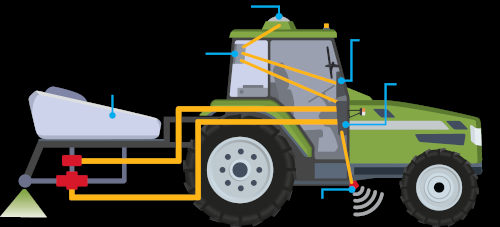
Figure 2: Thanks to GPS, the computer knows its position in real time and, based on a VRT prescription map, knows "approximately" where the herbicides should be applied. However, expanding the system with real-time information from sensors and cameras provides much greater accuracy.
As mentioned, low-power MCUs are already widely used in IoT devices and can therefore also be used in IoT Ag devices. Furthermore, it is possible to implement AI and ML in an MCU, thanks to initiatives such as the Tiny Machine Learning (tinyML) movement. By implementing ML algorithms in the MCU, it is possible to provide the edge processing and decision-making capabilities required for many VRT applications.
Abstract:
Smart agriculture involves accessing and effectively using data to improve yields. This data is already proving to be the lifeblood of practices like VRT, helping farmers achieve more with less and enabling increasingly higher levels of automation. However, it is the integration of AI and ML into the agribusiness ecosystem that promises the greatest benefits, by enabling on-the-spot decision-making and optimal resource utilization.
About the author:
Nilam Ruparelia leads Microchip's commercialization efforts for AI/ML in the cutting-edge technology sector, as well as for the 5G and communications markets. Ruparelia's career spans more than 30 years in the semiconductor industry, with roles focused on markets, customers, and applications for industry leaders in MCU, FPGA, and communications products. Nilam holds a Bachelor of Engineering degree with a specialization in Electronics and Communications from the LD College of Engineering at the University of Gujarat, India.