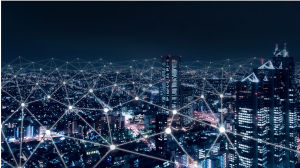
 To absorb the unstoppable global population growth, Smart Cities have emerged as the digital solution for developing efficient and sustainable urban planning. However, smart cities are built on networks, specifically, optical networks.
Then, in just 150 years, that figure more than doubled, with humanity reaching 2.6 billion inhabitants in 1950. Now, by 2050, the United Nations projects that the world population will reach 9.7 billion inhabitants1.
Well, if it once took 800 years to triple the world's population, the current accelerated rate of population growth will lead to humanity tripling again, but now in just 1 century.
Now, in addition to this population explosion, we must consider that half of the current world population lives in cities, but these only occupy 3% of habitable land2.
This progression of figures raises one of the main current social problems: the overpopulation of cities, which leads to overcrowding, high congestion, poor urban planning; and, ultimately, the deterioration of the quality of life of its inhabitants.
To address this situation, the digital age has provided us with the tools to design, plan, and build smart cities. Smart cities have emerged as the solution to mitigate the negative externalities arising from uncontrolled urban sprawl.
According to the McKinsey Global Institute, digital solutions could improve quality of life indicators in a city by up to 30%.³Technologies such as Artificial Intelligence, robotics, the Internet of Things (IoT), Big Data, and virtualization are already driving advances in urban development and coexistence, offering a new way of living. Furthermore, we cannot discuss smart cities without also addressing mobility: doing almost everything we want or need to do while on the move. For this, network connectivity via smartphones has become essential. In 2021, the number of unique mobile internet users exceeded 4.3 billion (more than 50% of the world's population), indicating that over 90% of internet users worldwide use a mobile phone to connect.⁴ And it's no surprise that this number will continue to grow and be further boosted by the deployment of 5G networks, which promise much faster mobile connections than those currently available, not to mention the increased coverage and connectivity they bring to so many other types of devices, applications, and services.
With this in mind, today it's possible not only to imagine a smart city, but also to experience interaction with smart vehicles, smart buildings, and even smart highways, all within easy reach.
But to make this digital revolution a reality, a robust, high-capacity, secure, and reliable telecommunications network and digital infrastructure are essential. Otherwise, without a modern network, Smart Cities remain merely a fantasy. While many edge applications can become wireless, the ultra-high bandwidth capacity required for cities to evolve and develop technologically undoubtedly depends on the deployment of a robust optical infrastructure to support the demands of a smart city. Business productivity needs to be as efficient as possible. People's commutes need to be increasingly safe and timely. The digital divide needs to be reduced. Environmental sustainability and people's quality of life need to be as high as achievable.
Smart Cities can be understood as the solution to the population explosion, since their very concept encompasses providing answers (among many others) to the disorganized growth of the population and the digital divide. The opticalization of digital infrastructure becomes a determining factor, given that optical networks have proven to be a technology capable of supporting and satisfying the demand generated by the demanding and dynamic ecosystem of a Smart City. We can expect to see increasingly optical data centers; municipalities deploying fiber optics to link security cameras, giving their citizens the ability to see what's happening in their neighborhoods through their cell phones; schools, hotels, industries, government offices, and businesses bringing fiber optics ever closer to users, providing high-quality, high-speed connections; and entire cities establishing optical networks to support the technologies and applications that are in demand.
Therefore, the cities that will be able to evolve from traditional urban centers to Smart Cities will be those that have deployed robust optical networks capable of meeting the demand for digital connectivity necessary to support what a smart city truly means.
From a global perspective, whether in the short, medium, long, or very long term, urban life is and will continue to be built on optical infrastructure.
Furukawa Electric seeks to highlight the importance of optical infrastructure as a solution to the demands of a hyperconnected and intelligent world, improving people's safety and quality of life. These demands primarily include greater bandwidth, higher speeds, ease of deployment and maintenance, and reduced latency—in other words, creating true digital highways, increasing coverage and connection quality for a wide variety of applications.
1https://www.un.org/es/global-issues/population
2https://www.un.org/sustainabledevelopment/es/cities/
3https://www.mckinsey.com/industries/public-and-social-sector/our-insights/thriving-amid-turbulence-imagining-the-cities-of-the-future
4https://www.statista.com/topics/779/mobile-internet/#dossierContents__outerWrapper
Belonging to the Japanese Furukawa Electric group with more than 137 years of history, Furukawa is a manufacturer of innovative communication and energy network solutions.
With a portfolio spanning from the external to the internal network, Furukawa has 3 main product and solution lines: Furukawa Broadband System: FTTx technology and solutions for applications and services in optical networks for telecommunications operators, Internet and Service providers, and Energy Concessionaires; Furukawa Connectivity System: complete connectivity solutions for corporate networks, and Furukawa IoT for Industry System: IoT communication solutions for mission-critical environments.
For more information, visit: http://www.furukawalatam.com