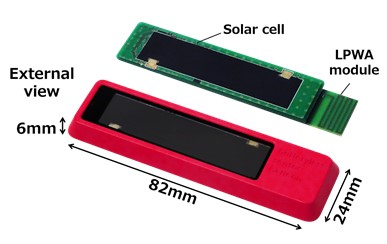
A medida que la expansión de los sistemas IoT gana impulso, aumentan las expectativas de los dispositivos de sensores que admiten la tecnología LPWA, que puede transmitir de forma inalámbrica información del sensor directamente a la nube. Con el fin de crear sistemas que empleen esta tecnología, ha existido una demanda para el desarrollo de dispositivos miniatura fáciles de instalar que usan celdas solares para lograr comodidad y bajo coste, que prescinden de la necesidad de reemplazar las baterías.
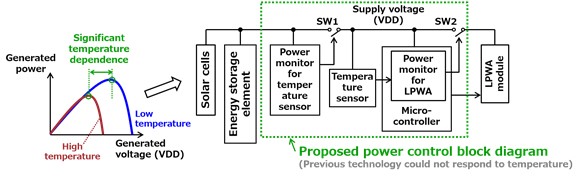 Los laboratorios de Fujitsu desarrollaron previamente tecnología de control de potencia (1) que puede operar una baliza con la potencia proporcionada por una célula solar. Convencionalmente, la variación de potencia de salida de las células solares debida a la temperatura se había tolerado ampliando el tamaño de los elementos de almacenamiento de energía. Ahora, sin embargo, Fujitsu Laboratories ha desarrollado tecnología que logra una alta eficiencia energética controlando el tiempo de transmisión de la señal en función de la variación de temperatura medida por un sensor de temperatura, lo que permite reducir a la mitad los elementos de almacenamiento de energía necesarios para la transmisión de señal. Esto ha permitido a Fujitsu Laboratories miniaturizar con éxito el dispositivo a un tamaño de 82x24x6 mm, creando el dispositivo sensor más pequeño del mundo compatible con LPWA que no necesita baterías de repuesto.
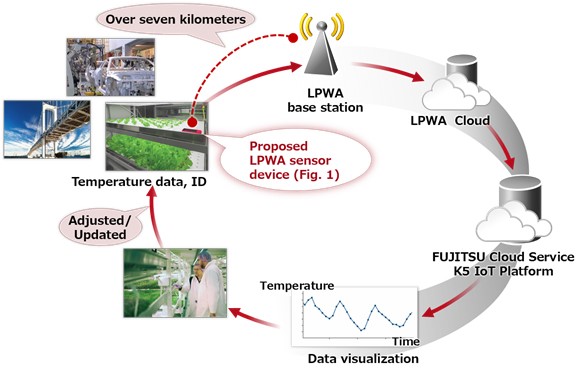
En una prueba del dispositivo sensor que usa esta tecnología, Fujitsu Laboratories confirmó que los datos recopilados de temperatura y humedad pueden transmitirse a una estación base Sigfox (2) a una distancia de aproximadamente 7 km. Dado que ahora es posible adquirir datos medidos incluso desde ubicaciones donde es difícil asegurar la energía e instalar cables de alimentación simplemente colocando estos dispositivos de sensores, la implementación y gestión sin mantenimiento de los sistemas IoT se ha convertido en una realidad, acelerando el proceso de digitalización "on-site".
 Antecedentes de desarrollo
La difusión de los sistemas de IoT ha progresado en los últimos años, y se prevé que para 2020, varias decenas de miles de millones de dispositivos de IoT se conectarán a la nube a través de redes. En los sistemas IoT, la información recopilada de múltiples sensores instalados en el campo, necesita ser transmitida y analizada en la nube, y LPWA ha estado ganando atención como una tecnología inalámbrica que puede transmitir datos directamente a la nube con bajo consumo de energía en una amplia zona. Desde el punto de vista de la comodidad y el coste, hay grandes esperanzas de miniaturización, que no solo cumplen con los estándares LPWA, sino que también utilizan células solares que eliminan la necesidad de reemplazarlas.
Cuestiones
Fujitsu Laboratories ha desarrollado previamente tecnología de control de potencia que utiliza circuitos en miniatura que pueden transmitir datos a distancias cortas de forma inalámbrica utilizando Bluetooth Low Energy (BLE). Esta tecnología realiza dispositivos de sensores que admiten BLE sin la necesidad de remplazar baterías, proporcionar energía con células solares y activar de manera fiable un circuito inalámbrico al monitorizar y ajustar el equilibrio entre la generación de energía y el consumo.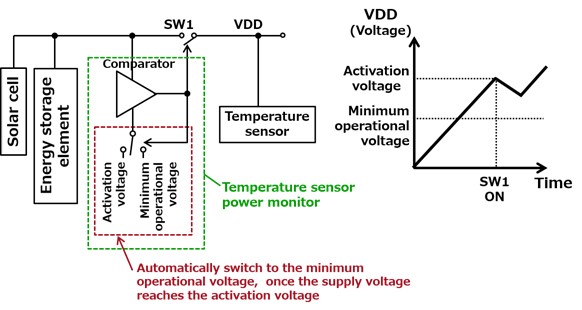 Sin embargo, los dispositivos de sensor que usan esta tecnología anterior no pueden soportar LPWA. Eso es porque el tiempo requerido para la transmisión con LPWA es significativamente más largo que con BLE. LPWA transmite pequeñas cantidades de datos lentamente para garantizar la calidad de la señal a largas distancias. En efecto, esto significa que una sola transmisión puede requerir un uso de energía significativo de hasta aproximadamente 1.500 veces de BLE.
Acerca de la tecnología recién desarrollada
Ahora, Fujitsu Laboratories ha desarrollado una nueva tecnología de control de potencia para garantizar la potencia de transmisión mientras se minimiza el tamaño del circuito. Las ventajas de esta tecnología son las siguientes:
1. Tecnología de control de potencia que permite variaciones de potencia con la temperatura
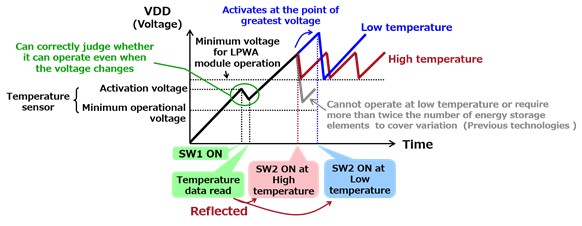
Fujitsu Laboratories ha desarrollado una tecnología de control de potencia que puede controlar el tiempo de las transmisiones de señal LPWA en tiempo real, en función de los datos de temperatura recopilados de un sensor de temperatura. Con esta tecnología, las transmisiones de señales solo se llevan a cabo en el momento en que la tensión de activación, que varía con la temperatura, se maximiza para evitar que caiga por debajo del voltaje operativo mínimo para el módulo LPWA (Figura 3). Al utilizar la energía de manera eficiente, es posible tolerar la variación en la potencia consumida por el circuito inalámbrico o la energía generada por las células solares debido a la temperatura. Esto elimina la necesidad del exceso de elementos de almacenamiento de energía que anteriormente eran necesarios para responder a la potencia
2. Tecnología de monitorización de energía que activa fiablemente el sensor de temperatura
Para que la tecnología de control de potencia funcione de manera fiable, el dispositivo debe poder activar de forma continua y fiable el sensor de temperatura con una pequeña cantidad de energía. Para resolver este desafío, Fujitsu Laboratories ha desarrollado una tecnología de monitorización de energía que analiza los cambios de voltaje en la fuente de alimentación y evalua con precisión si se ha almacenado suficiente energía para operar el sensor de temperatura. Esta tecnología puede evitar paradas innecesarias del sensor de temperatura mediante el uso de la cantidad mínima de energía en función de la temperatura.
 Efectos
Esta tecnología se implementó utilizando Sigfox, un estándar LPWA, creando el dispositivo sensor más pequeño del mundo (82x24x6 mm) que admite comunicaciones LPWA sin la necesidad de reemplazar las baterías. Los Laboratorios Fujitsu verificaron que los datos de temperatura y humedad pudieran transmitirse una vez cada diez minutos, durante siete días, directamente a una estación base a unos 7 km de distancia, en un entorno con una iluminación de 4.000 lux. Fujitsu Laboratories también verificó que los datos pudieran visualizarse a través de la plataforma Fujitsu Cloud Service K5 IoT Platform, el servicio plataforma de utilización de datos IoT de Fujitsu Limited, que ha recibido el programa Sigfox Ready Program para la certificación IoT PaaS como plataforma IoT que se conecta a la nube Sigfox (Figura 5)
Esto significa que los datos del sensor se pueden adquirir fácilmente en la nube simplemente configurando dispositivos de sensores, incluso en lugares donde es difícil asegurar la energía o instalar cables de alimentación. Esto permitirá la instalación y gestión sin mantenimiento de los sistemas de IoT, acelerando el proceso de digitalización en campo.
Planes futuros
Fujitsu Laboratories continuará realizando pruebas de campo para el uso real de estos dispositivos sensores, incorporando esta tecnología en la plataforma Fujitsu Cloud Service K5 IoT Platform y las soluciones de sensores de Fujitsu Frontech Limited como dispositivos conectados, con el objetivo de su comercialización en el año fiscal 2018. Además, continuaremos desarrollando tecnologías para miniaturizar dispositivos de sensores.
Comentario de Yoshihito Kurose, presidente de KYOCERA Communication Systems Co., Ltd. (KCCS)
Como se espera que la utilización de IoT aumente continuamente, KCCS predice que las soluciones que utilizan la característica de bajo consumo de energía de la red Sigfox se desarrollarán en muchas industrias. KCCS cree que el desarrollo de un dispositivo sensor por parte de Fujitsu Laboratories Ltd., que no requiere carga de batería por medio de una batería solar, promoverá el uso de Sigfox no solo en Japón sino en todo el mundo. Como operador de Sigfox en Japón, KCCS está trabajando con Fujitsu Laboratories Ltd. y otros socios para permitir que todo esté conectado a la red Sigfox y contribuye a la creación de una sociedad segura y agradable.
________________________________________
• [1] Desarrollo de tecnología de control de potencia
Fujitsu desarrolla la primera baliza flexible de soporte de IoT de la industria que no necesita reemplazo de batería (comunicado de prensa, 25 de marzo de 2015) http://www.fujitsu.com/global/about/resources/news/press-releases/2015/0325-02 .html
• [2] Sigfox
Una red global de IoT que utiliza LPWA proporcionada por Sigfox, una compañía establecida en Francia en 2009. KYOCERA Communication Systems Co., Ltd. es el único proveedor de servicios de red en Japón.