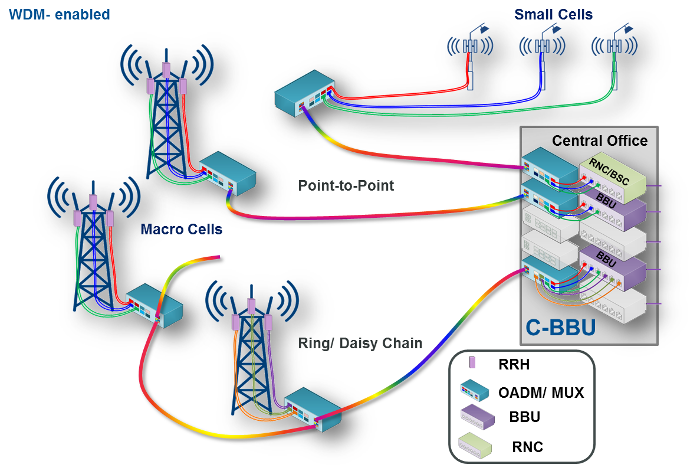
Baseband (BBU) signals are transported over fiber, using the OBSAI or CPRI standard (digital radio signal), to the remote radio units, RRH.
 CLOUD RAN
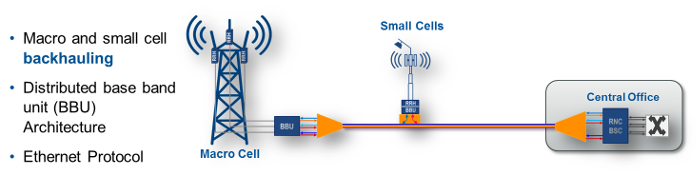
This architecture is known as Cloud RAN or simply C-RAN. Currently, most operators are in an initial phase of C-RAN, called LOCAL RAN or Local RAN. This means that both BBUs and RRHs are deployed at the same site, but connected to each other via fiber. At the site, there is a CSG (Cell Site Gateway) that handles the backhaul from the cell to the operator's backbone via fiber.
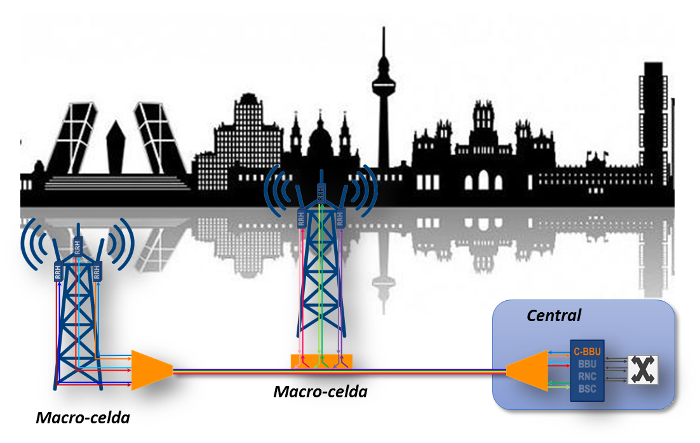 However, mobile operators are in the process of adopting a "CENTRALIZED RAN" or Centralized RAN configuration. In this scheme, the BBUs are housed in a central point of presence (PoP), connecting via fiber to the RRHs located at distances of less than 10 kilometers. Currently, a BBU serves an average of 6 remote heads (RRHs). In the case of an LTE cell, 3 RRHs are generally used, 1 per sector to cover 360°. To give an idea of scale, a macro cell with LTE, 3G, and 2G services can require up to 15 RRHs. Each RRH requires a fiber connection to transport the CPRI signal to the baseband unit (BBU).
The popularization of C-RAN is driven by operational and economic factors, such as the simplification of antenna sites, with reduced space requirements and energy consumption due to the elimination of the BBU. Other factors include shared sites among multiple operators, the need for new sites to improve 4G coverage, and the deployment of additional radio technologies (LTE) in areas with limited available space.
Other key factors include ease of repair due to reduced complexity, lighter and smaller metal structures, the elimination of cooling units in many cases, and the possibility of partial solar power (as with small cells).
Therefore, it can be summarized that cost reduction and ease of deployment and maintenance are the main drivers of C-RAN adoption.
It is also important to note that a single BBU could serve both a macro cell and small cells, making C-RAN an even more attractive option than considering only macro cells.
Once the new scenario is established, we can see that a new piece emerges in the architecture, one that is critical for determining the TCO, or total cost of ownership: the FRONT HAUL.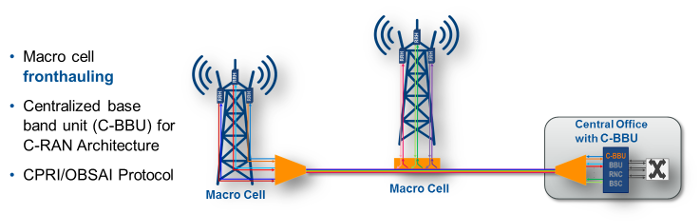 Most
Most
of the mobile backhaul and fronthaul currently deployed consists of point-to-point links over dark fiber, using gray transceivers. The growth of the access network, driven by the demand for mobile data, has a direct impact on the required fiber connections. Whether these are leased or new deployments, budgetary and design challenges arise.
The FRONT HAUL is the fiber connection between the remote radio heads (RRHs) and the baseband units (BBUs) located at the central office (excluding the Local C-RAN architecture). Two main alternatives are considered: using dark fiber, or WDM to multiplex several signals (or RRHs) over fiber, thus reducing the number of fibers required. To give you an idea, a macro cell with 15 RRHs would require 15 dark fibers from the site to the central office where the BBUs are located. If WDM technology is used, the 15 CPRI signals are multiplexed onto a single fiber, saving the remaining 14.
WDM FRONT HAUL
As mentioned, multiplexing signals from multiple antennas onto a single, existing fiber can avoid or delay the decision to lease or deploy new fibers. Both the fiber fronthaul and backhaul can be implemented using a passive architecture, which simplifies deployment and reduces investment and operating costs. The elements of this passive network consist of colored CPRI transceivers and optical multiplexers, supported by monitoring and fiber break protection systems.
CWDM technology is very mature, simple, efficient, and scalable to DWDM. CPRI transceivers are available across virtually the entire CWDM spectrum (and also in the DWDM spectrum).
The transition to a colored network may seem straightforward; however, mobile fronthaul networks present new challenges due to environmental limitations and the inherent limitations of CPRI technology. Transceivers and multiplexers must withstand extreme environmental conditions wherever antennas are located.
Furthermore, link monitoring and protection play a crucial role in maintaining peak network performance. Addressing these technical and business challenges step by step ensures that the evolution of front/backhaul is simple, efficient, and future-proof. 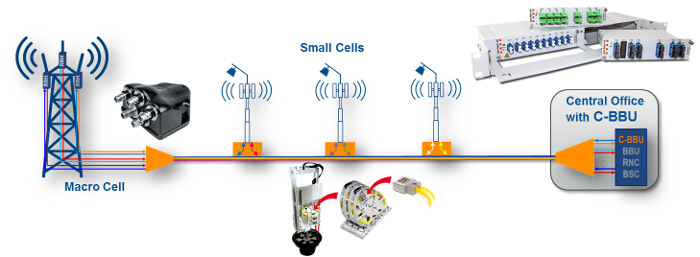 HUBER+SUHNER Cube Optics combines H+S's extensive experience in designing and manufacturing outside plant cabling solutions with its broad expertise in RF, fiber, and mobile technology (MASTERLINE Ultimate). Cube Optics (CUBO) is also a leading provider of WDM technology for the OEM sector, specializing in next-generation transceivers (40G, 100G) and telecom solutions.
The fronthaul requires flexible passive WDM solutions that can adapt to different scenarios: transmission over a single fiber or fiber pair, link length, minimum insertion loss, the ability to combine point-to-point links with point-to-multipoint links (Daisy-Chain), expandability by adding new remote antennas (RRHs), and the ability to combine DWDM wavelengths with existing CWDM, among others. From a network design perspective, flexibility will always be a challenge, and the ability to choose the number of channels and colors on demand provides a competitive advantage to the mobile network operator. Added to this is the knowledge and capacity for testing and certifying CPRI transceivers (up to 10G), whether CWDM, DWDM, or variants for industrial temperature ranges (-40°C to 85°C).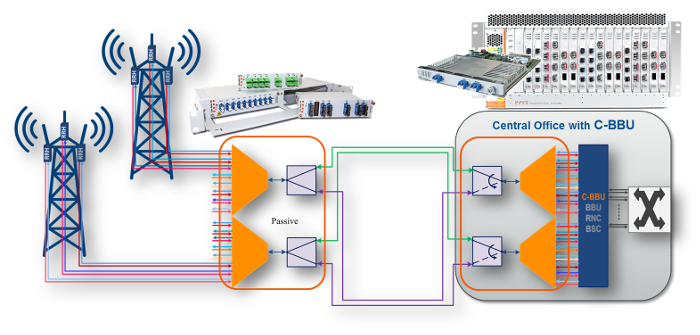 Remote antennas (RRHs) are often located in unprotected areas under harsh environmental conditions. This requires that CPRI (RF over Fiber) multiplexers and transceivers be housed in sealed enclosures that are also part of the macro-cell or small-cell cabling. Connecting and disconnecting the fiber connectors up to the RRH (Remotely Pointed Receptor) must be quick and easy. The fiber connectors must be protected and easy to clean to prevent dust, dirt, and foreign matter from increasing the overall attenuation of the path from the BBU (Broadband Breakdown Unit) to the RRH. This effect, which is the most frequent cause of fiber link failure or instability, should not be underestimated.
Often, the macro-cell is located in a strategic location, such as a campus or adjacent to corporate headquarters, government buildings, or shopping centers, and the operator must ensure compliance with Service Level Agreements (SLAs). Cutting the fronthaul fiber would interrupt mobile and data services, so the macro-cell is typically connected to the central office via two alternative paths. H+S Cube Optics provides optical switching solutions to route all traffic between the BBU and RRH to the alternate path.
An important factor to consider from a network operations perspective is monitoring the optical quality of the fiber link. 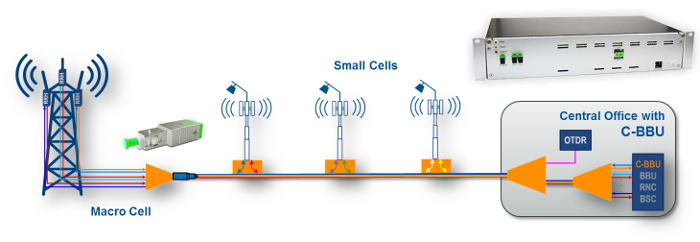 To simplify this monitoring, H+S Cube Optics has designed a passive solution, combined with optical multiplexing, that adds a new optical channel with a pilot wavelength (1625 or 1650 nm, etc.) and an end reflector (macro cell) that reflects the pilot wavelength. This allows us to characterize the fiber's condition and detect any degradation using an OTDR at the central office (manual or automatic). Having a pilot wavelength and an end reflector significantly simplifies the training requirements for the OTDR (Optical Time Domain Reflectometer) operator. An automated OTDR can also be used, capable of monitoring multiple fronthaul fibers via optical switching. The link is characterized at the initial deployment stage, and from that point onward, any measured deviation will trigger a maintenance alarm.
H+S Cube Optics solves the problem of integrating a pilot lambda sensor, monitoring port, and reflector into the macro-cell multiplexing assembly.
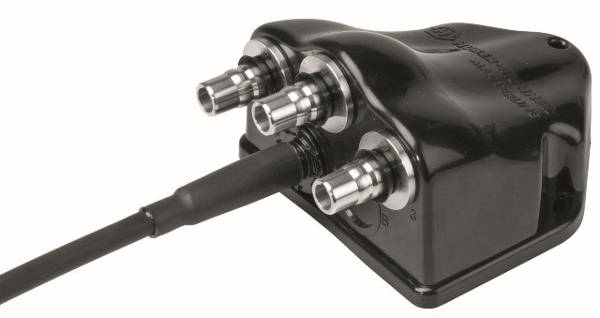
MASTERLINE Ultimate SC E1 (with CWDM) Multiriser cable with compact connector head
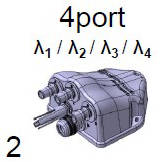
MLU SC E1 4port
2 input fibers and 3 or 4 output ports (Q-ODC®-2)
Author: ISSAC ALEGRE, Iberian Peninsula Delegate, HUBER+SUHNER Cube Optics AG