The PHY (Power Handling Hygrometer) is responsible for the transmission and reception of data over the air. Its modulation scheme determines how raw information bits are transmitted as electromagnetic signals and how they are converted back into baseband signals upon reception. The range of a radio communication link depends on the transmission power, receiver sensitivity, and communication frequency. Receiver sensitivity is determined by the receiver bandwidth (B), the receiver noise figure (NF), and the minimum signal-to-noise ratio (SNR) of the demodulator, which depends on the modulation scheme.
The frequency band cannot be freely selected, as its use is regulated by the authorities in the region where the system operates. However, sub-GHz frequency bands typically offer greater range than 2.4 GHz bands. Transmitter power is also regulated by regional standards, leaving receiver sensitivity and the modulation scheme as the two main factors we can design. Generally, the trade-off is between data rate and sensitivity, with greater communication range at the expense of a lower data rate. (It should also be noted that greater sensitivity can translate to greater resistance to interference.)
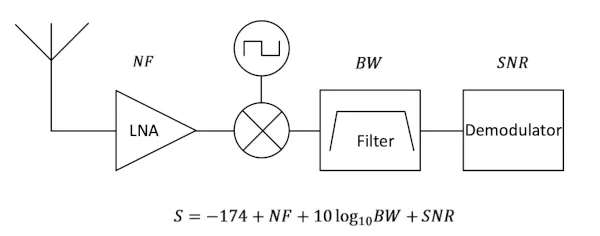
Figure 1. The receiver sensitivity (in dB) depends on the receiver noise (NF), the filter bandwidth (BW), and the demodulator signal-to-noise ratio (SNR).
Modulation and demodulation.
Digital modulation schemes in low-power devices tend to be simple and consume little energy. For this reason, OOK, FSK, and variations of FSK, such as MSK and GMSK, have historically been used in radio communications in mesh networks [1].
On-off modulation (OOK) encodes information bits onto an RF carrier wave in a rudimentary way: a binary value of "1" represents the carrier wave being "on," and a binary value of "0" represents the carrier wave being "off." This modulation is easy to generate and detect, but highly vulnerable to interference and many other problems, and requires a receiver signal-to-noise ratio (SNR) of approximately +16 dB for a bit error rate (BER) of 1%. [2].
Frequency-shift keying (FSK) maps digital information onto the frequency modulation of the carrier signal by shifting between two distinct frequencies, f1 and f2, representing a "1" bit and a "0" bit. FSK is easy to receive and has greater immunity to interference, but requires a demodulator signal-to-noise ratio (SNR) of around +9 dB for a bit error rate (BER) of 1%. [3].
LoRa Modulation (® )
To clarify the difference between LoRa and LoRaWAN: LoRa is PHY layer modulation, and LoRaWAN is a layer 2 LPWAN network architecture based on the LoRa modulation scheme.
LoRa modulation uses chirp spread spectrum (CSS) combined with forward error correction to spread the information to be encoded as a frequency chirp (a gradual change in frequency over time). Because of this, it is less susceptible to noise, narrowband interference, and bursty high-power interference.
While OOK and FSK modulation encode single-bit symbols ("1" or "0"), this is not the case with LoRa modulation. Instead, LoRa symbols, which represent multiple bits, are encoded within a single chirp. For example, with a spread factor (SF) of 7, a single symbol represents 2^7 = 128 possible values (7 bits per symbol). Each symbol is represented by a different location of the start and stop frequencies within the chirp.
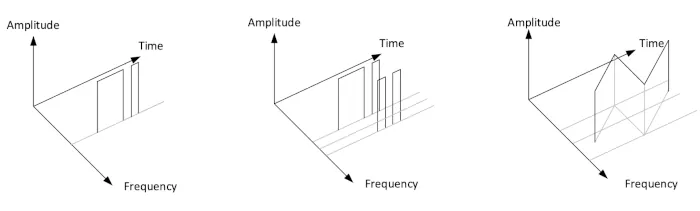
Figure 2. Visualizations of OOK (left), FSK (center) and LoRa (right) modulation
Signal-to-Noise Ratio (SNR)
To decode a modulated signal, an RF receiver must be able to distinguish the desired signal from the noise. As we saw in the previous section, OOK and FSK require significantly higher signal power than the receiver's background noise, 10–15 dB and 6–10 dB respectively: a positive SNR is required. However, with LoRa modulation, the receiver's ability to correlate the received spread-spectrum chirp below the background noise allows for the reception of signals with a negative SNR, below the transceiver's background noise. Furthermore, for the same transmission time (data rate), reception with a negative SNR confers an 8–9 dB sensitivity advantage over FSK. The extent to which LoRa can receive below the background noise is given by the spread factor:

This capability means that LoRa-based systems provide a more reliable radio link in noisy environments and have a greater range compared to traditional modulation. This characteristic has been the basis of LoRaWAN LPWAN technology, in which networks are created in star configurations around a gateway. The high sensitivity provides a range similar to that of mobile telephony with low transmission power, enabling network communication over many kilometers.
NeoMesh 2nd Generation Mesh Network
NeoMesh, launched in 2014, is a 2nd generation mesh network protocol that differs from traditional mesh networks, such as ZigBee, BLE Mesh, Thread, Z-Wave, etc., because the network is highly scalable, completely decentralized, and has very low power consumption for all devices on the network.
Traditional mesh networks rely on devices with different functions within the network. Some may be low-power devices with limited functionality, but they can only operate effectively if they are within range of other, more fully functional (non-low-power) devices. Only devices powered by mains electricity can act as routers, which are necessary to extend the network's reach. Finally, traditional mesh networks depend on a central "master" that manages the network.
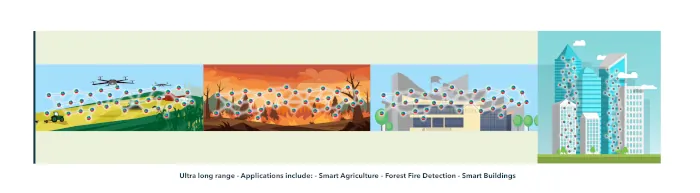
NeoMesh uses only fully featured devices, so each device can act as a router, helping to extend the network's reach by relaying data to other devices. All NeoMesh devices operate in synchronized mode, meaning they can remain in standby mode efficiently when no activity is required. This feature allows all devices on the network to run on batteries for many years.
Routing in NeoMesh is performed using the proprietary SpeedRouting protocol, which is optimized for large mesh networks and can route through networks with non-static topologies, such as mobile nodes. Furthermore, SpeedRouting has no hop count limitation, making it ideal for large networks.
The NeoMesh protocol is not specifically tied to a particular PHY layer. When NeoMesh was first introduced in 2014, it operated in the 2.4 GHz band using FSK modulation at 500 kbps. Later, in 2015, the sub-GHz bands of 868 MHz (EU) and 915 MHz (US) were added, still using FSK modulation, but at 250 kbps.
Although the 2.4 GHz version allows NeoMesh users to create products that can be used worldwide, its performance in terms of range and noise resistance is not impressive. The sub-GHz variants offer much better range, especially indoors or underground.
Although NeoMesh variants based on 2.4 GHz and sub-GHz FSK have enabled NeoMesh users to create many innovative solutions in smart buildings, smart agriculture, industry, transportation, and other areas, there are certain applications that require greater range between mesh nodes or better performance in noisy environments.
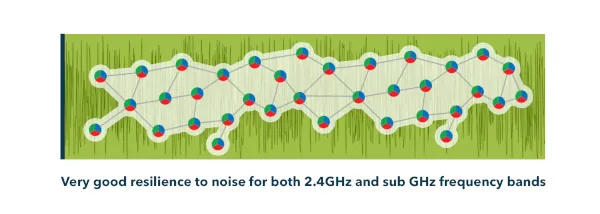
NeoMesh and LoRa: the best of both worlds
The combination of NeoMesh and LoRa offers the potential for greater range between mesh nodes and improved noise immunity. However, integrating these two innovative technologies is not as simple as plug and play.
Although LoRa provides the required enhanced link performance, it does so with limitations in the RF layer bit rate. As mentioned earlier, NeoMesh typically operates at a minimum data rate of 250 kbps. The reason for this high bit rate is not to transmit large amounts of data, but rather to transmit small data packets in a very short time, enabling NeoMesh's ultra-low power consumption. Incidentally, this short transmission time helps NeoMesh meet the stringent EU regulations for duty cycles in the 868 MHz band.
Depending on the frequency band and transceiver version used, the LoRa bit rate is limited to a maximum of 203 kbps (2.4 GHz, SF=5, BW=1625 kHz). While using this LoRa transceiver configuration does not provide the greatest range or the best SNR performance, it is still better than, for example, FSK for the same transmit power.
With configurations for longer ranges, such as SF=12, BW=125 kHz, and operation in the 868 MHz band, the bit rate drops to 292 bps (not kilobits, but bits!). Needless to say, with such a low bit rate, the transmission time for a given data size will be significantly increased, as will the average current consumption, making it difficult to comply with the EU duty cycle restriction.
Of course, not all applications require low power; consider, for example, electricity meters or street lighting controllers. Some applications don't require long range but would benefit from greater noise immunity, such as smart building solutions or shipping container monitoring, which would be ideal candidates for deployment in the 2.4 GHz band due to its global availability. These applications would also benefit from improved noise immunity because the band is often heavily used by other applications, such as Wi-Fi and Bluetooth.
Combining NeoMesh with LoRa modulation not only improves the range and performance of a standard NeoMesh link, but the combined solution also offers better indoor, deep indoor, and underground coverage compared to LPWAN, thanks to its multi-hop network topology. Furthermore, NeoMesh provides enhanced bidirectional communication and end-to-end awareness. NeoMesh also enables the distribution of firmware updates to all devices on the network via its file transfer function.
NeoMesh in LoRa: Now Available
In November 2023, NeoCortec first presented NeoMesh using LoRa modulation. It was unveiled at the Wireless Congress in Munich. A year later, at the Electronica trade fair in Munich, NeoCortec and Embit (an Italian manufacturer of wireless modules) launched the first NeoMesh module system using LoRa. Based on Semtech's LoRa Connect™ SX1281 transceiver, the module was designed for the 2.4 GHz frequency band. Approximately four months later, in March, at the Embedded World trade fair in Nuremberg, NeoCortec and Embit launched a module based on Semtech's LR1121 transceiver. This module offers NeoMesh mesh networking capabilities in a variety of configurations. Firstly, it is a multi-band module compatible with the 2.4 GHz, 868 MHz, and 915 MHz sub-GHz ISM frequency bands. Furthermore, the module can be configured for a wide range of LoRa modulation settings, giving the user the option to optimize range and performance. Finally, the module can also be configured to use (G)FSK modulation if the range and noise immunity offered by LoRa are not required.
In addition to the modules, NeoCortec ( http://www.neocortec.com ) also offers the NeoMesh protocol stack under license. This option is attractive for applications with special requirements or high volumes.
[1] Examples of meshes using FSK and OOK -> https://en.wikipedia.org/wiki/Z-Wave
[2] https://www.researchgate.net/publication/324564954_Impact_of_Error_Control_Code_on_Characteristic_Distance_in_Wireless_Underground_Sensor_Networks
[3] https://ietresearch.onlinelibrary.wiley.com/doi/10.1049/iet-cds.2018.5458
Article provided by NeoCortec – http://www.neocortec.com