It's best to keep the rack supported on its legs, not its wheels. You'll need to confirm that the raised floor, if present, can support the weight of the rack and its equipment. An alternative is to place the rack on the plinth, also known as the baseboard, to better distribute the weight.
Furthermore, enclosures (rack cabinets in this case) should be chosen that allow cable entry both through the base and the top and that are protected by brushes to prevent dust from entering as much as possible.
 How to choose the background? Sometimes the choice will be dictated by the available space where it will be housed, but, as a general rule, we will consider the largest dimensions of the equipment it contains and add at least 150 mm.
What is the most suitable width? If space allows, it's best to use an 800mm rack instead of a 600mm one. 800mm racks allow you to organize and route cables along the side, leaving the front free of cables for working properly on the equipment.
We will choose the doors (glass, mesh, etc.) depending on the location. In "clean" and climate-controlled rooms, racks with mesh doors on both the front and back are more convenient to facilitate the evacuation of hot air.
Heat removal is one of the crucial aspects. Keep in mind that we will need an air removal rate of 200 m³/hour for every kWh dissipated. If forced ventilation is insufficient, we will need to provide cooling air using refrigeration equipment.
To aid maintenance, it's advisable to install a rack-mounted drawer for storing tools and manuals. A good lighting system is essential, and for this, a magnetic surface-mounted LED light is ideal, as it can be quickly and easily attached to the area of the rack that needs illumination. The use of hinged side panels allows access to the equipment from the front, saving time.
Fiber optic cables or other cables that feed power from the rear of the equipment should be secured to the vertical guides using mounting kits. These kits guide and securely hold the cable guards in place.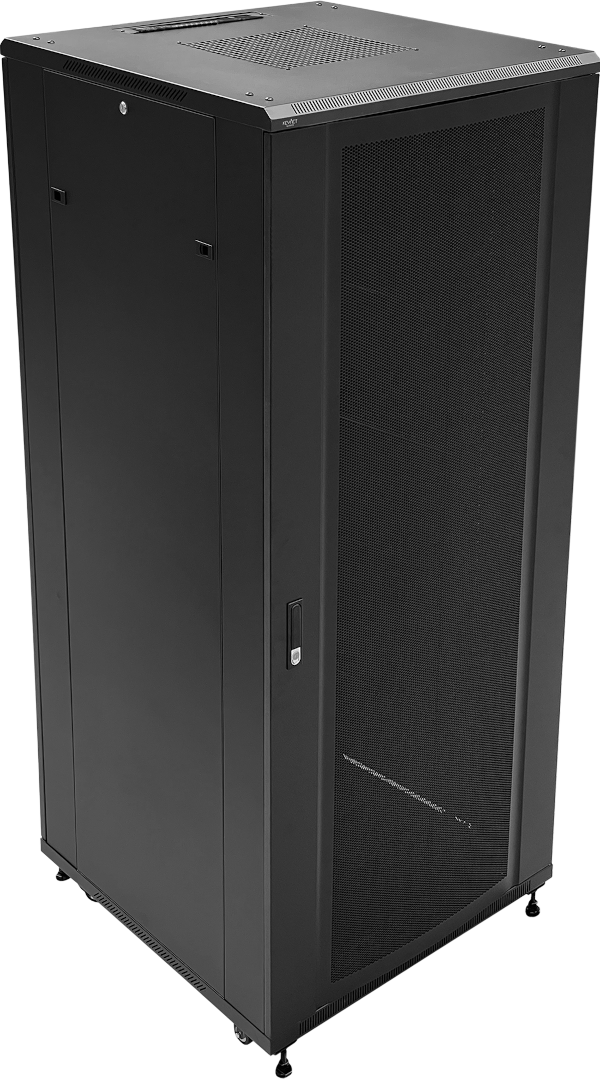
For proper cable management and identification, it's important to always provide sufficient cable organizers, both horizontal and vertical, as well as cable trays. The industry offers numerous accessories such as fixed and removable trays, brackets for heavy equipment, blanking plates to avoid gaps, hinged panels for easier access to the back of panels, cable guides, cable storage trays, etc.
If you have any questions about the best configuration for your rack cabinets, please contact our Keynet-Systems technical team at