In this context, Leviton's Cat 6A cables have a small diameter, making them an increasingly attractive alternative for companies looking to modernize their networks without undertaking costly modifications to existing conduits or support systems.
Among the most advanced solutions on the market offered by the COFITEL Group are the RDT and FDT models, designed to deliver high transmission performance in high-density applications while optimizing the return on infrastructure investment (ROII).
Smaller Diameter for Greater Efficiency.
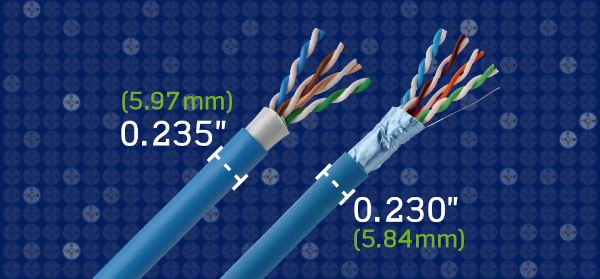
The main feature of these Cat 6A cables is their reduced outer diameter, which can reach as little as 5.84 mm. This makes them among the most compact in their category, allowing for better use of available space in cable trays, conduits, and raceways.
This size reduction has been achieved through a combination of proprietary manufacturing technologies, including a precision twisting technique and a cross-filler-free design. The result is a more flexible, lighter, and easier-to-install cable, without compromising the performance required by the Cat 6A standard for 10 Gigabit Ethernet applications.
In addition to facilitating installation, the compact design provides performance margins exceeding those required by the standard, offering greater capacity to support future network traffic demands.
Advantages in Retrofit Projects:
One of the main benefits of small-diameter cables is seen in modernization projects of existing infrastructure.
Many commercial, logistics, or industrial facilities were originally designed for Cat 5e or Cat 6 cabling, so the available conduits may be insufficient to accommodate conventional Cat 6A solutions.
Using more compact cables allows for the reuse of much of the existing infrastructure, reducing the need to extend conduits or install new cable trays.
This feature is particularly interesting in warehouses, logistics centers, retail stores, offices, and corporate buildings where structural modifications can significantly increase implementation costs.
According to manufacturer estimates, using these solutions can contribute to reducing installation and conduit costs by around 10% per project.
RDT: Unshielded Cat 6A Performance.
The RDT series is designed for installations requiring high network performance while maintaining an unshielded twisted pair (UTP) architecture.
Its design eliminates traditional center filler, simplifying the installation process and reducing waste generated during fieldwork.
Among its most outstanding features are:
• Ultra-small outer diameter.
• Performance margins exceeding the Cat 6A standard.
• Precision Twist technology to optimize transmission quality.
• Insulation envelope designed to improve thermal management in high-power PoE deployments.
• Exceptionally flexible covers that facilitate installation in complex layouts.
These features make the RDT family a suitable solution for network upgrades, high-density installations, and projects where available space is a critical factor.
FDT: Additional Protection for Demanding Environments.
When installation conditions require greater immunity to electromagnetic or radio frequency interference, the FDT series offers the advantages of a shielded F/UTP architecture.
The cable incorporates a protective foil that improves isolation from external noise, which is especially relevant in data centers, industrial facilities, government buildings, healthcare environments, and financial applications.
The filler-free design is also maintained in this family, combining the advantages of a reduced diameter with the performance of shielded cabling.
Common applications include:
• High-density networks with speeds of 10 Gbps.
• Infrastructures with stringent data security requirements.
• Installations subject to electromagnetic interference.
• Environments where space for cable trays is limited.
This solution is part of comprehensive systems designed to guarantee certified performance margins and compatibility with high-speed Ethernet applications.
Ready for High-Power PoE:
The expansion of Power over Ethernet (PoE) powered devices is increasing the thermal demands on cabling systems.
Wi-Fi access points, video surveillance cameras, IoT terminals, and industrial control systems are increasingly demanding more power through the Ethernet infrastructure itself.
Both RDT and FDT solutions have been developed to support advanced PoE deployments, including applications up to 100 W.
The thermal optimization built into the design helps maintain stable operation even in high-density installations with numerous powered links.
Sustainability and Carbon Footprint Reduction:
Another increasingly valued aspect of infrastructure projects is environmental impact.
The smaller diameter of the cables allows for a reduction in the amount of raw materials used during manufacturing, contributing to a lower carbon footprint associated with the product.
Likewise, the lighter weight facilitates transport and improves logistical efficiency, while the higher packaging density allows for more cable to be shipped per shipment.
In the case of the FDT family, some models are manufactured in carbon-neutral certified facilities and use fully recyclable packaging.
The reduction of waste during installation also represents an additional advantage for organizations pursuing sustainability and environmental efficiency goals.
A Future-Oriented Investment:
The evolution of enterprise networks demands solutions that combine performance, scalability, and cost-effectiveness.
Small-diameter Cat 6A cables offer an effective response to these challenges, enabling increased capacity in existing infrastructures without costly modifications.
Thanks to their high density, ease of installation, compatibility with 10 Gigabit Ethernet applications, and support for high-power PoE, RDT and FDT solutions offer a particularly attractive alternative for organizations seeking to maximize their return on technology investment.
The combination of space savings, reduced deployment costs, improved sustainability, and future-proofing for connectivity needs makes this type of cabling a strategic choice for data centers, smart buildings, industrial facilities, and next-generation corporate environments.