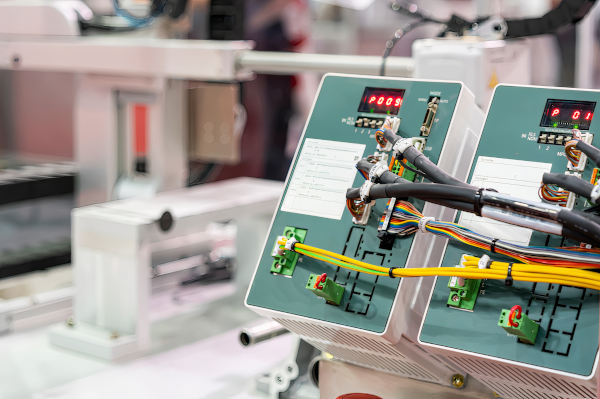
The main driver of growth in the industrial automation market is the Industrial Internet of Things (IIoT) and its primary consequence, the smart factory. While the Internet of Things has been the focus of the consumer market in recent years, it will reach its true potential in the industrial sector.
The Internet of Things (IoT) is the term used to describe machine-to-machine communication. It's the first time machines are sharing data with each other without human intervention, and while this might sound like the plot of an apocalyptic novel, it's actually an efficient way to share essential information and achieve greater levels of effectiveness.
For example, a machine could detect unwanted vibration in its own motor bearing and, as a result, schedule the delivery of a replacement part. If we extend this same example to the entire factory, the machines would communicate with each other to ensure a continuous flow of raw materials and finished products throughout the facility. In the smart factory, these machines also constantly communicate with business systems to integrate all elements of the operation, from sales and orders to shipping and maintenance.
 The Factory Environment:
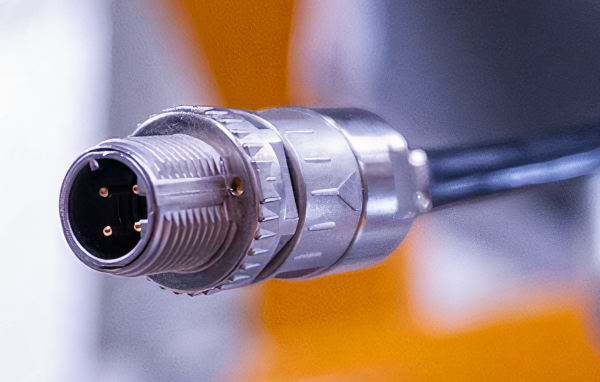
It's also important to consider that the industrial environment is harsh and demanding. Factors such as vibration, extreme temperatures, and potentially hazardous chemicals can damage sensors and controls—essential elements in the smart factory. Even sectors where hygiene is vital, such as food and pharmaceuticals, depend on the ability to clean processing equipment. In these conditions, harsh chemicals are replaced by cleaning materials and high-pressure water jets.
The smart factory will rely on new technology to benefit from new ways of working. At its most basic level, operational technology (OT) comprises the equipment that detects or triggers changes in the industrial process, such as sensors, drives, and other mechanical equipment. In traditional factories, these devices would be centrally managed and connected to the controls via potentially very long cables.
In the smart factory, a vast array of sensors is used alongside more sophisticated communication equipment, meaning the number of connections required will increase considerably. It's not possible to use cables and control cabinets to connect such a large number of channels: we'll need a new structure. The modern factory will employ a much more modular strategy, with OT devices connected locally via I/O blocks, which, in turn, will be connected to the network.
As a connector enthusiast, what I find most interesting is that, although the structure of the smart factory will change radically, the connectors used won't be new; they'll be the same ones that have been used for some time in industrial automation equipment. When we talk about edge computing or sensors, engineers, designers, and machine builders will happily adopt the latest innovations. However, when it comes to connectors, these same experts prefer to use tried-and-tested technology.
 Tried and Tested:
In the world of connectivity, there are very logical reasons for using existing products. The first is reliability: manufacturers can't afford to have a brand-new, state-of-the-art factory shut down because a connector has failed, so it makes perfect sense to choose connectors whose performance has been proven over years of operation under demanding conditions.
Another factor to consider is cost. Very few companies can afford to replace all their machinery simply to benefit from the latest advancements, so it's more common for new technologies to be integrated into existing systems. If the new devices use the same connectivity as the current equipment, installation, supply, and integration will be much simpler.
The HARTING M12 connector
means that machine builders will be familiar with the connectors used in the smart factory. For many years, the M series of circular connectors has been widely used in industrial connectivity. These metric thread connectors are designated by their diameter, from M5 to M23 and above. The M8 and M12 versions are among the most popular because they are very lightweight, have a very slim profile, and can be easily waterproofed. Many manufacturers offer them. Some, like Phoenix Contact, Lumberg, and HARTING, are specialists in industrial connectivity, while others, like TE Connectivity, offer these connectors as part of their broader connectivity range.
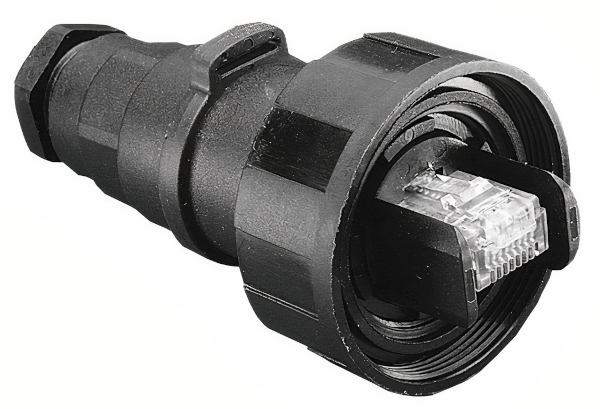
As IT makes its way into the industrial world, popular IT connectors are also finding their way into factories. Some well-known solutions, such as RJ45 or USB, are not ideal for industry, but there are already manufacturers who have developed solutions to integrate these popular interfaces into rugged housings suitable for harsh environments, from Amphenol's RJTV connector, a legacy of the military field, to the industrial connectors of the Bulgin Buccaneer range.
 The latest innovations:
The industrial automation sector relies heavily on established connector technologies. However, I don't want to give the impression that the interconnection industry isn't developing new products. In the May 2021 issue of this publication, we discussed connectors for sensors. In that analysis, we addressed the standard for Single Pair Ethernet (SPE) connectors, which was created specifically for the industrial market. The SPE isn't intended to replace existing Ethernet infrastructures, whether using RJ45 connectors or M12 circular connectors. Rather, it's designed to complement them and bring Ethernet to industrial plants.
Manufacturers are also succeeding in innovating with existing products. As we mentioned, the M-series connectors, especially the M12, are very popular in industrial applications, but that doesn't mean they can't be improved. M-series connectors typically employ a screw-locking process to achieve a solid and reliable mating. However, that process is slow. It might not seem like much time when installing a single product, but if you have a network of connectors for a new machine, all that time adds up. Furthermore, screw-lock connectors can fail. For example, the installer might not tighten them sufficiently, leaving them vulnerable to water ingress.
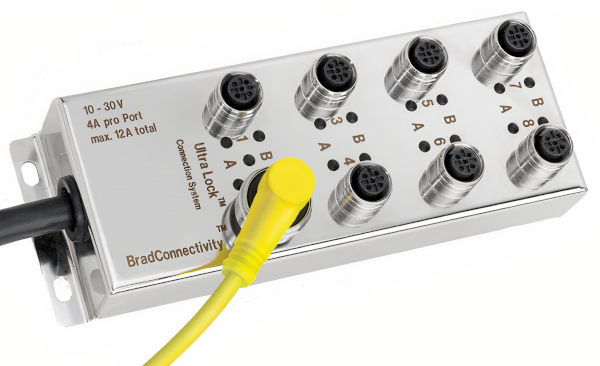
Ultra-Lock (Brad)
Molex's new Brad Ultra-Lock range of M12 connectors uses a push-lock system for quick installation. This method ensures a consistent connection and provides a tighter seal against water ingress. It is also available with various options, such as cable sets and panel-mount receptacles. These receptacles are compatible with both the new push-lock method and existing M12 threaded cable sets, simplifying the integration of new equipment into existing networks. This backward compatibility could be a crucial advantage for many machine manufacturers.
When it comes time to install the latest smart device, don't be disappointed if the connector is the same old thing. The smart factory is a place full of new and innovative technology where connectors may not be the most exciting component, but they will play an essential role.