
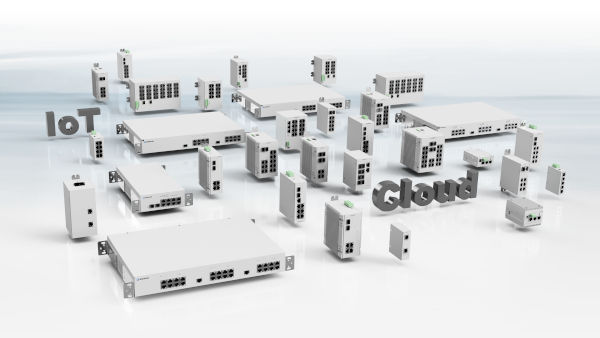
Advanced high-performance chips, automation solutions, 5G connectivity, and IT—not to mention industrial switches—are essential building blocks for the success of Industry 4.0 and IIoT applications. Complex solutions used in rugged industrial environments require seamless interaction between hardware and software and connectivity with production systems. Industrial switches play a crucial role in this interaction, as they are the basic coupling elements in Ethernet networks and enable communication between the various Ethernet participants. Because switches reduce cabling costs and allow for flexible, simple, and space-saving installation, they will play an increasingly important role in the race toward digitalization.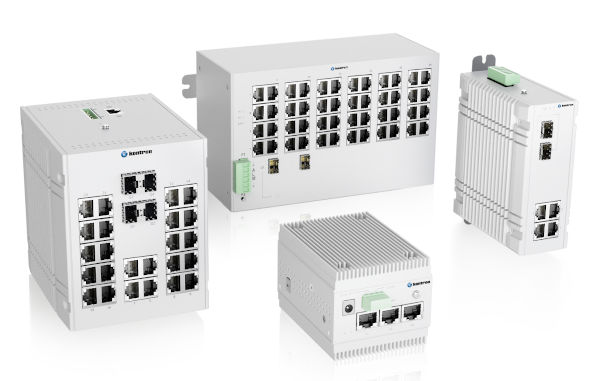
Engineering expertise and a strong partner
Kontron has many years of experience and extensive technical expertise in the development and production of industrial switches. In the first quarter of 2021, its existing portfolio of boards, modules, and systems for industry was complemented by a new family of high-quality, competitively priced industrial Ethernet switches. This offers industrial customers the opportunity to implement complete, customized solutions from a single supplier.
The new product family offers a broad portfolio of diverse and cost-effective switches, ranging from small, unmanaged switches to products with management and Power over Ethernet (PoE) capabilities. With this new product line, Kontron aims to become one of the top three suppliers in the European industrial switch market, estimated at €600 million annually, by 2023. Kontron is not only leveraging its own expertise in this field but is also establishing an additional and exclusive sales channel through its long-standing partnership with Rutronik to provide customers with the best possible support for their projects.
 Industrial switches for high-speed Ethernet
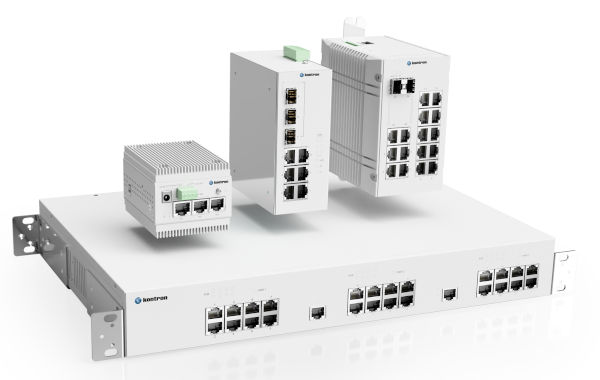
Kontron's "KSwitch" product line is suitable for Fast, Gigabit, and even up to 10G Gigabit networks, meeting all the requirements that industrial applications demand of their components. Thanks to their robust metal construction, the switches can also be used in harsh industrial environments with temperatures ranging from -40°C to +75°C. Cost-effective unmanaged switches with basic standard protocols are available for quick connection, as well as products that can be managed via a web interface. In addition to a compact design and redundant power input (12–58 V DC or 230 V AC), the switches offer the possibility of easily connecting and integrating machines, controllers, and other components based on industrial standards. The devices are equipped with RJ45 ports and, optionally, SFP (Small Form-factor Pluggable) slots. This provides companies with a wide range of standardized and cost-effective connection options, regardless of the product used.
Kontron is committed to a single-chip design across all its industrial Ethernet switches. This means that all necessary components are integrated onto a single chip whenever possible, resulting in more reliable and cost-effective products. Performance and capabilities are also enhanced, while power consumption is reduced. This has a positive impact on the total cost of ownership (TCO) of the industrial environment. The reduced number of individual components on the board also leads to a more cost-effective and compact design, which can reduce the required space in control cabinets or industrial racks by up to 35% compared to other solutions. Flexibility is achieved through DIN rail mounting in 19" control cabinets or direct machine installation using various adapters.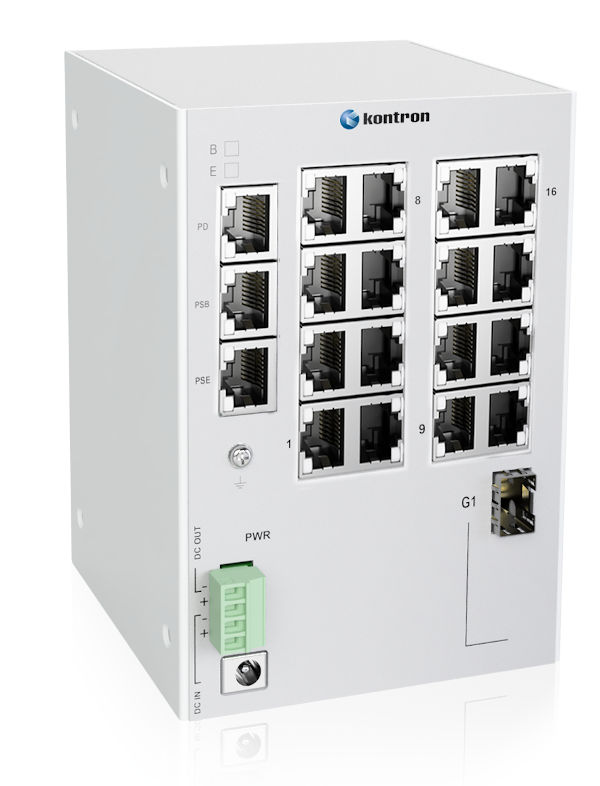
Ethernet Switches for a Wide Range of Requirements.
Kontron's new KSwitch D3 UF series, for example, includes cost-effective, unmanaged Fast Ethernet switches that offer both copper and fiber optic ports, depending on individual needs. Thanks to their fanless design, compact build, and plug-and-play functionality, the D3 UF series switches can be easily integrated into production lines and machine systems or used for simple network expansions. If a switch is to be part of a Power over Ethernet (PoE) network, it must have special PoE capabilities. Kontron's D3 UMPD series Ethernet switches are equipped with a 12V DC PoE splitter with a 1A output, enabling network connectivity and powering of Powered Devices (PDs) over a single Ethernet cable. To integrate a PoE switch into the network, only a power cable for the switch and a network cable to connect the PDs are required. The PD connects directly to the Gigabit PoE switch port for both data transmission and power delivery. Kontron's D3 UMPD switches supply up to 56 V DC via PoE++ technology.
The technology of the future: PoE offers numerous advantages
Not only the KSwitch D3 UMPD series, but also other switches in Kontron's KSwitch product line support Power over Ethernet (PoE), simplifying the powering of external components. A PoE network switch eliminates the need to purchase and install additional power supplies and outlets, resulting in significant cost savings. Extension cables become obsolete, leading to significantly greater flexibility in the overall installation.
The example of an offset printing press can illustrate how PoE can be implemented in practice: The numerous network components (such as sensors, cameras, etc.) are simply daisy-chained using CAT5/7 network cabling and therefore no longer require a separate power supply. The cables that would otherwise converge at a central power point are distributed among the component ports, making the entire installation much more flexible, space-saving, and cost-effective. The power supply can be switched on or off via a central switch.
Thus, customers who choose the new generation of Kontron KSwitch not only benefit from cutting-edge design, high quality, and functional diversity, but also from future-proof PoE solutions that can be easily integrated into any environment. Attractive investment and operating costs, along with flexible modular expansion options, enable the creation of an infrastructure that meets the current and future requirements of Industry 4.0 and the IIoT.
By: Reiner Grübmeyer, Director of Product Management for Systems and Software at Kontron



